
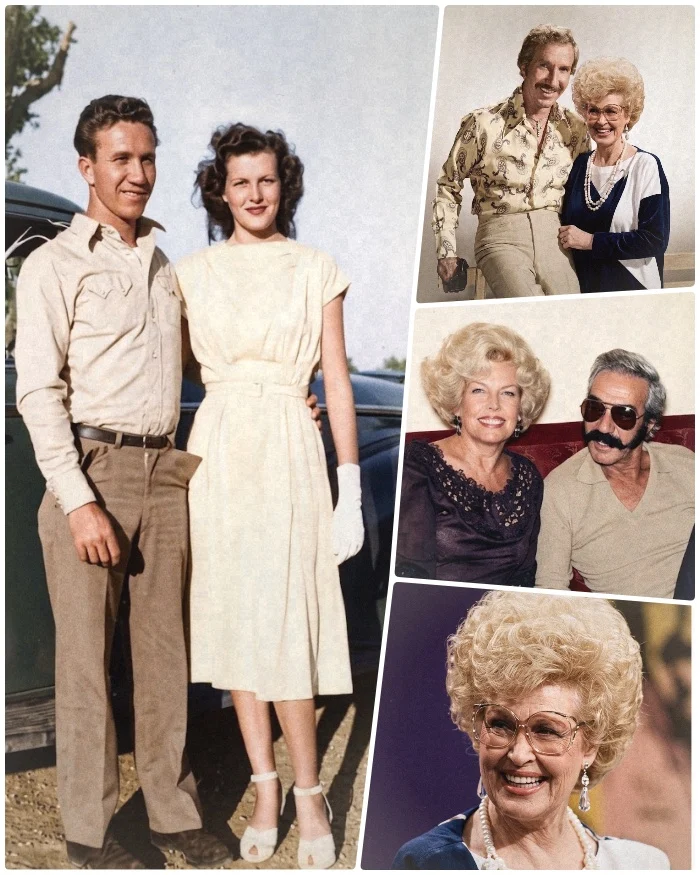
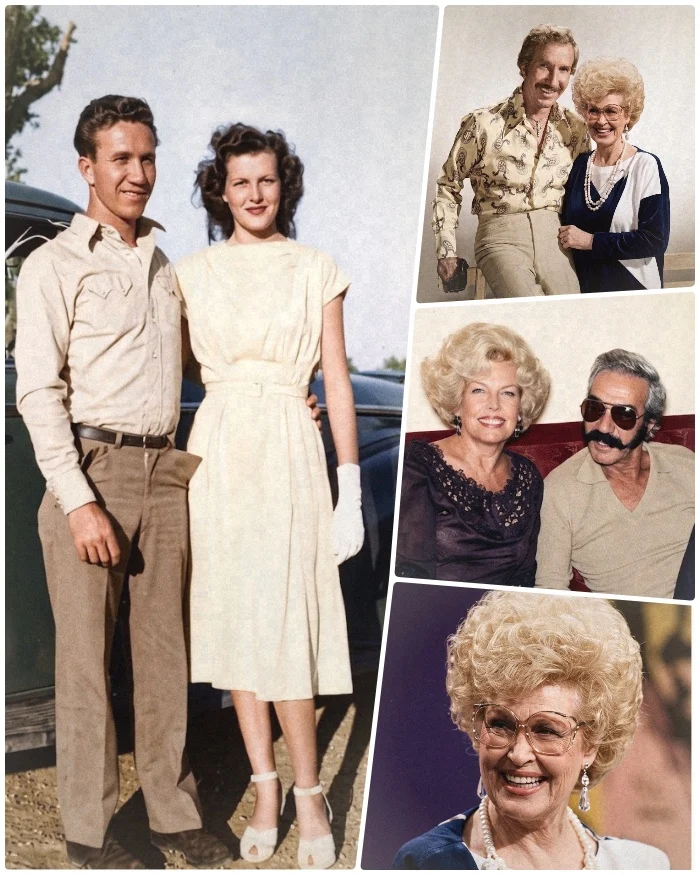
In October 1982, with less than two months left to live, Marty Robbins stood on the stage of the Country Music Hall of Fame induction ceremony and turned his moment of honor into a moment of gratitude. As he accepted his medallion, he looked out from the podium and thanked Marizona for standing beside him since their early days in Glendale. It was the public closing chapter of a thirty-four-year marriage that would last until his final breath in Nashville on December 8, when a third heart attack claimed his life at age fifty-seven.
The story had begun decades earlier when twenty-year-old Martin David Robinson walked into Upton’s Ice Cream Parlor in Glendale, Arizona, after leaving the United States Navy in 1946. He had no steady income and no record contract. Behind the counter stood Marizona Baldwin, the young woman who would spend the next thirty-four years holding his household together while he became Marty Robbins.
They married on September 27, 1948, in Parker, Arizona. In those early years, Marty dug ditches, drove delivery trucks, and worked as a mechanic’s helper while picking up five- and ten-dollar singing shifts in Phoenix nightclubs. Even after their son Ronny was born in 1949, money stayed so tight that Marty could barely cover rent while chasing local radio spots.
Marizona kept their home steady while her husband filled in for bandleader Frankie Starr at Vern and Don’s bar in Phoenix and eventually earned his own radio and television shows, including Western Caravan, on KPHO. When guest performer Little Jimmy Dickens heard Marty sing during a station visit in 1951 and helped persuade Columbia Records executives to sign him, the young family finally found a path out of Arizona club work.
The move to Nashville in 1953, after Marty joined the Grand Ole Opry, brought national hits like “I’ll Go On Alone,” “Singing the Blues,” and “A White Sport Coat,” along with the birth of their daughter Janet in 1959. It also meant Marty spent months on the road every year, often closing the Saturday night Opry broadcast past midnight before driving straight to the next tour stop.
When he was not in a recording studio or on a tour bus, he was frequently at a stock-car track. Marty competed in thirty-five NASCAR Grand National Series races at high-speed ovals like Daytona, Talladega, and Charlotte, suffering heavy wrecks that left him with broken ribs, a concussion, and a permanent scar across the bridge of his nose.
Through the long absences and the constant worry of racing weekends, Marizona stayed out of the Nashville spotlight at their home in Brentwood, Tennessee, raising Ronny and Janet and handling the daily responsibilities her husband left behind. She rarely gave interviews or chased publicity, preferring to keep family life private even after “El Paso” made Marty an international star.
That fast pace broke down in August 1969 when forty-three-year-old Marty suffered a severe heart attack. Doctors diagnosed advanced cardiovascular disease, and in January 1970 he underwent one of the earliest triple coronary bypass operations performed at St. Thomas Hospital in Nashville.
During his hospital stay and recovery, Marizona remained beside his bed through the long nights. Watching her quiet endurance after more than two decades of marriage, Marty wrote “My Woman, My Woman, My Wife” to thank her for the years she had carried their family.
Rather than painting a glamorous portrait of a star’s marriage, the song honored the everyday cost of keeping a home running, celebrating hands worn from work and the faith that held their household together when he was gone.
It was a completely true song, with every line saying exactly what he wanted to say to his wife.
Released in early 1970, the single climbed to number one on the Billboard Hot Country Singles chart that May and crossed over into the top forty of the pop chart. The following year, it earned Marty the Grammy Award for Best Country Song, giving him his second career Grammy a decade after “El Paso”.
Ignoring doctors’ warnings to slow down, Marty returned to the stage and the racetrack just months after surgery, though his health remained fragile. Whenever he introduced “My Woman, My Woman, My Wife” on the Grand Ole Opry or network television across the 1970s, he paused to tell the audience about Marizona’s patience through his years on the road.
Marizona lived in the area for nearly two more decades before passing away in July 2001, leaving behind a love story that began at an ice cream counter, survived the road and the racetrack, and was finally set to music in a hospital room.