
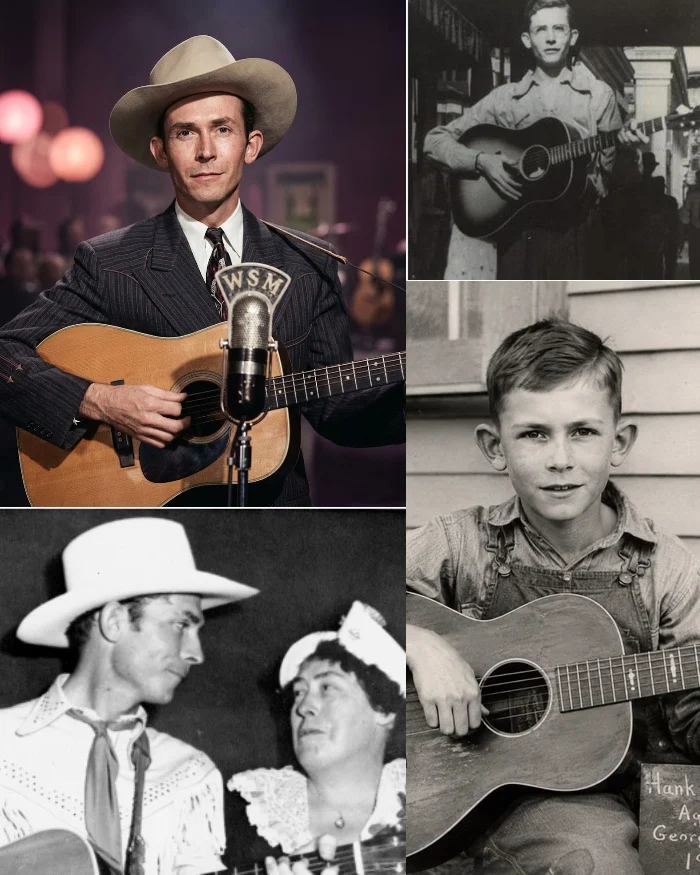
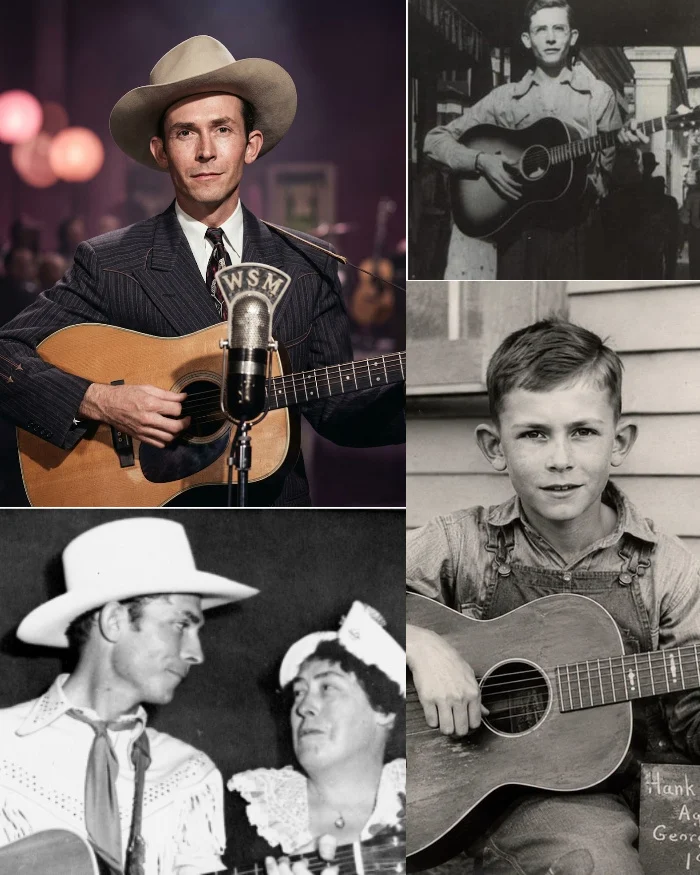
Beneath the damp boards of a small Alabama house, a hungry boy with an aching spine and a battered guitar learned the secret pulse that would later shake America.
Long before radio towers carried his name, ten-year-old Hiram “Hank” Williams crawled into a hidden crawl space in Georgiana, Alabama, between 1932 and 1934. The town lived under harsh Jim Crow division, and his frail body carried the constant ache of undiagnosed spina bifida occulta. His father sat hundreds of miles away in a veterans facility, leaving the boy to wander the Louisville and Nashville depot while freight cars moved through Butler County.
On those dusty platforms he met Rufus “Tee-Tot” Payne, a Black street musician and wandering blues guitarist who earned nickels with a worn hat and a beat-up acoustic guitar. Payne understood hunger, rhythm, and survival. Hank understood melody, longing, and the ache of a child who could not pay for lessons.
Their bargain became one of the most tender and dangerous friendships of the rural South. With no coins for formal instruction, Hank carried hot biscuits, farm eggs, and pantry scraps made by his mother Lillie down the road and traded them for time with the fretboard.
Open friendship between a young white boy and an older Black bluesman could invite violence. Payne led the child away from storefronts and curious eyes to the raised timber foundation of the house at 127 Rose Street. There, side by side in cool dirt, Payne worked the boy’s calloused fingers through basic chords, minor-key blue notes, syncopated chord chopping, and the sliding vocal phrasing of Gulf Coast blues.
Two traditions met in the dirt, one mournful and one hillbilly, and American music was changed forever.
Payne also taught Hank how to make a single guitar carry over noisy street corners. He showed him how rhythm could become emotion and how a voice could bend around pain. Those hidden afternoons fused Black southern blues into rural white string music, creating the raw timing and mournful vocal breaks that later shaped honky-tonk.
When the Williams family moved to Montgomery in 1937, the crawl space lessons ended. Payne kept performing across Butler and Montgomery counties, living thinly on music. He died on March 17 1939 at a charity hospital in Montgomery. He was buried in an unmarked pauper grave in Lincoln Cemetery, while the boy he taught was rising toward national fame.
Hank never erased that debt. Even at the height of his Grand Ole Opry fame, he credited Payne as his only real teacher and traced his rhythmic approach back to those covert afternoons. Hank recorded thirty-five Top 10 country records and reshaped songwriting before his early death in 1953.
Yet the engine of that revolution was not built in a bright studio or beneath Nashville spotlights. It was forged under wooden joists, where an older street musician shared a lifetime of rhythm with a hungry boy who had nothing to give except food, fear, and an ear willing to listen.