
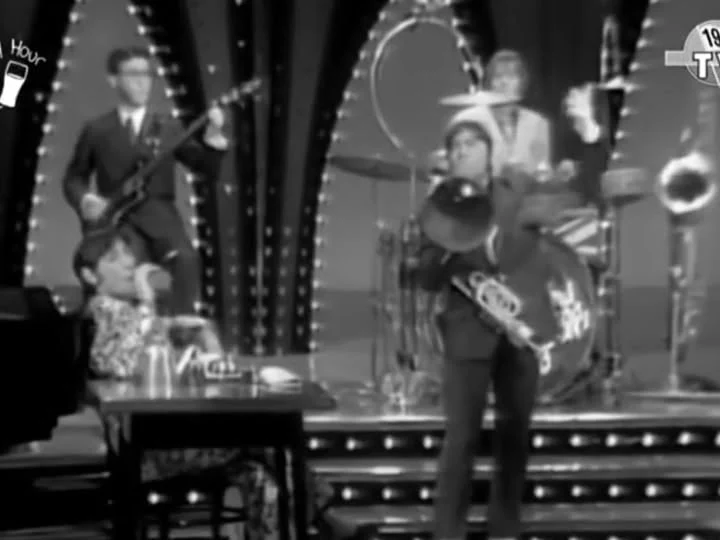
It starts with a voice that sounds like it is being filtered through a cardboard tube. The voice is singing about a cathedral in England, but the melody feels like it belongs in a smoky speakeasy from a bygone era. This is not the sound of 1966. Yet somehow, Winchester Cathedral became one of the biggest records of its time. The band behind it did not exist. And that was exactly the point.
The mid-1960s were a period of restless musical evolution. The Beatles were reinventing the studio. The Beach Boys were crafting elaborate vocal arrangements. Motown was polishing soul to a brilliant shine. And into this whirlwind of innovation stepped a song that looked backward with immense affection. It was a piece of pure escapism, a carefully constructed fantasy of the Jazz Age that managed to charm its way to the top of the American charts.
The mastermind behind this delightful deception was Geoff Stephens, a British songwriter and producer with a gift for pop craft. Stephens had already written hits for other artists, but with this song he created something entirely unique. He assembled a group of session musicians, the best in the business, to bring his vision to life. But the true stroke of genius was the vocal performance. John Carter, a gifted singer and co-writer, delivered the lead vocal with his hands cupped around his mouth. This simple technique imitated the megaphone style of singers like Rudy Vallée from the 1920s. It gave the song its signature sound, a warm and slightly comical texture that made it instantly memorable.
Released on the Fontana label, the song was an immediate sensation in some parts of the world. It performed respectably in the United Kingdom, but in the United States it became a phenomenon. It climbed to the very top of the Billboard chart and stayed there for weeks. In doing so, it managed to knock The Supremes from their perch. The fact that a song recorded by a fictional band could achieve such dominance in the revolutionary year of 1966 remains a fascinating cultural footnote. The track was later included on the album of the same name, Winchester Cathedral.
The arrangement is where the song truly comes alive. Every instrumental choice feels deliberate, like a piece of a puzzle that forms a perfect picture of the past. The melody is carried by a brass and woodwind section, with a low-register clarinet or bassoon giving the tune a dark and smoky colour. The trumpet adds bright and cheerful fills, while the drums are mixed dry and tight. There is no thunderous rock backbeat here. Instead, listeners hear the crisp punctuation of wood blocks and brushes on the snare. The guitar stays in the background, providing a gentle strummed bed that supports the harmony without ever taking center stage. The piano dances through the track with a bright, honky-tonk timbre that evokes speakeasies and silent films. Its rhythmic patterns carry a hint of ragtime, adding to the bouncy and infectious momentum.
The track operates not as a protest or a commentary on the present, but as a pure, distilled drop of musical escapism.
What makes this song work so well is the restraint. The musicians stay entirely within the stylistic boundaries they have created. There is no attempt to modernize the sound or make it more accessible to contemporary audiences. The result is a miniature work of art, a tiny snow globe containing a lost world. Listening with a quality pair of studio headphones reveals the intricate balance of the woodwinds and brass against the dry rhythm section, exposing the depth of the production choices.
Novelty hits often rely on shock value or silliness. Winchester Cathedral succeeds because of its craft. It is a loving parody that transcends its own joke. It speaks to a deep human longing for simpler times, an escapism that resonates during periods of social upheaval. In 1966, with the counterculture movement gaining momentum, this song offered a brief and harmless retreat to an imagined past of flappers and uncomplicated rhythms.
The lyrics are simple, a plea for a loved one to meet the singer at the historic landmark. The words are sweet and straightforward, secondary to the music’s texture. The song provides a narrative hook without burdening the breezy atmosphere. It is the sound itself that matters, the clipped notes of the brass, the theatrical intimacy of the megaphone vocal.
The song’s success led to the creation of a touring version of The New Vaudeville Band, assembled to capitalize on the single’s momentum. The legacy of the song is quiet but enduring. It proved that sophisticated musical parody could find a massive audience, and it stands as a unique chart-topper that completely ignored the prevailing sounds of its era. It remains a testament to the enduring appeal of clever arrangement and a well-executed concept.
For those who want to explore similar musical territory, there are several worthwhile starting points. Tiny Tim offers a similar blend of high-register vocals and charmingly campy nostalgia in Tiptoe Through the Tulips. Marlene Dietrich brings the smoky theatrical intimacy of cabaret in Falling In Love Again. The Temperance Seven revived the sounds of 1920s dance bands with remarkable authenticity in You’re Driving Me Crazy. Ray Noble and his Orchestra capture the genuine lushness of 1930s orchestral pop in Midnight, the Stars and You. The Bonzo Dog Doo-Dah Band explore the surreal side of British novelty music in The Intro and The Outro. And The Lovin’ Spoonful demonstrate how jug band and early jazz influences could be integrated into mainstream pop with Daydream.
Returning to Winchester Cathedral is like opening a perfectly preserved time capsule. It is a fleeting and joyous glimpse of a carefully constructed fantasy, proof that sometimes the past makes the best kind of pop. For aspiring musicians studying the nuances of historical arrangement, the original sheet music offers a fascinating glimpse into the formal construction of early pop forms.