
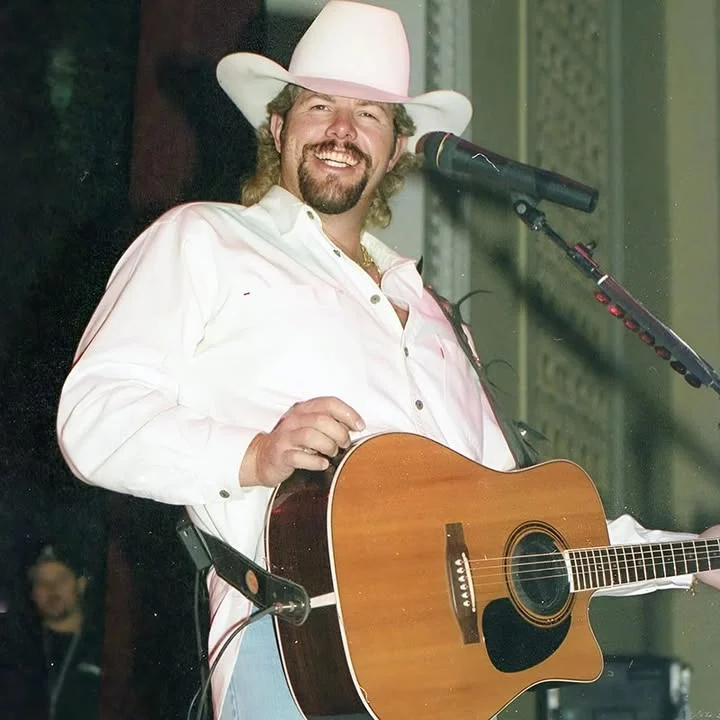
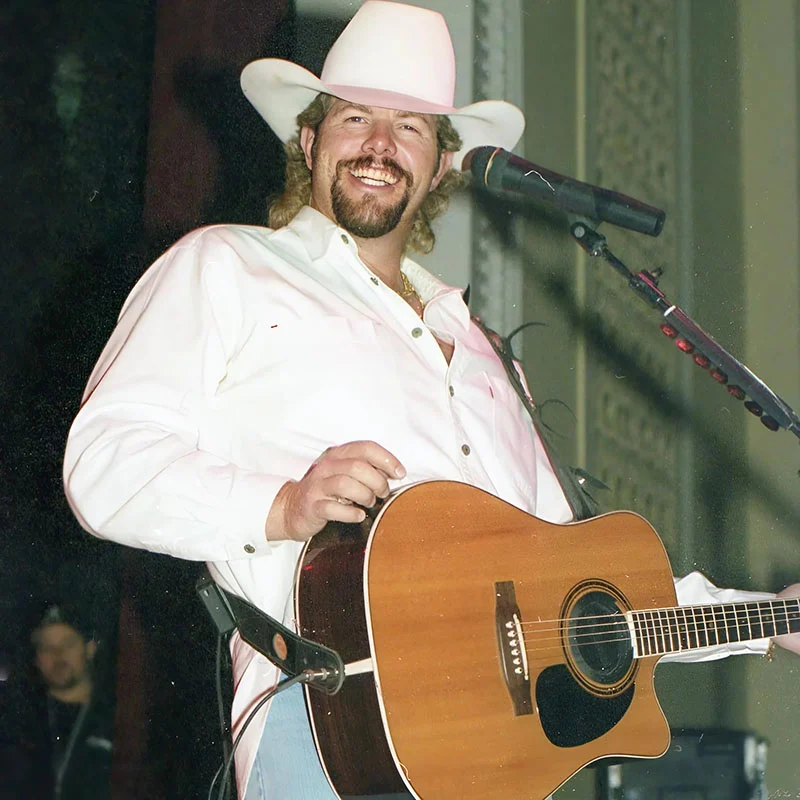
Under the bright lights of the Blossom Music Center in July 2005, Toby Keith made a choice that no chart could measure.
He did not simply invite a young Make-A-Wish guest onto the stage. He stepped back and let a fragile boy hold the microphone.
Trevor Scott was 10 years old and fighting a severe illness at Cleveland Clinic Children’s Hospital. He was waiting for a life-saving liver transplant.
Keith lowered himself to one knee so the boy could be seen as an equal. Then the country giant handed over his own microphone and gave Trevor the entire moment.
The song they sang together was one of Keith’s defining hits. It had been written to honor military veterans. On that night it became something else, a public salute to a child facing an invisible battle with the same courage as a soldier.
As Trevor led the melody, the crowd changed. The roar shifted from concert excitement into a wave of collective support. When Keith finally joined him again, the two closed the performance by saluting the audience together.
Toby Keith did not share the spotlight. He gave it away entirely.
Seventy-two hours after that stage moment, Trevor received the transplant he had been waiting for. Decades later, the boy who once sang for his life is a healthy law student.
That Ohio night was not a one-off gesture. It pointed toward a private devotion that grew deeper as Keith’s career continued.
He kept releasing chart-topping albums and filling arenas, yet his focus away from the stage remained fixed on helping sick children. In 2006, a year after meeting Trevor, he established The Toby Keith Foundation to organize his charitable work.
The mission became even more personal after his longtime guitar player Scott Webb lost his two-year-old daughter to cancer. Keith understood the crushing financial and emotional toll pediatric illness places on families.
He spent nearly a decade planning and fundraising to build a permanent sanctuary in his home state.
In 2014, he opened the OK Kids Korral in Oklahoma City.
The 16-room, multi-million-dollar facility provided cost-free, comfortable housing for pediatric cancer patients and their families while they received treatment at nearby medical centers. Keith poured time and resources into the Korral, making sure families had everything from indoor playgrounds to daily meals without ever receiving a bill.
The public saw a rugged superstar with defiant anthems. The families inside the Korral saw a man trying to lighten the burden of a medical crisis for parents who had nowhere else to turn.
Toby Keith left behind a catalog that permanently altered country music. But his deepest legacy was never cut onto a record. It lived in the microphone he handed to a boy in Ohio and in the shelter he built for children in Oklahoma.