
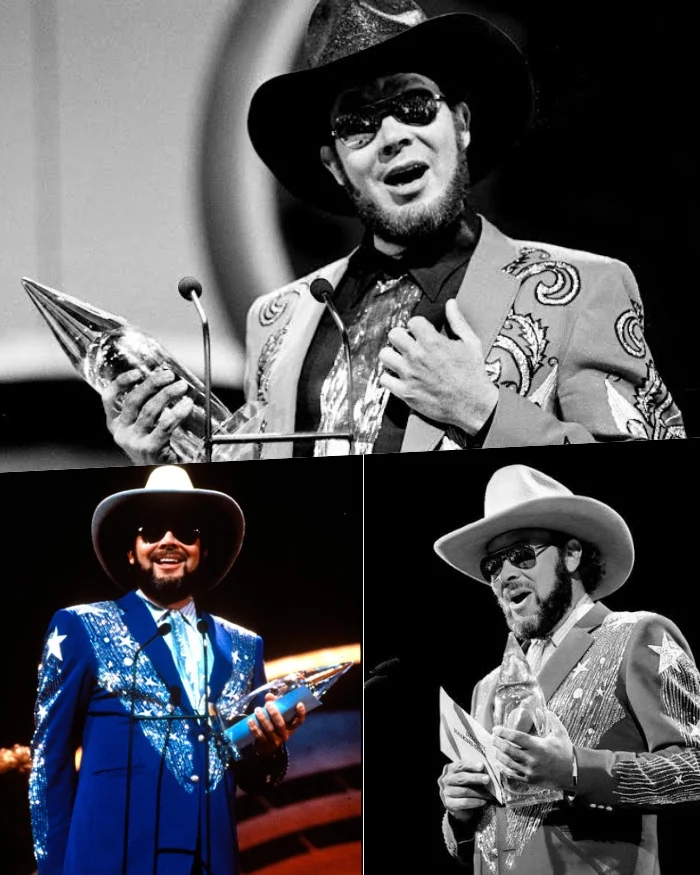
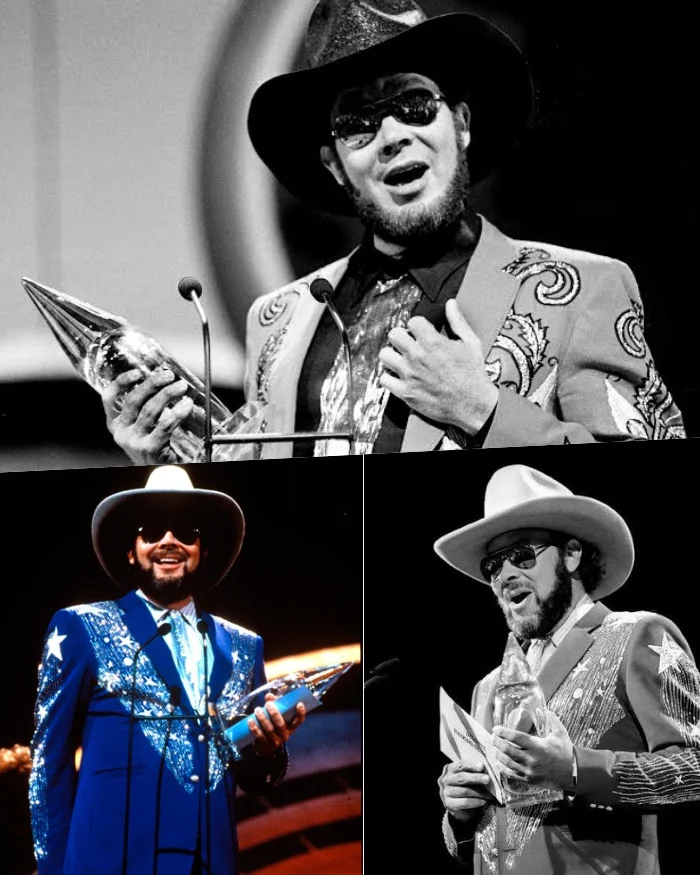
On a Nashville night in October 1987 Hank Williams Jr. walked to the Country Music Association Awards podium wearing dark glasses a wide brimmed hat and a beard that hid the wreckage of a mountain fall. The room gave him its highest honor not as the son of a dead legend but as a survivor who had rebuilt his face his music and his name.
For much of his early life he had been pushed into the spotlight as a living memorial to Hank Williams Sr. An eight year old boy in a tailored suit carried a guitar and sang songs from a father he barely remembered after the elder Williams died in a Cadillac at age twenty nine.
He was not performing as himself he was keeping a dead man’s memory alive
By the early 1970s the pressure of imitation had driven him toward heavy drinking and prescription pills. He wanted louder electric guitars and his own words but Music Row warned that leaving his father’s catalog could cost him everything.
The break came on August 8 1975 while he was climbing Ajax Mountain near the Idaho Montana border. A melting snowpack gave way and he fell nearly five hundred feet down a rocky slope. The impact fractured his skull crushed his cheekbones and jaw and left his brain tissue exposed.
Mountain rescuers reached him hours later and a helicopter carried him to Missoula Community Hospital. Surgeons spent years rebuilding his face with metal pins and bone grafts taken from his ribs.
During that painful recovery Waylon Jennings and Dickey Betts of the Allman Brothers Band sat at his bedside. When he finally looked in a mirror the boyish face that had reminded fans of Hank Sr. was gone.
To hide the scars he grew a dense beard lowered a wide brimmed western hat and put on dark aviator sunglasses. That disguise became armor for a new artist.
Free from the obligation to look like his father he abandoned polished Nashville strings and worked with producer Jimmy Bowen in Muscle Shoals. He hired hard hitting rock musicians wrote blunt autobiographical songs and released Family Tradition in 1979 followed by Whiskey Bent and Hell Bound.
By the early 1980s he brought arena rock energy to country music. With the Bama Band he filled fifty thousand seat football stadiums and outdoor amphitheaters across rural working class America. His shows used massive light rigs soaring guitar solos and high volume outlaw anthems.
Between 1979 and 1989 he placed thirty consecutive singles in the country top ten including eight number one hits. The Nashville establishment that had once watched his volume and attitude with suspicion could no longer ignore his reach.
The reckoning came on October 12 1987 at the Grand Ole Opry House during the 21st Annual Country Music Association Awards. When the envelope opened for Entertainer of the Year Hank Williams Jr. took the stage in his dark glasses and western hat. He repeated the victory in 1988 and proved that carrying a family name forward did not mean spending a lifetime trapped inside it.
He did not sing a single note from his father’s songbook that night.
He had built his own legacy out of shattered bone loud amplifiers and a stubborn refusal to spend an entire life pretending to be someone else