
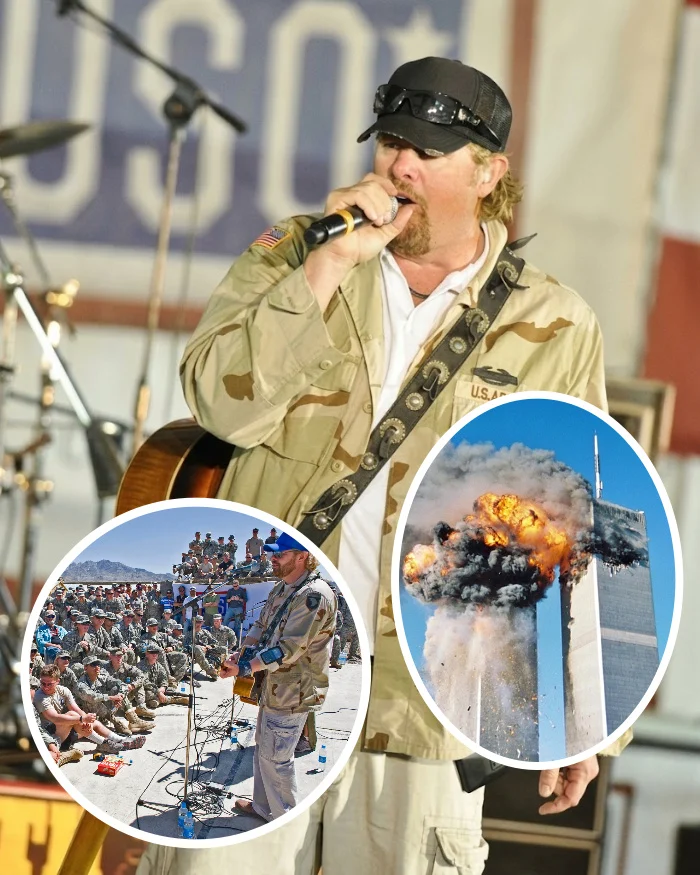
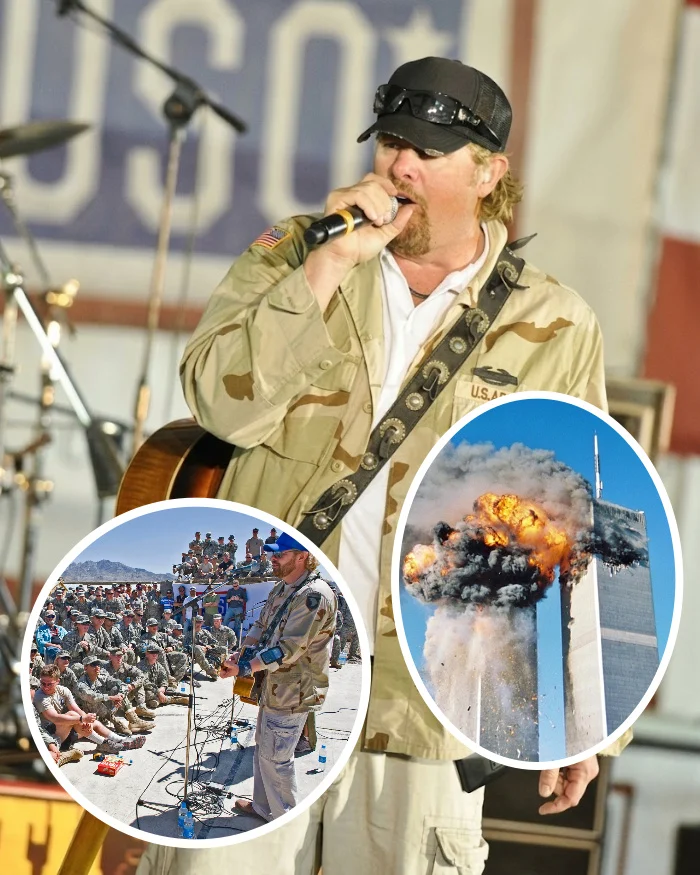
Toby Keith was mid-song in Kandahar, Afghanistan, in spring 2008 when mortar sirens split the desert air. The country star and 2,500 troops ran 100 yards into a reinforced concrete bunker. He could have asked for immediate evacuation as a high-profile civilian, but he stayed inside the cramped shelter for an hour, casually talking with service members, posing for photos, and signing autographs. When the all-clear sounded, he did not pack his bags or seek secure transport out. He walked directly back to the stage, picked up his guitar, and resumed the exact song he had been playing.
That single night showed the courage and tenderness behind more than a decade of USO work. Keith began touring with the USO in 2002 and completed 11 tours across 17 countries, bringing music to more than 250,000 service members in active war zones. He did not settle for safe, heavily guarded headquarters. He insisted on FOB hopping and demanded to be flown on Black Hawk helicopters into remote forward operating bases in Iraq and Afghanistan, where live fire was a daily reality, placing himself directly in harm’s way.
At each outpost, military leaders quickly viewed him as one of their own. They dressed him in proper desert camouflage and led him to makeshift stages built from camouflage netting and empty supply crates. He traded luxury tour buses for body armor, combat helmets, and spartan desert accommodations where running water was often a luxury.
The drive came from a deeply personal place. His late father, H.K. Covel, was an Army veteran who had lost his right eye during a combat training mission in the 1950s. Covel raised his son with unwavering respect for the military, and that foundation remained Keith’s guiding force long after his father’s passing.
“Every acoustic set played to eighteen-year-old soldiers in the sand was a way of speaking to his dad.”
Keith understood the silent sacrifices of a military family firsthand. Playing for young men and women deployed thousands of miles from home was never a calculated public relations strategy. It was an extension of the values he learned at his kitchen table in Oklahoma.
He also saw that troops at the most remote outposts lacked basic comforts. He helped launch the USO2GO program, an initiative that delivered electronics, entertainment, and personal care items directly to soldiers stationed at isolated bases where traditional USO centers could not be built.
The physical toll of those desert flights was matched by the private emotional weight of what he witnessed off the stage. Beyond the loud cheering crowds at overseas bases, away from public cameras, Keith spent quiet, unpublicized hours at Walter Reed National Military Medical Center sitting by the bedsides of severely wounded service members. Those visits were not broadcast on television or advertised to the press. They were private moments of quiet gratitude for men and women facing years of difficult physical and emotional recovery.
In 2014, his relentless dedication was officially recognized when retired Air Force Brigadier General John I. Pray, Jr. surprised him with the Spirit of the USO Award. The honor acknowledged a commitment that went far beyond standard expectations of celebrity support, highlighting a man who consistently chose to stand by the troops wherever they were stationed.
Keith wrote some of the most recognizable patriotic anthems of the modern era, but his actions spoke louder than any melody. He backed up his words by standing alongside the military in the exact places where the harsh reality of those songs was lived out every single day.
Sold-out arenas for decades, platinum albums, and awards secured his permanent place in country music history. His most important stages were built on the backs of dusty military trucks in active war zones, in hospital rooms, and in the dust of overseas outposts, where a battered guitar became a message of home.