
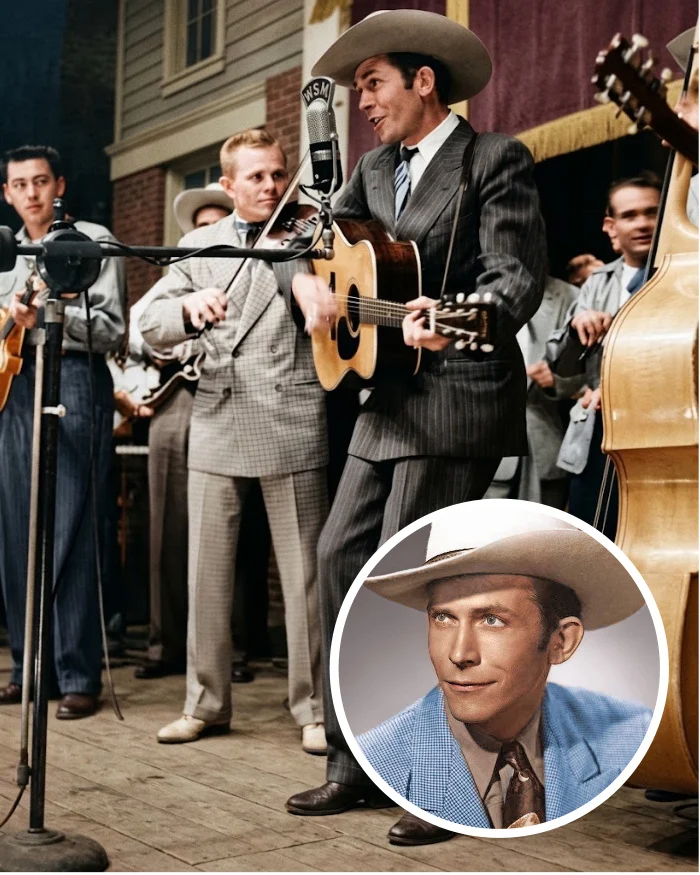
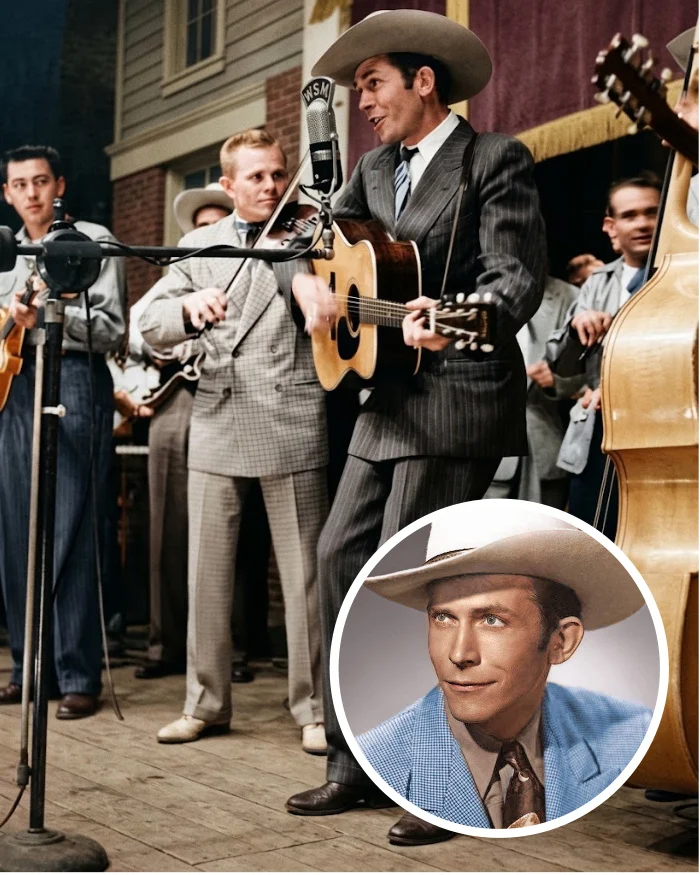
The final ride was cold, quiet, and unbearably lonely. On New Year’s Day 1953, a seventeen-year-old driver named Charles Carr pulled a baby blue Cadillac into a small gas station in Oak Hill, West Virginia, and found his passenger completely unresponsive beneath an overcoat. The man in the backseat was Hank Williams, the voice that had made heartbreak sound beautiful, and he was gone at twenty-nine.
Months before that silent highway ending, the Grand Ole Opry had already cut him loose. On August 11, 1952, manager Jim Denny officially dismissed the biggest star in country music. Williams had repeatedly missed scheduled performances and struggled with severe visible intoxication. For the singer who had grown up poor and dreamed of standing on the stage of the Mother Church of Country Music, the expulsion severed his strongest tie to the industry he helped define.
He had built enormous wealth for publishers, promoters, and record executives. His songs turned a regional sound into a national commercial force. Yet as his body failed, the same men who profited from his pain began to see him as a liability.
The chaos on the road was only the visible surface of a deeper collapse. Williams was navigating a bitter public divorce from Audrey while living with spina bifida occulta, a congenital spine defect that caused relentless back pain. A recent fall during a hunting trip made the agony worse. To stand at a microphone and survive long drives, he leaned heavily on alcohol and powerful prescription painkillers. The combination, along with heartbreak, stripped away his ability to function and left him isolated from the people who had once guided his career.
The establishment that capitalized on his ability to sing about pain abandoned him the moment he could no longer hide his own.
After losing his Opry membership and his Nashville stability, Williams retreated to the Louisiana Hayride in Shreveport. He walked back onto the smaller broadcast stage where his career had first gained national traction four years earlier. He was no longer a hungry young artist. Though he had not yet reached his thirtieth birthday, he carried his guitar like an exhausted frail man waiting for an inevitable end.
That rejection set the stage for a desperate final tour. Needing income, he booked a pair of holiday shows in Charleston, West Virginia, for New Year’s Eve and in Canton, Ohio, for New Year’s Day. To make the long trip from Alabama, he hired Carr, a college student, to drive the car.
Severe winter ice storms grounded commercial flights across the region. Carr had to navigate freezing highways while Williams rested in the backseat. After a stop at the Andrew Johnson Hotel in Knoxville, Tennessee, a local doctor was called to administer a sedative for the singer’s immense pain. The pair pushed back into the dark and icy night.
The tragedy deepens in its irony. Williams possessed a voice that made millions feel less alone, yet his journey ended in absolute isolation in the backseat of a luxury car on a cold mountain highway.
The Nashville industry that had fired him just months earlier immediately rushed to press his records and memorialize his name. The Opry stage eventually recognized him as an untouchable historical figure. But his quiet final ride proved that the music business demanded everything he had to give long before his heart finally gave out.