
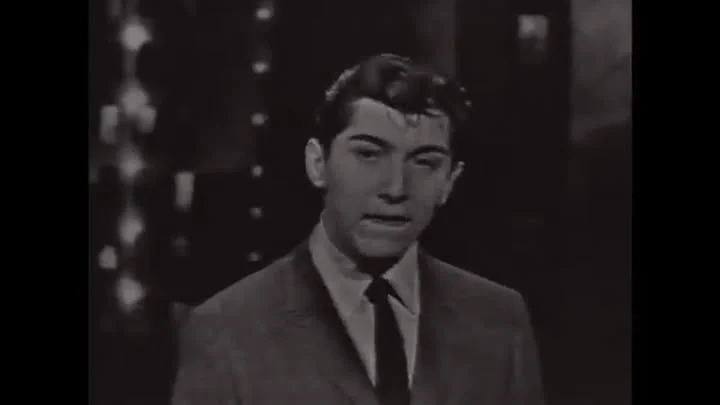
In an age of fleeting digital hits and auto-tuned confessions, there exists a song that can still stop time with a whisper. Paul Anka’s “Put Your Head on My Shoulder” does not scream for attention. Instead, it invites the listener into a quiet cocoon of vulnerability and trust. Six decades after its release, the track remains a cherished anthem of young love, its gentle melody and tender lyrics carrying the weight of a generation’s most innocent dreams.
The magic of this 1959 classic lies in its radical simplicity. Anka, just 17 years old and already a seasoned star with hits like “Diana,” understood that the most powerful emotions often require the least decoration. The song opens with a fragile guitar line, soon joined by soft strings, creating an atmosphere that feels both intimate and universal. There are no dramatic key changes, no booming drums. Just a heartbeat rhythm and a voice that trembles with sincerity.
“Put your head on my shoulder, hold me in your arms, baby, squeeze me oh so tight, show me that you love me too…”
These words, penned by a teenager in Ottawa, capture a moment of pure emotional surrender. It is not merely a request for physical closeness; it is an invitation to trust. Anka asks for something more profound than a dance or a kiss. He wants the reassurance that comes from being held without reservation. This longing for a deep, safe connection resonates as powerfully today as it did in the Eisenhower era.
To fully appreciate the song’s impact, one must step back into the late 1950s. Rock ‘n’ roll was still a rebellious storm shaking up the mainstream, led by icons like Elvis Presley and Chuck Berry. Yet alongside the energy, there was a softer current of teen ballads that spoke directly to young hearts. Anka became a master of this art form, blending a pop sensibility with an emotional maturity beyond his years. “Put Your Head on My Shoulder” emerged as the perfect encapsulation of that tender side of the golden age.
The song’s lyrical arc is deceptively simple. It moves from the physical act of resting a head on a shoulder to a hopeful question: “Maybe you and I will fall in love.” That line is everything. It transforms the gentle sway of the melody into a plea for a future together. It is the quiet, breathless moment before a first confession, the universal heartbeat of young romance. The song never promises certainty, only possibility. And that uncertainty makes it endlessly human.
Over the years, countless artists have paid homage to this standard, from pop crooners to jazz ensembles. Each cover brings a new texture, but the soul of Anka’s original remains untouched. Its power to transport listeners to a simpler time is perhaps its greatest gift. In an era often defined by relationship complexities and digital distance, “Put Your Head on My Shoulder” feels like a rediscovered letter from a past love. It reminds us that love, at its purest, is about quiet connection and the safety found in another’s arms.
The song has enjoyed a remarkable second life in popular culture, appearing in films, television shows, and even viral TikTok clips. This resurgence proves that timelessness is not about staying the same, but about remaining relevant to new hearts. Anka’s legacy extends far beyond this one track—he gave Frank Sinatra “My Way,” after all. Yet this ballad holds a special resonance. It is a snapshot of the moment when a teenage boy decided to write down the feeling of a perfect embrace, and in doing so, gave the world a musical keepsake of innocence.
As long as people continue to fall in love, they will return to this song. Not for complexity, but for comfort. Not for flash, but for truth. “Put Your Head on My Shoulder” is a whispered promise that tenderness never goes out of style.