
Three days after Waylon Jennings died, the Nashville stage he spent decades resisting became the place where his closest friends said goodbye.
He had never asked for permission, polish, or a comfortable box to stand in.
He was the stubborn, roaring heart of outlaw country, a man who turned defiance into music and made independence feel like a religion.
For years, record executives wanted singers who were safe, tidy, and easy to steer.
Waylon gave them the opposite.
He fought labels, pushed back against powerful managers, and protected the rough, honest sound that made his voice impossible to ignore.
Yet time is the one road an outlaw cannot outrun.
Behind the leather, the glare, and the deep voice, diabetes was stealing pieces of the man many fans assumed could never fall.
The disease claimed his left foot and forced a restless performer into painful stillness.
He kept playing, kept dreaming, and kept pushing until his body finally stopped on a Wednesday, February 13, 2002.
He was sixty-four.
Country music did not know how to honor a rebel who had always left on his own terms.
Then Saturday came at the Ryman Auditorium.
That room had once represented the polished tradition Waylon challenged, and the Grand Ole Opry stage carried the weight of a complicated history.
On that night, grudges softened.
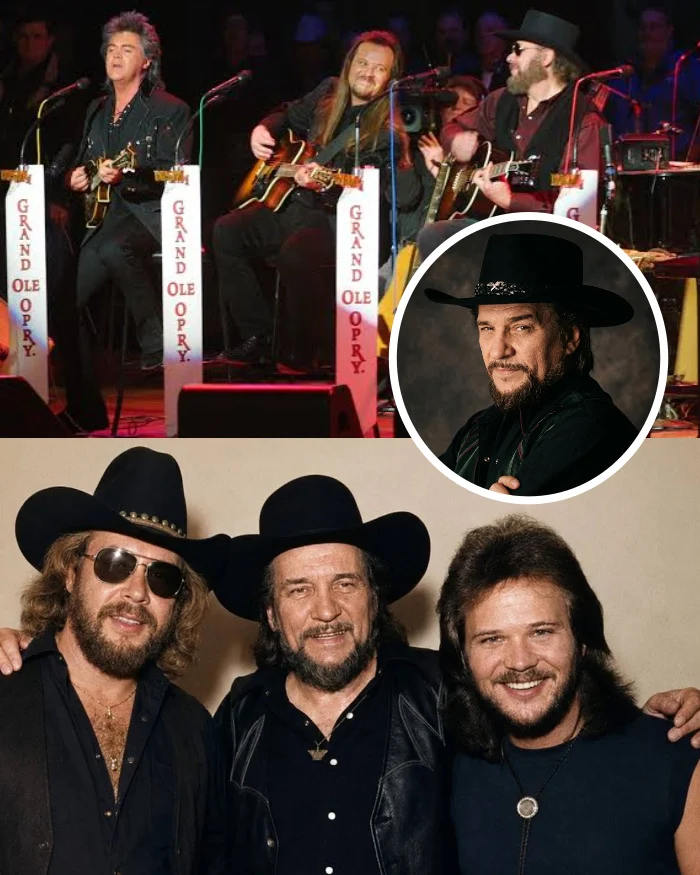
Hank Williams Jr. walked onto the Opry stage for the first time in more than twenty years.
Travis Tritt and Marty Stuart joined him, and Porter Wagoner hosted the evening.
They did not bring speeches, cameras, or a glossy memorial.
They brought four stools.
Three men sat down under the lights.
The fourth stayed empty.
That empty seat became the loudest part of the night.
For more than an hour, they sang Waylon’s songs into the silence around that vacant stool.
When Hank Jr. leaned into the microphone and sang “Eyes of Waylon,” his voice carried the ache of a brotherhood that death could not erase.
They were not playing for applause.
They were playing for the friend they believed was still listening.
Waylon Jennings had spent a lifetime refusing to be controlled.
His final tribute happened in the most sacred room in country music.
It proved that beneath the outlaw armor was a man loved fiercely by the people who knew him best.
Today the Ryman has welcomed thousands of new faces, and the outlaw era has moved into memory.
But that quiet Saturday night remains one of the most devastating goodbyes American music has ever witnessed.
It reminds us that true rebels do not only leave records and legends.
They leave an empty space no one else will ever fill.