
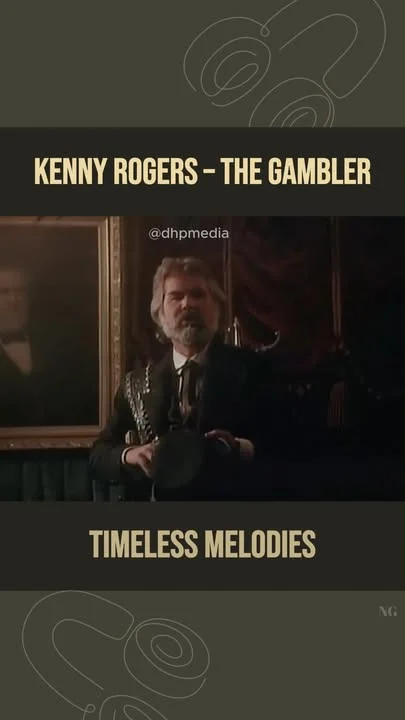
The darkness swallowed the train car and the stranger’s voice carried the weight of a hundred mistakes. When Kenny Rogers sang about a gambler who broke even in the darkness, he gave millions a code to live by. That moment on a train bound nowhere became the centerpiece of a 1978 classic written by Don Schlitz. It was a song that turned a simple card game into a philosophy of survival.
Schlitz labored over the final verses until the story felt exactly right. Rogers supplied the weathered voice and the knowing expression that made the character believable. He did not simply sing the narrative. He became the man whose face was etched with hard lessons and quiet observation. The result was a recording that transcended country radio and settled into the heart of American culture.
By the time the song arrived, Rogers had already crossed over from The First Edition to a thriving solo career. He had tasted success with “Lucille” and other hits. But “The Gambler” lifted him to another level. The album of the same name appeared in November 1978 on United Artists with Larry Butler producing. It became a defining example of the Urban Cowboy sound, a polished Nashville style that bridged country and pop without losing its storytelling spirit.
Listen carefully to the opening bars and you can hear the motion of a train. A warm acoustic guitar strums in a steady pattern, joined by a walking bass and a soft drumbeat. The arrangement is a masterclass in restraint. Nothing shouts for attention. Electric guitar fills appear like quiet punctuation, while the piano from Hargus “Pig” Robbins adds a gentle melancholy beneath the vocal. Ray Edenton and Jimmy Capps supplied the acoustic guitar work and The Jordanaires provided a comforting layer of background voices. The production feels dry and immediate, free of heavy reverb, so that every word lands with clarity.
The chorus arrives with a burst of energy that never overwhelms. The drums press forward, the voices lift, and the message rises with them. It is a moment of pure musical release and it has lost none of its power after all these decades.
You got to know when to hold ’em, know when to fold ’em, know when to walk away and know when to run. You never count your money when you’re sittin’ at the table. There’ll be time enough for countin’ when the dealing’s done.
At its core the song is not about gambling at all. The cards represent the circumstances life deals out. The advice is simple and profound. Know when to hold on and when to let go. Know when to walk away and when to run. Do not count your blessings while you are still in the middle of the struggle. Wait until the dealing is done. Every hand can be a winner or a loser. The best anyone can hope for is a peaceful end.
The song became far more than a hit single. It won a Grammy and spawned a series of television movies with Rogers playing the card-playing philosopher. It entered the vocabulary of everyday guidance. Parents quoted it to children. Coaches used it in locker rooms. Songwriters studied it as a model of economy and narrative force. It gave listeners a way to talk about timing and risk and acceptance without sounding preachy.
Rogers grew into the role he created. He became the calm and measured figure who always seemed to know the odds. “The Gambler” turned a successful singer into a genuine icon. As one critic noted, the track is a perfect short story, three verses of impeccable setup and a chorus that works as the unforgettable punchline.
The final scene remains the most moving part. The old man shares his whiskey and his wisdom, then turns toward the window, crushes out his cigarette, and fades into sleep. He broke even in the darkness and left behind a single ace that the young man could keep. That quiet dignity is the true lesson of the song. It is not about winning big. It is about living with honesty and knowing when to walk away.
For listeners who want more songs in this spirit, a handful of tracks share the same blend of story and insight. “Islands in the Stream” with Dolly Parton brings the same polished country pop energy. “The Last Unbroken Heart” by Patti LaBelle and Bill Champlin offers dramatic adult contemporary storytelling. “She Believes in Me” from the same album captures an intimate vocal tone. “Gentle on My Mind” by Glen Campbell delivers classic narrative cool. “Coward of the County” shows Rogers mastering another character driven tale. And “A Boy Named Sue” by Johnny Cash proves the enduring power of a single protagonist’s journey.
Lyrics
On a warm summer’s evening on a train bound for nowhere I met up with a gambler. We were both too tired to sleep. So we took turns a-starin’ out the window at the darkness. The boredom overtook us and he began to speak.
He said, “Son, I’ve made a life out of readin’ people’s faces and knowin’ what the cards were by the way they held their eyes. So if you don’t mind my sayin’, I can see you’re out of aces. For a taste of your whiskey I’ll give you some advice.”
So I handed him my bottle and he drank down my last swallow. Then he bummed a cigarette and asked me for a light. And the night got deathly quiet and his face lost all expression. Said, “If you’re gonna play the game, boy, you gotta learn to play it right.”
You got to know when to hold ’em, know when to fold ’em, know when to walk away and know when to run. You never count your money when you’re sittin’ at the table. There’ll be time enough for countin’ when the dealing’s done.
Every gambler knows that the secret to survivin’ is knowin’ what to throw away and knowin’ what to keep. ‘Cause every hand’s a winner and every hand’s a loser and the best that you can hope for is to die in your sleep.
And when he finished speakin’ he turned back toward the window. Crushed out his cigarette and faded off to sleep. And somewhere in the darkness the gambler he broke even. And in his final words I found an ace that I could keep.
You got to know when to hold ’em, know when to fold ’em, know when to walk away and know when to run. You never count your money when you’re sittin’ at the table. There’ll be time enough for countin’ when the dealing’s done.