
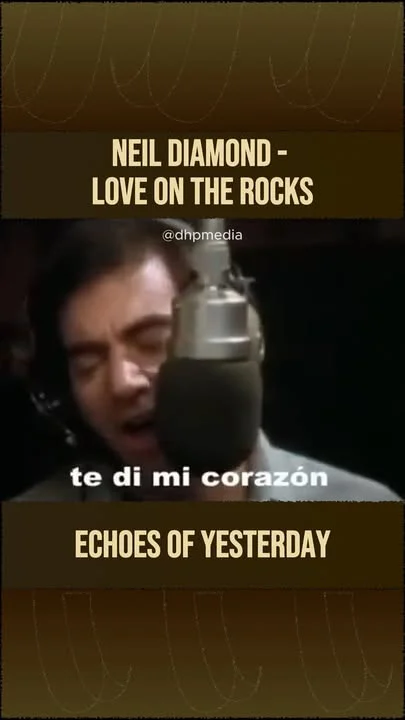
Neil Diamond sits at a piano, letting his voice crack and waver with raw vulnerability. He is not performing acrobatics. He is confessing. In 1980, when Love on the Rocks first poured out of speakers, listeners felt something shift. Here was a ballad that stripped away all pretense, leaving only the sting of betrayal and a near-empty glass. The song, written for The Jazz Singer soundtrack, became a defining moment in Diamond’s career. But its power goes far beyond nostalgia. Nearly half a century later, this track still speaks to anyone who has watched love fall to pieces.
Love on the rocks ain’t no surprise
Pour me a drink and I’ll tell you some lies
Those opening lines land like a blunt truth. Diamond does not sugarcoat. He sings with a husky, almost weary tone, acknowledging that heartache is not shocking any more. It is familiar. The narrator has been here before. And so have we. The lyric “Pour me a drink and I’ll tell you some lies” hints at the secrets we tell ourselves to numb the pain. Deception becomes a survival tool. But the real gut punch arrives later, when Diamond’s voice rises into a storm of frustration, breaking through the restrained arrangement. That crescendo feels like a cry. It is a release we all crave when love turns cold.
Produced by Bob Gaudio, the song’s simple piano opening is deliberately sparse. It sets a somber mood, one that never tries to dazzle with complexity. Instead, the arrangement creates space for Diamond’s voice to carry the emotional weight. Every crack and waver is left intact. No smoothing over. No distractions. This is a masterclass in understated emotion. The song builds slowly, mirroring the journey from disbelief to resignation, and finally to a bitter acceptance.
While Love on the Rocks originally belonged to The Jazz Singer — a semi-autobiographical film where Diamond played a cantor leaving tradition behind — the song quickly outgrew its cinematic roots. It reached No. 2 on the Billboard Hot 100 and became a permanent fixture in live performances. Audiences around the world connected with its honesty. The film received mixed reviews, but the soundtrack shone. And at its heart was this ballad, a song that refused to pretend love is always gentle.
Diamond’s voice is the anchor. His deep, gravelly timbre never tries to be pretty. Instead, it embraces imperfection to heighten vulnerability. As the song progresses, he lets go, surging into a powerful climax that feels almost like a confession shouted into a storm. That rawness is why Love on the Rocks endures. It does not offer false hope. It does not pretend that time heals everything. Instead, it meets listeners exactly where they are: standing in the wreckage of a failed relationship.
First they say they want you, how they really need you
Suddenly you find you’re out there walking in a storm
Those lines capture the sudden isolation of being discarded. One moment, you are everything to someone. The next, you are alone, wondering where it all went wrong. Diamond’s metaphor of walking in a storm is visceral. It is not about anger. It is about confusion and coldness. And the song does not flinch. It acknowledges the bitterness, the lies we tell, and the urge to numb the ache with a drink. Yet within that bleakness, there is solidarity. Diamond is not here to fix us. He is here to say, “I know this song. We all know this song.”
More than four decades later, Love on the Rocks remains a beloved classic. Its appeal is timeless because heartbreak is timeless. The sound of pop music has changed dramatically since 1980, but the emotions that Diamond tapped into are as universal as ever. New generations discover the track and feel the same sting. Cover versions appear, each putting a fresh spin on the ache. But none captures the original’s raw honesty. Diamond’s delivery is one-of-a-kind. He does not hide behind production. He stands bare on that piano ledge and lets us see the cracks.
This song is more than a ballad about heartache. It is an exploration of human resilience. It acknowledges that love can leave us stranded, but it also offers a strange comfort: we are not alone in our storms. Neil Diamond’s timeless anthem will continue to resonate, a reminder that the best songs are those that tell the truth, even when the truth hurts.
On the screen or on the stage, Love on the Rocks carries a legacy that defies time. It is a song that refuses to be forgotten, and it never needs to sugarcoat its message. For anyone who has ever raised a glass to lost love, this track remains a bittersweet companion.