
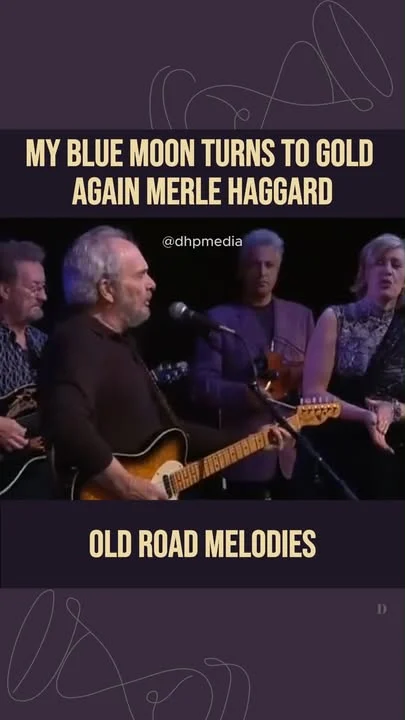
There are songs that arrive like a gentle breeze on a lonely night, carrying the promise of a brighter dawn. Merle Haggard’s rendition of “My Blue Moon Turns to Gold Again” is exactly that kind of balm for the soul. It transforms heartache into hope with every note, and it does so with a grace that only a true country legend could summon.
Haggard, one of the most revered figures in country music history, had a gift for wrapping raw emotion in a melody that felt both intimate and universal. His version of this classic, originally penned in 1940 by Wiley Walker and Gene Sullivan, appeared on his deeply personal 1981 album Songs for the Mama That Tried. That record was a tribute to his mother and the gospel and traditional country sounds that shaped his childhood. It is within this context that the song truly shines, a beacon of renewal on an album steeped in memory and respect.
“My Blue Moon Turns to Gold Again” captures a universal sentiment — the transformation of sorrow into joy. Haggard’s rich baritone voice imbues every word with authenticity, making the song a source of comfort for those navigating their own emotional journeys.
The arrangement itself is a masterclass in classic country instrumentation. Haggard understood that the best music breathes, allowing each instrument to speak without crowding the story. An acoustic guitar provides a steady, gentle foundation, while slide guitar and fiddle weave in and out like old friends sharing a bittersweet memory. The piano appears sparingly, adding warmth without stealing the spotlight. Even the bass and percussion remain unobtrusive, anchoring the song so that the emotional weight of the lyrics can float freely. It is, in every sense, a sound of open fields and quiet resilience.
This track resonates because it tells a story that belongs to everyone — a tale of love lost and found, of a blue moon turning gold. Haggard’s delivery makes the listener feel every syllable. The chorus repeats like a mantra, a reassurance that hope is never truly gone. For anyone who has ever known heartbreak, these words offer a steady hand in the dark.
Fans of this song will find kindred spirits in other classics. Willie Nelson’s “Blue Eyes Crying in the Rain” shares the same understated power, while George Jones’s “He Stopped Loving Her Today” carries an emotional depth that echoes Haggard’s sincerity. Elvis Presley’s “Always on My Mind” also explores the fragile territory of regret and devotion. And for those who want to stay inside Haggard’s world, his own “Today I Started Loving You Again” makes a perfect companion piece, a meditation on love, loss, and the courage to begin again.
More than four decades after its release, “My Blue Moon Turns to Gold Again” remains a testament to the enduring power of traditional country music. It has outlived trends and tastes because it speaks to something eternal — the human need for hope. Whether heard under a starry sky or through crackling speakers in a dive bar, the song carries a timeless warmth. It is not just a track on an album; it is a reminder that even in the deepest night, a new dawn is always waiting.
For both longtime devotees of Merle Haggard and newcomers exploring his vast catalog, this song offers a perfect entry point into a legacy built on truth, grace, and the gentle art of storytelling. It will keep turning hearts to gold for generations to come.