
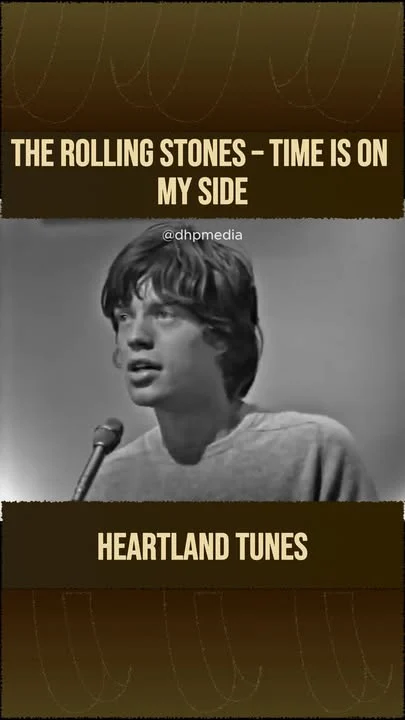
There are songs that teach you how to wait. Time Is On My Side is one of them. It arrives like a slow exhale in a crowded room, the kind of moment when you realize that the most powerful thing you can do is nothing at all. The first notes lean into the air with a patience that feels almost defiant, as if the band had decided that hurry was beneath them.
Patience becomes power in this song. The arrangement holds its breath just long enough to make belief feel inevitable.
For The Rolling Stones, this track became a quiet landmark. In 1964, still hungry and just beginning to understand their own voice, they stepped into a borrowed tune and made it their own passport. The song climbed into the U.S. Top Ten, a pivotal early success that proved the band could translate American R&B into something that felt both foreign and familiar. It appeared on their second American album 12 x 5, overseen by manager-producer Andrew Loog Oldham and released on London Records. That album is where the Stones’ fascination with rhythm and blues began to harden into a signature sound.
The roots of the song reach back before the Stones ever touched it. Composer Jerry Ragovoy, writing under the name Norman Meade, originally crafted the melody. Jazz trombonist Kai Winding recorded the first version in 1963, a curious brass-laden prototype with gospel-inflected backing vocals. Then Irma Thomas reshaped it in New Orleans R&B terms, adding a spoken monologue and extra lyric material co-written by Jimmy Norman. Her interpretation was as resilient as the narrator she portrayed. When the Stones recorded their version later that year, they drew from that well, simplifying the frame and dialing up the patience until the message felt like fate.
One of the most intriguing details is that the band cut the song twice in quick succession. The earlier 1964 take opens with a soft, organ-led entry that feels like the room taking a long inhale. That version appears on 12 x 5 and became the single that broke through in the States. Later that same year, the Stones recorded a tighter version in Chicago with a guitar-led intro. More immediate, drier, stripped of the dreamy haze, it showed up on a subsequent U.K. release and later on an American compilation. Two readings of the same tempo, different ways of arriving at the same promise. The contrast is a miniature lesson in how the Stones learned to control atmosphere as much as groove.
What does that atmosphere sound like? Imagine a small, warm room and a ribbon microphone catching more air than you expect. The drums move with a restrained skip, no thunder, only a soft insistence that refuses to be hurried. The bass lines bloom and fade rather than punch. Over that cushion, the guitar lays out clipped phrases with a just-behind-the-beat patience, a touch of tremolo wobble that suggests human breath. When the organ or piano shades the chords from behind, it feels like light changing color in the corner. Small details—a brushed cymbal, a slide, a spill of room reverb—do the quiet work of meaning.
Mick Jagger delivers the vocal with a remarkable balance of sweetness and grit. He leans into vowel endings, lengthening them just enough to imply control rather than surrender. Listen to how he shapes the word “ti-i-ime,” the second syllable almost a smile. He does not plead or crow. Instead, he promises. The phrasing leaves space between declarations, making each one feel like a step he is not afraid to pause on. That restraint is the secret energy of the performance.
This is also an early example of the Stones wearing another composer’s clothes without looking like they borrowed anything. Keith Richards and Brian Jones carve out a guitar lattice that invites the vocal to hang back by a fraction of a second. Andrew Loog Oldham favors proximity in his production sensibility. Nothing feels distant. You are in the same radius as the instruments, close enough to hear the air. The effect is modest but intimate. What you lose in polish you gain in empathy.
If the Stones were still students of American music in 1964, Time Is On My Side is their term paper on patience. This piece of music understands that longing is not the same as chasing. While other British Invasion bands translated U.S. R&B into brisk, brash pop, the Stones chose to slow down, to let space and micro-silences do the talking. You can almost hear the light in the studio: chalky, steady, unshowy, like a late afternoon that refuses to admit it is almost evening.
There are millimeter-scale pleasures to hear, especially in the first U.S. version. The organ draws soft halos around the chords, as if sketching the harmony in pencil before inking it. The guitars converse in brief sentences, one clipped, one more legato, so the figure never feels busy. The drum accents hesitate on purpose, like someone leaning against a doorframe mid-conversation. It is a model of dynamics with almost no volume tricks. The drama comes from thickness and thinness, how many instruments are speaking at once, and how close they are standing.
Through all of this, the lyric’s simplicity becomes an advantage. It is declarative without being specific, letting listeners hang their own narratives on it. Over decades, people have attached it to reunions, reconciliations, and plain old stubborn optimism. One reason it works live, even in modern stadiums, is that it gives everyone in the building the same magnetic center: hold steady, and time will choose sides.
Let me tell you three small stories that the record calls to mind. First, a back seat on a long drive after midnight. Someone up front who has been quiet all day starts to talk. The song comes on, and they admit they are not ready to send that message they drafted earlier. The chorus becomes a permission slip they did not know they needed.
Second, a college apartment with walls too thin and a secondhand turntable that never sits perfectly level. The record wobbles a bare fraction, and so does your mood. You are contemplating a text you promised you would not send. The song buys you five more minutes.
Third, a crowded kitchen on a Sunday afternoon. An uncle who rarely talks about the past slides the fader on an old playlist and tells you about a dance hall that does not exist anymore. He swears the floorboards sang. He says he believed then, and kind of still believes now, that if he waited long enough, the right things would circle back.
What Time Is On My Side captures so well is the productive use of patience. Not paralysis, not martyrdom, but a posture of steadiness. Musically, that shows in the arrangement’s refusal to be needy. Every line sits down when it finishes and lets the next one speak. There is confidence in that courtesy.
Pull the camera back to the Stones’ career arc and you see a bridge. On one side, they are a crack young band importing American R&B to U.K. and U.S. teenagers. On the other, they are the writers of their own legends. This track stands mid-span, proof that they could take a song conceived elsewhere and make it so clearly theirs that it would serve as a passport. From there, their path to original hits like (I Can’t Get No) Satisfaction and The Last Time makes more narrative sense. The early success also shows why Andrew Loog Oldham vision mattered. He believed the band’s personality could be as potent as their repertoire, and he produced accordingly.
There is also the lived-in grace of the vocal blend. The responses cushion Jagger without prettifying him, a balance that would become a hallmark of the band’s best ballad-tempo cuts. Even the small decorative flares—an organ chord that lingers, a brushed snare that smudges the measure’s edge—feel earned. The patience is not passive. The arrangement constantly makes micro-decisions in favor of poise.
Some listeners meet the song through Irma Thomas, others through later compilations, others through live recordings where the tempo lifts and the audience sings the title back like a testimony. The beauty is that the song tolerates all of it. Its bones were designed for mileage. Its spirit can live inside a late-night dedication or a stadium’s giant echo. The Stones’ version taught whole generations to hear longing not as crisis, but as tempo.
If you have somehow never sat with the track closely, try a deliberate listen. Let the intro unfold. Follow the bass notes as they step across the bar lines. Notice how the lead vocal saves its sharpest consonants for the ends of phrases, like punctuation that does not need to shout to be heard. And notice how the band resists the temptation to crowd the final chorus. The payoff is not a high note. It is a feeling that the center has held.
Time Is On My Side proves that durability begins with patience. It is not just about who wrote it first or who sang it loudest. It is about who understood that waiting can be a form of strength. The Rolling Stones, young and still learning their weight, chose to wait. In doing so, they found a tone that would carry them for decades. For all the noise that rock and roll can make, sometimes the most persuasive move is the soft one.
If you are exploring the band’s early catalog, it is worth hearing how the track sits among its neighbors on 12 x 5. You will catch the group toggling between Chicago blues homage and pop craft, rehearsing the blend that would soon turn into a signature. When you return to Time Is On My Side, it might feel slower than you remember. That is not drag. That is design. It leaves room for you to step into the promise and decide whether you believe it too. And if you happen to revisit it via a music streaming subscription, pause for a moment to notice how restrained the mix is. Proof that confidence does not require volume.
In the end, the song asks for nothing more than trust in duration. Play it once, then again. If time truly is on our side, the second listen lands deeper.
Listening Recommendations
Irma Thomas — “Time Is On My Side” (1964). The luminous R&B template that inspired the Stones’ reading, complete with a spoken passage and gospel-tinged backing.
The Rolling Stones — “It’s All Over Now” (1964). From the same period as 12 x 5, a swaggering cover that shows the band’s early command of American R&B forms.
The Animals — “Bring It On Home to Me” (1965). A British Invasion take on American soul that pairs restraint with gravelly intensity.
The Zombies — “The Look of Love” (1965 live/various comps). For the patient pulse and keyboard glow.
The Rolling Stones — “As Tears Go By” (1965). A ballad-tempo statement of poise and maturity that favors space over spectacle.
Otis Redding — “That’s How Strong My Love Is” (1965). A masterclass in measured delivery and unforced conviction.