
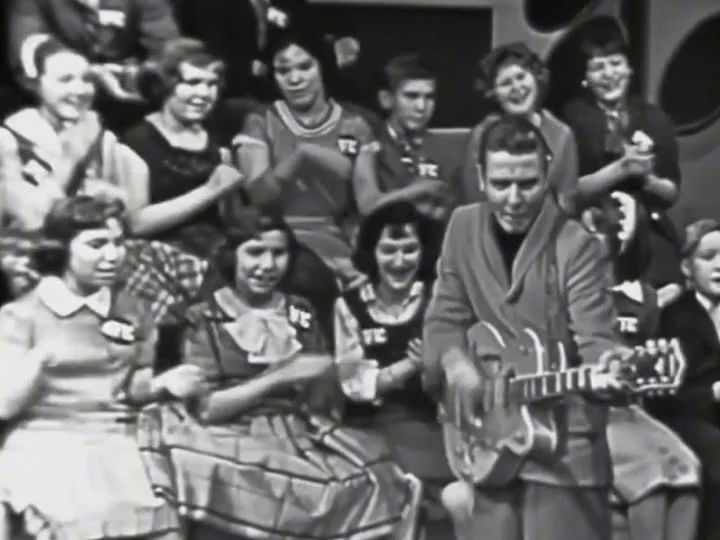
There’s a moment in every music lover’s life when a decades-old track lands like a fresh conversation. For those who stumble upon Eddie Cochran’s “C’mon Everybody” for the first time today, that moment arrives in under three minutes—a compact blast of rhythm and invitation that turns any room into a dance floor. The opening bars feel like a car door slamming before the night’s first joyride, a sound so immediate it bypasses nostalgia and heads straight for the gut.
Released in 1958 on Liberty Records, the song was co-written by Cochran and his manager Jerry Capehart. It was never meant to be a deep cut buried in an album. It was designed to stand alone on a 45 rpm single, pulled from a diner’s jukebox or a teenager’s portable turntable, setting a mood of pure motion. After Cochran’s untimely death, it found a second life on compilations like The Eddie Cochran Memorial Album, but its origin as a standalone single remains key to its character.
Cochran was only 20 when he cut the track, yet he already carried himself like a studio captain. Accounts of the production credits vary—as they often do for that era—but the record bears his fingerprints: the punchy arrangement, the brash confidence, the sense that the singer knew exactly what the microphone wanted. This was a young American rocker who could sing, write, and shape the sound around him, and the self-assurance comes through in every bar.
“C’mon Everybody is that rare two-minute engine: it doesn’t just move; it teaches you how to move with it.”
What strikes a listener today is not nostalgia but efficiency. Every sound has a job. The rhythm section leans forward rather than drags, the bass walks with a bounce, and a rasping lead guitar line slices through like a grin you can hear. Slapback echo adds spatial depth without washing anything out. The mono image is narrow by modern standards, yet the record feels roomy, as if the walls themselves pulse in time.
The arrangement pivots on clever stop-time breaks—quick drops where the band holds its breath—that springboard into the chorus. Background shouts and stacked voices create a crowd that forms instantly, a sonic line outside the door telling you the party has already started. Cochran’s vocal rides just above the band, neither crooned nor barked, with a relaxed enunciation that keeps the celebration from tipping into chaos.
The lyric concept is simple: get together, make noise, claim your own night. But Cochran hosts rather than preaches. He is the friend who knows the right house, brought the records, and says “c’mon” with no subtext. The verses sketch a clear image—parents out, furniture pushed, dance floor invented—so the track doubles as a micro-movie of teenage America in the late fifties, where independence was measured in borrowed time and borrowed rooms.
Listen closely to the mic character. The vocal sits close and dry, catching a faint edge of breath, then shadowed by quick echo that returns like a wink. The snare has a papery crack, the kick a compact thump, and cymbals are mixed with restraint so the pulse stays centered. There is little low-end smear, suggesting careful placement rather than brute force. It is concise engineering: a small-town soundstage, with dynamics like a main street at dusk, everything ready to move.
The track passes the baton from verse to chorus with a call-and-response that borrows communal electricity from gospel, even if the form is different. The band’s energy compresses and rebounds; the crowd vocals answer as co-conspirators. You are not just hearing a performance—you are being drafted into it. That may be rock and roll’s oldest trick: turn the listener into a participant, a warm body in the room.
Structurally, the song is deceptively sturdy. A straightforward chord pattern grants the performance enormous flexibility. Slow it down and it might swagger; push it and it would scream. Cochran lands in the sweet spot—fast enough for kinetic excitement, controlled enough to stay intelligible. The economy makes every vocal punctuation and instrumental interjection matter. Nothing is ornamental; everything is functional.
The instrumental colors are classic rockabilly: a bright lead guitar with quicksilver runs and pointillist accents, short clipped phrases that bloom and vanish. There is warmth in the midrange but very little haze, keeping rhythmic details crisp. In the middle eight, the band leans forward on its toes, catching the chorus before it arrives. The momentum is that physical.
Notably, the arrangement avoids ornate keyboards. A bar-room piano would have tipped the texture toward boogie; keeping it minimal preserves the record’s inhale-exhale precision. The discipline pays off when the final chorus lands and the voices widen, offering a broader impression without any single element blasting beyond its weight class. It is the difference between teenage mayhem and teenage command.
Cultural context helps explain the song’s durable grin. In the United States it turned heads; in Britain it became a genuine hit and echoed across the early sixties when British groups studied American singles like textbooks. Cochran’s catalog never sprawled across decades—his life was heartbreakingly brief—but his impact radiated outward: onstage swagger, studio smarts, the idea that a young artist could both front the performance and steer the console.
There is an almost cinematic quality to the recording. Modern listeners can imagine the room: a small crew, head-nodding engineers, a red light above the door. The take does not feel labored; it feels chosen. That mysterious “rightness” makes it hard to imagine a better version existing in some vault. Played today on modern studio headphones, you catch the pleasing grit—the edges of consonants, the tight echo, the slightly compressed tone that feels like lacquer on a well-worn instrument.
From a historical vantage point, “C’mon Everybody” arrives in the hinge years when rockabilly’s country-blues DNA was being repackaged for mass teenage audiences. Cochran is not a preacher or a wildman here; he is a translator, filtering the idiom through a suburban lens without sanding it dull. The brief instrumental break models the aesthetic: articulate, catchy, recession-proof against time.
For collectors, note that some reissues boast improved transfers that present more air without sacrificing punch. The difference is not essential, but pleasant—like cleaning a window you did not realize was dusty. Those versions capture tiny shifts in breath and faint resonances that help the performance stand up to modern premium audio habits. Yet the original mono single remains the definitive experience: the centerline focus is part of its locomotion.
In the end, the track is not merely an artifact of the fifties. It is a living, renewable invitation. Play it today and it still finds the soft spot between planning and action, between the thought and the move. The party ends before the neighbors call. The promise remains. By the time the last chorus fades, you are either in or you are not. Press play again, let the night redraw itself, and see how ordinary rooms turn elastic.