
At two in the morning, the fluorescent hum of an interstate gas station becomes an unlikely cathedral. The radio sputters a familiar melody through static, and suddenly the world feels smaller, quieter. It is the voice of Alan Jackson, not as a stadium-filling star but as a man alone with his history, singing the gospel standard “In The Garden.”
This track sits at the heart of Jackson’s 2006 album Precious Memories, a project born from a deeply personal place far removed from Nashville’s commercial machinery. What began as a Christmas gift for his mother eventually became a Platinum-certified triumph, topping both the country and Christian charts. The album revealed a side of the neotraditional country icon that had always been present beneath the cowboy hats and honky-tonk swagger: a reverence for tradition that transcended hit-making. Producer Keith Stegall, Jackson’s longtime collaborator, understood that this piece of music demanded restraint, and their partnership here is defined by what they chose to leave out.
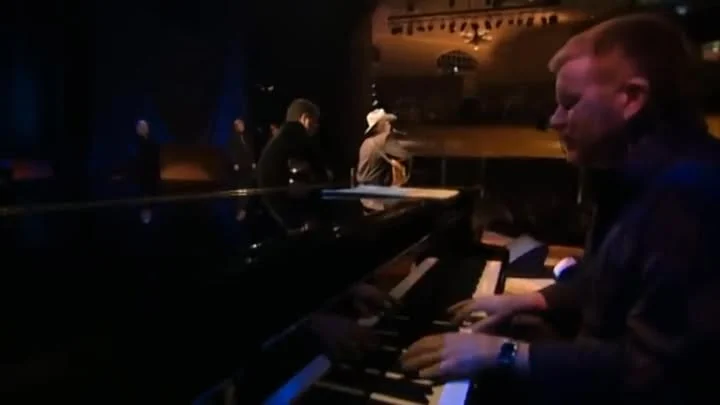
The arrangement of “In The Garden” is deliberately austere, like an intimate performance captured in a small country church rather than a polished studio recording. The core instrumentation relies on the deep, comforting tones of the B3 organ, played by Gary Prim, whose sustained chords form the harmonic bed. This piano-like sound, heavy with gentle vibrato, establishes a spiritual time-out-of-mind mood from the first note. It is the sound of sanctuary.
Against this warm backdrop, Jackson’s voice is remarkably close-miked. Every breath and subtle break in his timbre becomes audible, lending the performance an almost confessional quality. His delivery is unhurried, his phrasing stretched to honor the gravity of C. Austin Miles’ century-old lyrics. There is no trace of country bravado or witty narrative here. He is simply a humble interpreter.
Alan Jackson stripped away the veneer of the recording studio, not to sound raw, but to sound true.
The song’s momentum is carried by a quietly plucked acoustic guitar, reportedly played by Brent Mason, which serves as a textural element rather than a rhythmic one. The soft strumming provides a delicate, almost hesitant pulse. The notes are clean without excessive reverb, reinforcing the sense of immediate presence. It is a masterful study in sonic minimalism. Many contemporary recordings would clutter this landscape with orchestral flourishes or power-ballad dynamics, but Stegall and Jackson hold back, trusting the melody and vocal sincerity to carry the weight.
The true artistry lies in Jackson’s quiet contrast to his commercial work. His smash hits often celebrated the swagger and simple pleasures of rural life—the neon, the Chattahoochee rush, the fast cars. But here, the focus turns inward toward ultimate questions of faith and remembrance. When he sings “And He walks with me, and He talks with me, and He tells me I am His own,” the lines are delivered with a simple, unfettered conviction that bypasses theology and speaks straight to an elemental, shared feeling of peace.
This is why the album resonated so widely. It spoke not only to Jackson’s established fanbase but to an entire demographic who valued the songs they grew up singing in the pews, often feeling alienated by modern CCM production values. Jackson gave them back a hymnbook recorded with the quiet dignity of classic country music. It became the sonic equivalent of a worn favorite sweater—comforting, familiar, and without pretense.
The song’s success offers a subtle commentary on the enduring value of melody and lyric over production flash. It proves that a truly great song performed with utter honesty needs little else to connect. For a generation raised on the complexity of digital recording, listening to the pure unadorned tones on this track through premium audio equipment can be a revelation. You hear the wood of the acoustic instruments, the air around the voice, the gentle attack and long sustain of the organ keys. It is a lesson in acoustic truth.
Think of the micro-moments this song soundtracks today: the quiet solemnity of a late-afternoon funeral service, the moment of reflection during a Sunday morning drive, or simply a solitary moment where the world outside seems too loud. It is music built for internal contemplation, for moments where the noise must recede for the self to be heard.
In a musical landscape often obsessed with complexity and virtuosity, Jackson’s handling of this piece of music is an exercise in restraint that few mainstream artists would dare attempt. The few vocal harmonies that drift in, reportedly sung by family members including his wife Denise, are gentle and almost ghostlike, folding into the organ’s wash rather than demanding attention. This subtle inclusion adds another layer of deeply personal resonance. It ensures the song feels like a shared, familial devotion.
Ultimately, “In The Garden” reminds us that the most powerful emotions in music are often conveyed through the simplest means. Jackson’s voice, a plainspoken instrument built for storytelling, finds a new authority in prayer. The song does not chart a course through the charts. It charts a path toward stillness. It asks the listener not to be entertained, but to be still and remember. It reminds us that sometimes the hardest and most rewarding thing to do in music is simply to stand back and let the hymn speak for itself.
Listening Recommendations
- “O Sacred Head, Now Wounded” – Johnny Cash (from My Mother’s Hymn Book): Shares the same spare, intimate acoustic guitar and vocal-first arrangement, focusing entirely on meditative delivery.
- “Take My Hand, Precious Lord” – George Jones (from Hymns by George Jones): Similar emotional gravitas and traditional country vocal approach to classic gospel material.
- “How Great Thou Art” – Vince Gill (from Souvenirs): Adjacent mood of reverent, beautifully sung traditional Christian hymnody, featuring a gentle, prominent piano.
- “Softly and Tenderly” – Amy Grant (from Legacy… Hymns and Faith): Offers a similar focus on the melody and the comfort of the hymn, arranged with quiet acoustic warmth.
- “Blessed Assurance” – Alan Jackson (from Precious Memories): An obvious but necessary suggestion for its direct connection to the same album and the same masterful, restrained style.
Video
Lyrics
I come to the garden aloneWhile the dew is still on the rosesAnd the voice I hear, falling on my earThe son of God disclosesAnd he walks with meAnd he talks with meAnd he tells me I am his ownAnd the joy we share as we tarry thereNone other has ever knownI’d stay in the garden with himThough the night around me is fallingBut he bids me goThrough the voice of woeHis voice to me is callingAnd he walks with meAnd he talks with meAnd he tells me I am his ownAnd the joy we share as we tarry thereNone other has ever knownAnd the joy we share as we tarry thereNone other has ever known