
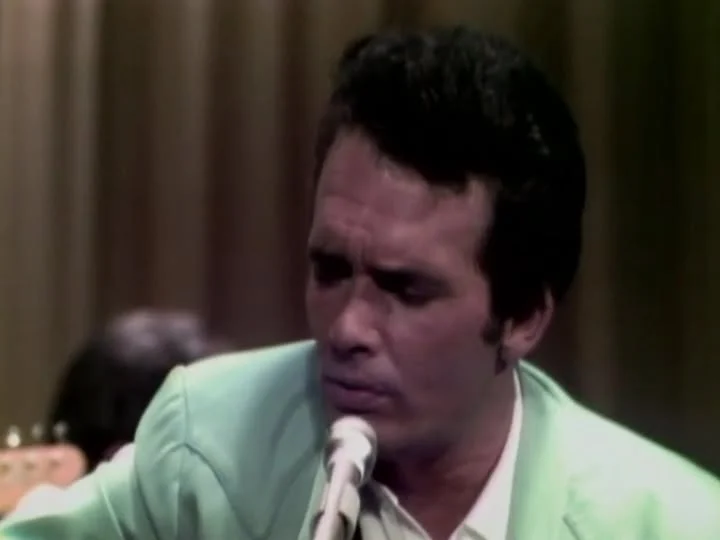
There are songs that simply tell a story, and then there are songs that carry the weight of a life lived on the edge. Merle Haggard’s Branded Man falls decisively into the latter category. It is a raw, unflinching confession set to a twanging melody, a track that doesn’t just discuss regret but embodies it with every note. More than half a century after its release, the track still cuts deep, serving as a stark reminder that while time may heal some wounds, it doesn’t always erase the scars society inflicts.
For the uninitiated, Branded Man is a cornerstone of the 1967 album of the same name, which proved to be a pivotal moment in Haggard’s ascendancy within the Bakersfield sound. This was a movement that rebelled against the polished, orchestral output coming out of Nashville in the mid-’60s, favoring instead a grittier, more emotionally direct style. Where Nashville dressed songs in strings, Haggard stripped them down to their denim-clad essence. The album wasn’t just a collection of tracks; it was a testament to survival, forged in the fires of personal hardship and institutional confinement.
To understand the song’s profound resonance, one must look at the man behind the microphone. Long before he was lauded as a living legend, Haggard was a man wrestling with his demons. His young adulthood was a turbulent spiral of run-ins with the law, culminating in a stint at San Quentin Prison. This institutional experience, far from breaking him, provided the emotional blueprint for his most enduring work. Branded Man is his most direct reflection on that period, a lyrical exploration of the permanent social stigma attached to an ex-convict.
It is a poignant artifact of a bygone era of country music, yet its themes remain alarmingly modern.
From the very first chord, the song sets a scene painted in shades of gray. The iconic introduction, a clean guitar riff that evokes the desolate open road, immediately hooks the listener. It is simple, yet achingly melancholic. This is the sound of the Fender Telecaster at its finest, producing a tone that doesn’t just play notes but speaks volumes. The rhythm section anchors the track, providing a steady, somber heartbeat that pushes forward without ever seeming rushed. It allows the narrative to breathe.
Lyrically, Haggard and his collaborator constructed a masterclass in storytelling. The lyrics speak to the psychological prison that persists long after the physical bars have been removed. It’s a feeling encapsulated in the narrator’s desperate admission that he cannot hold his head up with pride because society will not allow him to forget his past. This sense of having a “number” permanently affixed to one’s name is a powerful metaphor for the inescapability of judgment. The song doesn’t offer easy answers; instead, it lays bare the agonizing tension between wanting to reform and being forever forced to look back.
The instrumental arrangement plays an integral role in shaping the song’s atmosphere. In the corner of the mix sits the steel guitar, played by Norm Hamlet—an instrument that quite literally cries through the track. Its weeping slides and mournful glissandos are not just decoration; they serve as an emotional mirror to Haggard’s vocal delivery. His voice, weathered by a lifetime of hard living, is full of a gravelly vulnerability that makes the performance feel terrifyingly honest. The steel guitar is the perfect foil, its lonely sound stretching out into the distance like the long road ahead of the narrator.
It would be remiss to discuss this track without acknowledging its production. The steady hand of Ken Nelson crafted a sparse, present sound that places the listener in the room with the band. There is no studio gloss here, just pure, unadulterated feeling. This commitment to a “back-to-basics” approach defines the Bakersfield movement and is the very reason why the song sounds as powerful today as it did in 1967.
For devoted fans of this style and theme, Branded Man doesn’t exist in a vacuum. It is part of a broader tapestry of songs dealing with alienation and the quest for redemption. If this track speaks to you, consider exploring “Mama Tried”, another Haggard classic that deals with the heartbreak of a mother watching her son fail despite her best efforts. Similarly, “I’m a Lonesome Fugitive” revisits the road-worn loneliness of a man on the run. For a crossover appeal, one cannot ignore Johnny Cash’s groundbreaking Folsom Prison Blues, a song that shares the same DNA of moral weight, while Lefty Frizzell’s The Long Black Veil offers a chilling look at guilt taken to the grave.
Ultimately, Branded Man is more than just a brilliant piece of country music history. It is a universal story about the human struggle to overcome one’s past. It speaks to anyone who has ever felt judged before they had a chance to speak. Haggard succeeded in transforming his own personal tragedy into a work of art that offers solace to others. The song does not just wallow in pain; it acknowledges the struggle, which in itself is a form of catharsis.
In the vast landscape of country music, few songs achieve the level of authenticity present here. The legacy of Branded Man remains one of quiet strength and painful honesty. It stands as a vital listening experience for anyone who appreciates the art of lyrical storytelling, offering a glimpse into the soul of a man who stared into the abyss and came back with a song that will forever be etched into the canon of great American music.
Below are the haunting words that have resonated with audiences for generations.
I’d like to hold my head up and be proud of who I am
But they won’t let my secret go untold
I paid the debt I owed them, but they’re still not satisfied
Now I’m a branded man out in the cold
When they let me out of prison, I held my head up high
Determined, I would rise above the shame
But no matter where I travel, the black mark follows me
I’m branded with a number on my name
I’d like to hold my head up and be proud of who I am
But they won’t let my secret go untold
I paid the debt I owed them, but they’re still not satisfied
Now I’m a branded man out in the cold
If I live to be a hundred, I guess I’ll never clear my name
‘Cause everybody knows I’ve been in jail
No matter where I’m living
I’ve got to tell them where I’ve been
Or they’ll send me back to prison if I fail
I’d like to hold my head up, be proud of who I am
But they won’t let my secret go untold
I paid the debt I owed them, but they’re still not satisfied
Now I’m a branded man out in the cold
Now I’m a branded man out in the cold