
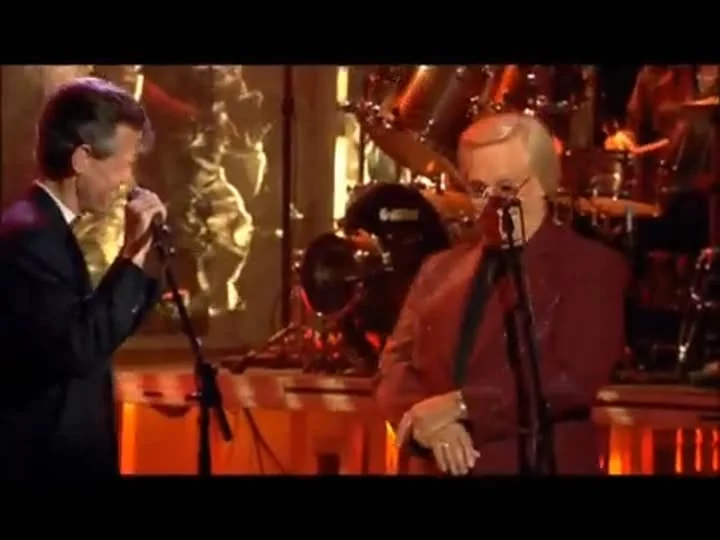
Thirty seconds. That is all it takes for the track to transform from a polite conversation into a masterclass in country music soul. Randy Travis, the newly crowned king of neotraditional country, opens with his signature baritone, steady and clear as morning light. Then George Jones enters, and the song starts breathing differently. His voice, cracked and lived in, slides into the melody like a man who knows every backroad of the human heart. For a brief moment, the listener is caught between two worlds one polished and proud, the other raw and timeless.
It is the sound of a torch being passed, not with a reluctant sigh, but with a shared grin and a knowing nod.
That moment arrived in 1990, when two microphones faced each other in a warm wood-paneled studio. The engineer watched through the glass as Randy Travis, the man who had single-handedly pulled country music away from pop excess, stood opposite George Jones the Possum, a survivor whose voice held more honky-tonk history than any library could contain. They were there to record A Few Ole Country Boys, a duet that was less a performance and more an overheard conversation between generations.
The song served as the lead single for Travis’s fifth studio album, an ambitious project called Heroes and Friends. The concept was simple and profound. Travis, then the biggest star in Nashville, used his commercial clout to create an entire album of duets with the artists who had inspired him. It was a public thank you to legends like George Jones, Merle Haggard, Tammy Wynette, and Loretta Lynn. A gesture of deep reverence wrapped in melody.
Kyle Lehning, Travis’s career-long producer, handled the project with the class it deserved. His production style clean, spacious, and deeply respectful of the song and singer was the perfect framework for such a historic undertaking. He understood that his job was not to impose a modern sound on these legends but to create a sonic space where their voices could coexist naturally. For A Few Ole Country Boys, this meant crafting a track that was pure, uncut neotraditional country music.
The arrangement itself is a masterclass in understated support. It opens with a classic country flourish a bright, confident fiddle melody that dances over a shuffling drumbeat and a walking bassline. The steel guitar joins soon after, not to dominate but to answer the vocal phrases with long, mournful sighs. It evokes the sound of a thousand Saturday nights in a Texas dancehall, polished just enough for national radio without losing its grit. A crisp acoustic guitar anchors the rhythm, while an electric guitar adds subtle, clean licks that punctuate lines with taste and restraint. Deep in the mix, a honky-tonk piano provides percussive warmth, a gentle harmonic bed that thickens the sound without calling attention to itself. Listening back on quality home audio reveals layers of texture that Lehning carefully wove together.
But the instruments, as perfect as they are, merely set the stage. The real drama unfolds in the interplay between two voices. Randy Travis kicks things off with smooth assurance, his baritone rich and centered, every word delivered with clarity and sincerity. He sings his lines straight, setting the scene with a friendly, conversational tone. He is the narrator, the steady hand, the young man laying out a thesis on the simple virtues of the country way of life. Then George Jones enters, and everything changes.
Where Travis is a sturdy oak, Jones is lightning in a bottle. His voice, weathered by decades of living the very songs he sang, electrifies the track. He does not just sing notes he bends them, slides into them, pinches them with that iconic, nasal cry. He phrases with an instinctual, behind-the-beat swagger that no amount of training could replicate. When he sings the line We have been known to get a little loud, you believe him without a shadow of a doubt.
The genius of this recording lies in how Lehning and the vocalists navigate that contrast. Travis never tries to mimic Jones’s wild emotionality. Instead, he holds his ground, providing the anchor that allows Jones to soar. In the chorus, their voices blend in a harmony that is both surprising and deeply satisfying. Travis takes the lower register, a foundational hum of stability, while Jones’s tenor glides over the top, finding pockets of harmony that feel both ancient and spontaneous. To truly appreciate their distinct vocal textures, listen with a good pair of studio headphones. You can hear every bit of breath and gravel in Jones’s delivery against the pure tone of Travis’s voice.
The song’s narrative is a simple, proud declaration of identity. It is about being content with a life of farming, fishing, and old fashioned values. There is no deep, hidden metaphor. Yet when sung by these two men, it becomes a meta-commentary on country music itself. Travis represents the new country boy, one who remembers and reveres the old ways. Jones is the original, the man who needs no introduction and no justification. The song becomes a dialogue about authenticity, a quiet promise that the traditions are in good hands.
Imagine being a young country fan in 1990. You have grown up with Randy Travis on the radio. He is your hero. This song comes on, and you hear his familiar voice, but then you hear this other voice. A voice that sounds older, wilder, more unpredictable. You ask your dad who it is, and he smiles. That is George Jones, he says. That is the greatest there ever was. In that moment, the song becomes a bridge, connecting your generation to your father’s generation, revealing that the music you love has a history as deep and rich as the soil the lyrics praise.
Today, the song evokes a different kind of feeling. In a world of hyper-produced, pop oriented country music, A Few Ole Country Boys feels like a transmission from another time. It is a reminder of the power of simplicity, of what can be achieved when two masters of their craft are given a great song and the space to simply sing it. It is a warm, comforting sound, the audio equivalent of a well-worn leather chair.
It is not a ballad of epic sorrow or a tune of foot stomping revelry. It is something quieter but just as potent a moment of perfect, unforced camaraderie. The sound of a living legend giving his blessing to the new guard, and the new guard respectfully saying thank you. The song became a top ten country hit, but its true value is not measured on a chart. It is measured in the warmth it still generates. A testament to the enduring power of two honest voices and one timeless truth. Go back and listen. You will hear it, too.
Merle Haggard and George Jones Yesterday’s Wine A foundational legend on legend duet with a similarly reflective and conversational tone.
Alan Jackson and George Strait Murder on Music Row A sharp critique of Nashville’s pop crossover, delivered by two of the era’s neotraditional titans.
Willie Nelson and Waylon Jennings Mammas Don’t Let Your Babies Grow Up to Be Cowboys The quintessential Outlaw duet, capturing a different but equally powerful strand of country camaraderie.
Brooks and Dunn with Reba McEntire Cowgirls Don’t Cry A more modern example of a superstar collaboration where distinct vocal styles elevate a shared narrative.
Brad Paisley and Alison Krauss Whiskey Lullaby For a darker, more cinematic duet that hinges on the powerful interplay between two unique voices.
Vince Gill and Patty Loveless Go Rest High on That Mountain A gospel infused duet that showcases the sublime beauty of two pure country voices blending in harmony.