
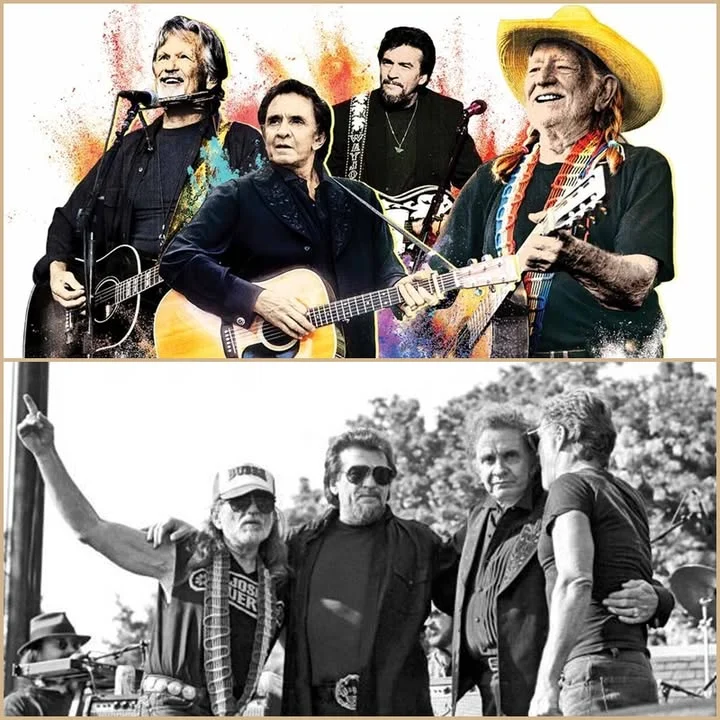
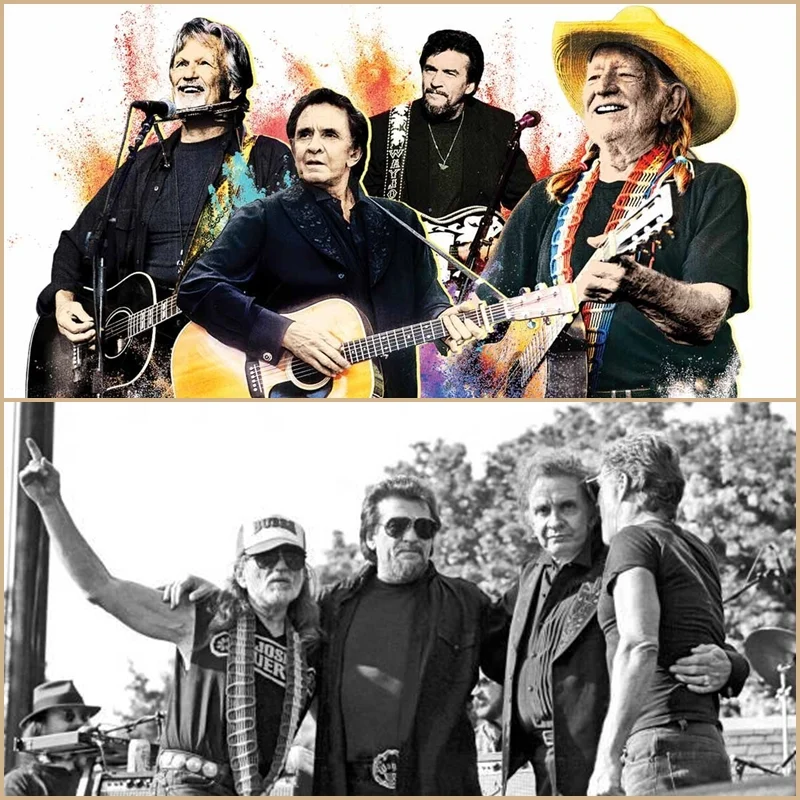
In the heart of the 1980s, four titans of American music made a choice that defied every rule of the industry: they stood in a straight line, no one first, no one last. Johnny Cash, Waylon Jennings, Willie Nelson, and Kris Kristofferson—names that alone could fill arenas—chose to share the spotlight as The Highwaymen, a band born not from commerce but from a moment of pure artistic connection.
The story begins in 1984, not in a boardroom, but in a Swiss hotel room. The four men had gathered to film a Christmas special for Cash, and after the cameras stopped rolling, guitars came out. In that impromptu jam, they discovered something rare: their voices and personalities melded with a natural ease. What started as a casual hangout soon became a vision—a supergroup where ego was set aside and collaboration reigned supreme.
But the real forging of their bond happened in 1985 at a Nashville studio, under the guidance of producer Chips Moman. These were four famously stubborn outlaws, each accustomed to total control. To make them a unified front, they had to surrender something deeply personal: the need to be the star. The defining test came with their debut single, a Jimmy Webb song brought to them by Marty Stuart. Rather than fight over the lead vocal, they dove into the lyrics and divided the verses to match their own voices and life stories. Nelson took the opening outlaw, Kristofferson the wandering sailor, Jennings the dam builder, and Cash anchored it as the starship captain. They became character actors in a shared narrative—no separate booths, no ego trips, just four men serving the song.
That trust carried straight to the stage. On tour, they split every classic anthem into four-way conversations, turning hits into dialogues rather than solos. They were no longer a lead singer with three famous backers; they became a single, breathing unit. For men who had spent decades bearing the weight of entire arenas alone, this was a refuge. A legend could finally lean back and simply be a musician again, knowing his peers had his back.
Audiences saw more than a supergroup. They witnessed quiet, profound loyalty in real time. When one of them hit a rough vocal patch or forgot a lyric, the others stepped in without a beat of hesitation. A tilted head yielding the tempo, a tipped hat across the stage, the silent pride of an old friend taking the solo—these small gestures defined their live shows.
“They proved that the heaviest crowns are best worn lightly among peers.”
The Highwaymen left behind more than albums and sold-out tours. They left a masterclass in brotherhood—a lasting lesson that even the most solitary outlaws eventually need a place to belong. In the end, their greatest legacy wasn’t the music they made together, but the way they made it: as equals, forever.