
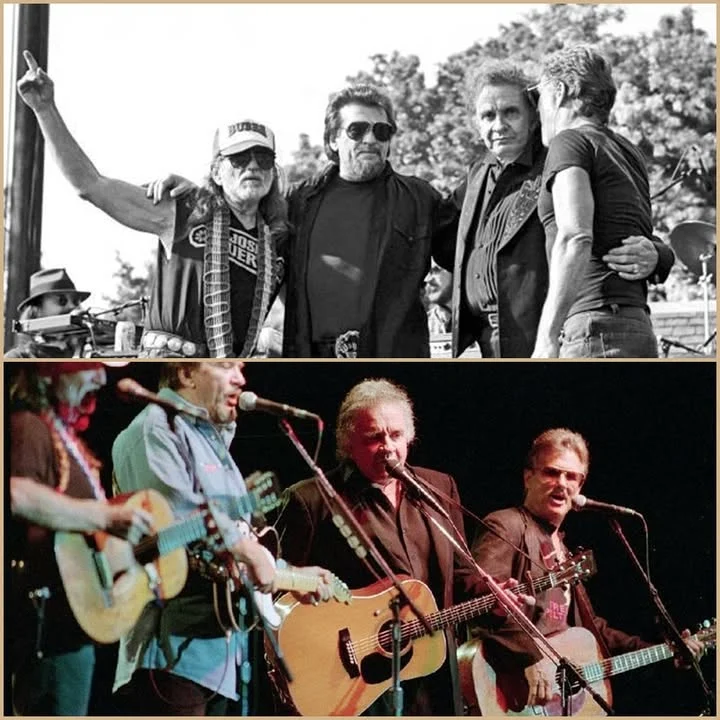
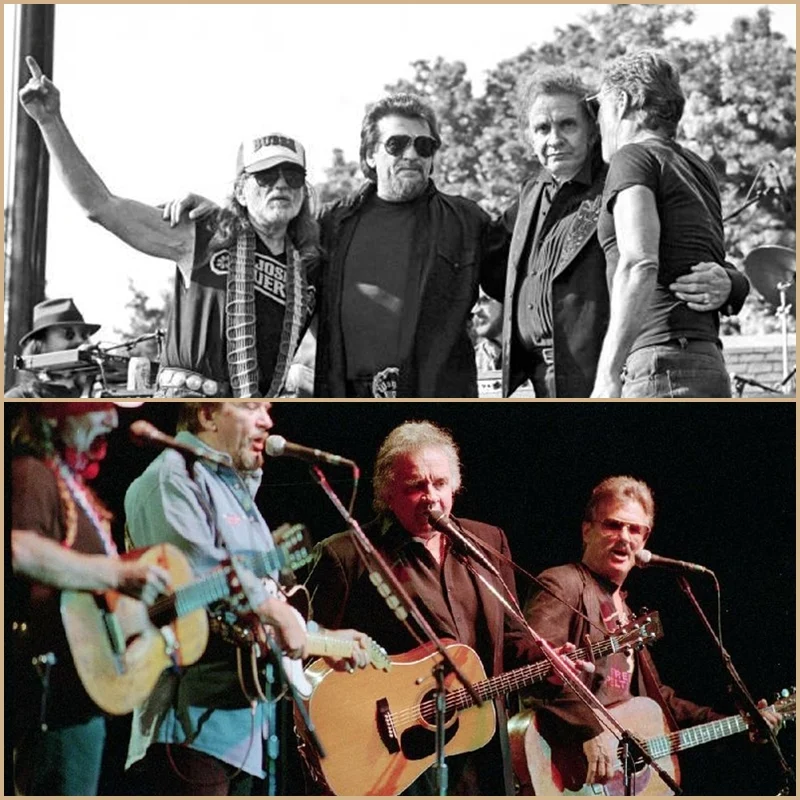
On a winter night in Montreux, four of country music’s most independent voices stopped fighting for the spotlight. They passed an acoustic guitar around a Swiss hotel room and found something the charts could not give them. Rest. Brotherhood. A reason to keep going.
The scene began with a television job. In 1984 Johnny Cash invited Waylon Jennings, Willie Nelson and Kris Kristofferson to Switzerland to film his annual Christmas special. All four were already icons with unmistakable voices. They were also facing a hard shift in Nashville. The establishment that once resisted their outlaw reputations and later profited from them was turning toward younger, more polished voices. The men were aging, carrying old health struggles and decades of road wear. The industry seemed ready to treat them as relics.
After the cameras stopped, the four men gathered in a hotel room in Montreux. They sat together, passed an acoustic guitar back and forth and played songs they had known for years. For decades each had been a frontman carrying his own show and his own massive career. In that room the competition faded. They realized they wanted to make a record together. They did not yet know how four distinct lead singers would share a single track.
When they met at Chips Moman’s Nashville studio in December 1984, the problem became clear. Cash’s booming baritone, Nelson’s jazz-inflected phrasing, Jennings’ driving grit and Kristofferson’s gravelly storytelling did not fit the tight harmonies of most country vocal groups. After a couple of days the session was struggling to capture the magic they had felt in Switzerland.
Then Marty Stuart, a young mandolin and guitar player in Cash’s band, offered a solution. He remembered a 1977 song by Jimmy Webb called Highwayman. The track had four verses about a single soul reincarnated through time. It needed four distinct characters. It needed no harmony at all.
The song did not ask them to blend. It asked them to stand as four separate lives and let the story move through each voice.
The roles fell into place. Willie Nelson took the first verse as an outlaw robbing travelers on the old roads. Kris Kristofferson sang as a sailor on the sea. Waylon Jennings became a construction worker building the Hoover Dam. Johnny Cash claimed the final verse as a starship captain exploring the edges of the universe.
The song gave them more than a creative fix. It gave them an identity. Released in spring 1985, their version of Highwayman went straight to number one on the country charts. The success convinced four fiercely independent stars to commit to a decade-long recording alliance. As The Highwaymen they released three studio albums and played sold-out tours around the world.
The stage dynamic was plain to anyone watching. Nobody fought for the center microphone. They stepped back, played rhythm guitar and smiled while the others took their turns in the spotlight. Behind the public personas, the group became a sanctuary where four veterans could rely on one another and shield each other from an industry that often forgets its pioneers.
Jennings died in 2002 and Cash died the following year. Their passing permanently closed the circle. The shared catalog now stands as a completed era.
They began as rebellious outsiders who fought the system for creative space. Their final act of defiance was proving they did not have to stand alone to remain relevant. A song about reincarnation gave them a name. Their willingness to share the stage gave country music a legacy that will never be duplicated.