
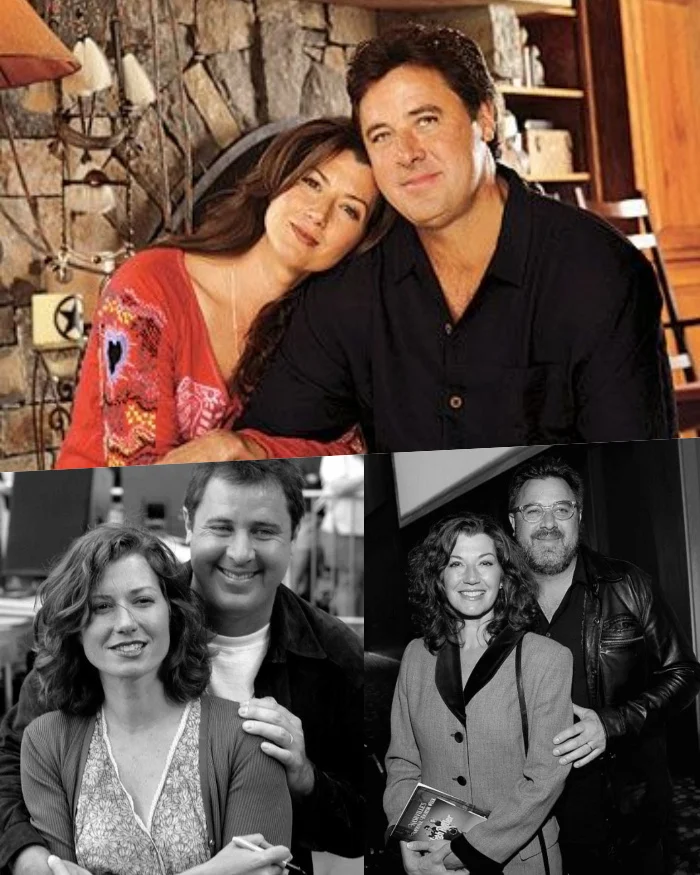

The scar down Amy Grant’s chest is more than a mark of survival. It is a permanent record of a marriage vow lived out in a Nashville farmhouse, one painful step at a time.
That visible line tells a story that began in early 2020, when Grant accompanied her husband Vince Gill to a cardiology appointment in Nashville. The visit was meant to check Gill’s health. Dr. John Bright Cage examined Gill, gave him a clean bill of health, and then turned his attention to Grant. Even though she showed no obvious symptoms, the doctor insisted on running tests on her.
The results uncovered a congenital heart defect called PAPVR, or Partial Anomalous Pulmonary Venous Return. Since birth, Grant’s blood had been routing incorrectly through her chest. Her heart had been working twice as hard for six decades just to keep her standing. She had blamed her periodic exhaustion, dizzy spells, and shortness of breath on a grueling touring schedule and the natural process of getting older. In truth, she had been living with a ticking time bomb.
By June 3, 2020, during the quiet isolation of a global pandemic, Grant was taken into an operating room for emergency open-heart surgery to reroute her blood flow. For decades she had used her voice and guitar to comfort millions of listeners. Now she had to lie still under surgical lights while medical hands repaired the center of her own body.
For the first time in her life she would learn what proper oxygenation and normal blood flow actually felt like.
When Grant returned to the couple’s Nashville farm, Gill immediately cleared his work schedule. The country music legend stepped away from his own musical commitments and the spotlight to become her full-time caregiver. He fed her, managed her needs, and physically supported her weight as she took her first painful steps across the living room.
Grant later shared raw photos of the long incision down her chest. She refused makeup or staging to hide the physical cost of her survival. The scar remains a permanent record of their marriage vows in action. Yet the quiet months of recovery revealed a much longer journey as she learned to navigate her newly repaired heart.
She defied medical expectations by leaving the hospital in three days and began a steady 14-week rehabilitation period at home. During those quiet months, Grant experienced a profound revelation. The irregular heartbeat and shortness of breath she had always known had vanished. The physical toll of major surgery, however, left her core strength depleted, a difficult reality for a vocalist who relied on her diaphragm to perform.
Knowing she could not endure traditional high-impact workouts, Grant found healing in the water. She spent hours swimming laps in the pool, using the weightlessness of the water to slowly rebuild her lung capacity without putting undue stress on her healing chest. She turned the daily routine into a quiet meditation, dedicating each stroke to her children and praying for the medical staff who had saved her. With every lap, she taught her repaired heart how to sustain her body and gradually reclaimed the vocal stamina she feared she had lost.
The surgery did not just save her life before it was too late. It gave her a physical resilience she had never truly experienced. The heavy exhaustion she once fought through on stages across the country was replaced by a quiet, steady strength.
Her recovery was not simply about returning to the microphone to sing another song. It was a testament to a timely intervention, a husband’s unwavering presence in the darkest moments, and the profound grace of finally learning to breathe freely.