
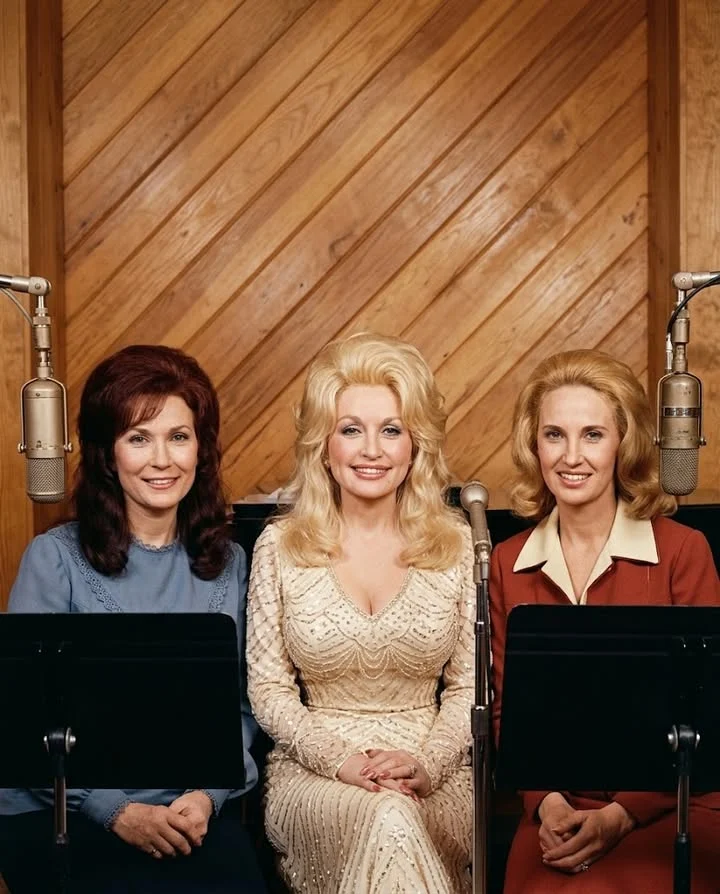
Loretta Lynn stood in the recording studio, listening to a voice from beyond the grave. It was Patsy Cline, her mentor and friend, singing “Lovesick Blues” as if she were right there in the room. Thirty years had passed since Cline’s death, but her voice was as clear and powerful as ever. Lynn was not alone. Beside her stood Dolly Parton and Tammy Wynette, three of country music’s biggest stars. They had come together to sing with a ghost.
By the early 1990s, Nashville’s sound was shifting toward slick commercialism. Radio programmers were pushing veteran female artists aside in favor of younger stars. In response, Dolly Parton, Loretta Lynn, and Tammy Wynette decided to join forces. They recorded the album Honky Tonk Angels to celebrate the unvarnished roots of country music and to prove that their sisterhood was stronger than any manufactured rivalry. For decades, the industry had operated on an unwritten rule that female singers had to compete for a single spot on the charts. Parton, Lynn, and Wynette had survived that system, selling millions of records and building international empires.
As they selected classic country standards for the album, the trio realized their celebration of female pioneers would be incomplete without one specific voice. They wanted to honor Patsy Cline. Cline had died in a tragic plane crash in 1963, leaving behind a legacy that fundamentally changed how women were treated on Music Row. For Lynn, the connection was deeply personal. When Lynn was an overwhelmed newcomer trying to navigate Nashville, Cline ignored the industry’s competitive standards. She stepped in as a fiercely protective mentor. Cline taught the younger singer how to demand respect from record executives, drove her around town, and even physically handed down her own stage clothes so Lynn would look the part of a star.
Thirty years after that devastating loss, the three living legends decided to bring Cline into their historic project. They secured the original 1960 master recording of Cline performing “Lovesick Blues.” Using studio technology that was highly advanced for the era, engineers painstakingly isolated Cline’s original lead vocal. They stripped away the old backing instrumentation, leaving her pristine, powerful voice standing entirely alone in the modern mixing room. For the women standing in the studio, the playback was an overwhelming experience. Lynn was suddenly forced to listen to the isolated voice of her old friend echoing clearly through the monitors, completely untouched by time.
The emotional weight in the room grew so heavy that Lynn eventually broke the tension with her trademark blunt humor.
“Patsy’s spirit is in this room haunting us,” she joked to the producers.
When it came time to record their contributions, Parton, Lynn, and Wynette made a deliberate artistic choice. They were all powerhouse vocalists accustomed to carrying their own stadium shows, but they did not attempt to outsing the archival track. Instead, they arranged their voices to wrap carefully around Cline’s lead. They traded verses and built a lush, three-part harmony specifically designed to support the pioneer who was no longer there. The recording process became a masterclass in respect, bridging a three-decade gap to create a seamless collaboration between the living architects of modern country music and the woman who had first cleared their path.
The Honky Tonk Angels album went on to achieve Gold certification, proving that the public was deeply hungry for their traditional sound. It stood as a commercial triumph for three veterans who refused to quietly fade into the background of a changing industry. Yet the defining legacy of the project was forged in that quiet studio room. Parton, Lynn, and Wynette had spent their entire careers proving they could stand alone under the brightest lights. But on that one track, they proved that a pioneer’s voice never really fades, as long as the women who follow are willing to stand back and sing the harmony.