
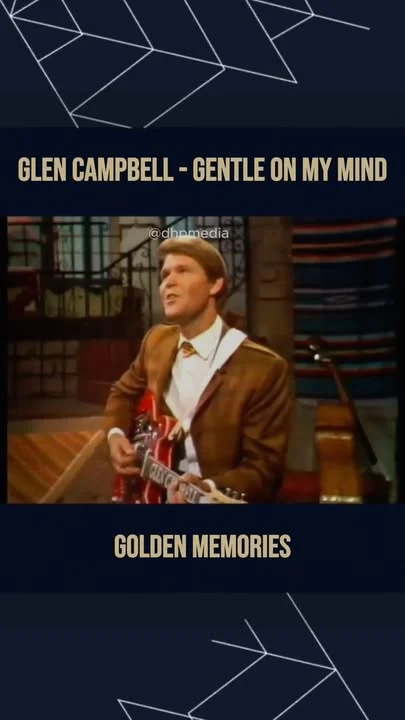
There are songs that simply play in the background. Then there are songs that settle into the softest corners of your memory, refusing to fade. Glen Campbell’s 1967 rendition of “Gentle On My Mind” is one of those rare, enduring pieces. It is a gentle, quiet masterpiece that has comforted generations, a tune that feels less like music and more like a warm, familiar thought. Over fifty years later, its power remains undiminished. It speaks of a love that is not possessive, a freedom that is not lonely. And it all began with a moment of inspiration from a movie screen.
It’s knowing that your door is always open and your path is free to walk
The song was written by John Hartford, a gifted banjo player and songwriter, who watched the film Doctor Zhivago and was struck by a specific kind of love. Hartford spent only a few minutes writing the lyrics after leaving the cinema. He captured a bond that was never fully realized yet remained deeply intimate. The narrator of “Gentle On My Mind” is a wanderer. He carries no possessions, only memories. He is unshackled by forgotten words, comforted by a door that is always open. In Hartford’s original vision, the love is a backdrop, always present but never demanding.
When Glen Campbell recorded the song, he did not just sing the words. He inhabited them. His voice was smooth and warm, carrying both strength and a tender vulnerability. Campbell did not dramatize the lyrics. He let them breathe. The result was a performance that felt like a quiet conversation with an old friend. The song became his signature. It earned him multiple Grammy Awards, including Best Country and Western Solo Vocal Performance, and quickly crossed over from country to folk and pop audiences.
The musical arrangement itself is a blend of country and folk with a touch of bluegrass. It opens with a lively guitar riff that feels like the start of a journey. The banjo, played by Hartford himself, adds a rustic texture that sets the song apart from the polished Nashville sound of the era. The gentle interplay of acoustic and electric instruments creates a flowing, riverlike soundscape. It perfectly mirrors the lyrics about walking along backroads and rivers of memory. The song does not rush. It glides.
One of the most remarkable aspects of “Gentle On My Mind” is its universal appeal. The song has been covered by artists as varied as Elvis Presley, Aretha Franklin, and Dean Martin. Each version brings a new flavor, yet Campbell’s remains the definitive take. It captures a balance of independence and affection that is rare in popular music. The narrator does not cling. He does not ask for permanence. He simply holds the memory of a loved one, knowing that the world will not curse or forgive him when he walks along a railroad track and finds that memory waiting for him.
The cultural impact of the song extends far beyond the charts. It has appeared in films, television shows, and commercials. It has become a touchstone for anyone who has loved someone from a distance or carried a fond memory of a person or place they can no longer reach. In a world that often feels rushed and crowded, “Gentle On My Mind” offers a rare moment of stillness. It reminds us that love does not always need to be held tightly. Sometimes the gentlest love is the one that stays with us, ever smiling, ever gentle on our minds.
For Glen Campbell, this song solidified his place in American music history. It showcased his versatility and his ability to convey profound emotion without overstatement. It also highlighted Hartford’s brilliance as a lyricist. The song’s imagery is both rustic and poignant. Lines about sleeping bags stashed behind a couch and a dirty hat pulled low across the face paint a vivid picture of a life lived on the edges of society, yet rich with inner meaning. The narrator finds warmth in memory, not in possession. He dips his cup of soup from a train yard cauldron and pretends to hold his love close. It is a moment of quiet beauty.
“Gentle On My Mind” endures because it captures something real and honest. It speaks to the value of slowing down, of cherishing memories, of holding something gently in our minds as we move forward. In the late 1960s, a time of social upheaval and change, this song stood out for its introspective calm. Today, that calm is even more precious. It is a song for anyone who has ever known the comfort of a memory that will not let go. It is a testament to simplicity and sincerity in music, a quiet masterpiece that belongs to everyone.
As the narrator moves through wheat fields and junkyards, through summer heat and silent tears, the love remains. It is waiting from the backroads, by the rivers of memory. It is ever gentle on his mind. And for us, the listeners, it remains just the same. A gentle thought. A timeless song. A piece of American soul that never grows old.