
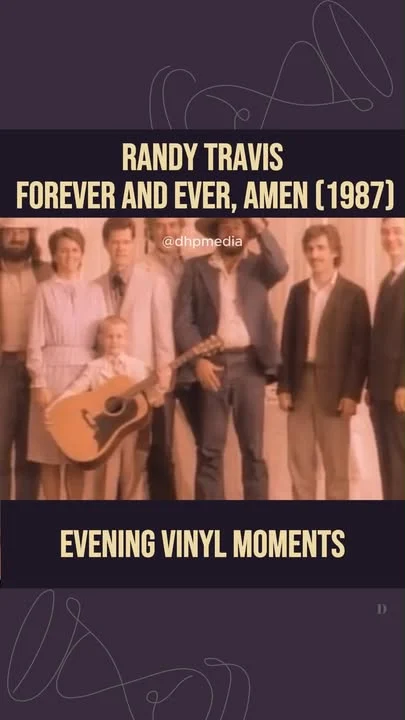
Some promises are made to be kept. Some are sung in a voice so sincere that the whole world stops to listen.
In 1987, Randy Travis gave country music one of its most enduring declarations of love with “Forever And Ever, Amen”. It begins with a line that sounds simple at first, but carries the weight of a lifetime. “I’m gonna love you forever and ever” is not just a lyric. It is a vow wrapped in a melody, delivered with such honesty that it feels less like a performance and more like a confession.
Travis placed the song on his album Always & Forever, and it did not take long for listeners to realize they were hearing something special. The song was written by Paul Overstreet and Don Schlitz, two songwriters who understood that real love is not about perfection. It is about staying. The verses speak of life’s inevitable storms, of sunshine and rain, of good times and hard times. There is no fantasy here. There is only a promise to remain.
Part of what makes the song so powerful is its deliberate simplicity. The arrangement stays out of the way, with little more than acoustic guitar, gentle piano, and subtle percussion. That leaves the listener alone with Travis’ voice, and his voice is more than enough. Every syllable feels earned. When he sings about love being the reason for living and the air he breathes, you believe him completely.
“You’re the reason for my livin’, you’re the air that I breathe.”
There is a gospel-like quality to the repeated phrase “Forever and ever, Amen.” The word Amen does not belong only to churches. In this song, it becomes a seal on a sacred promise. It gives the narrator’s words the weight of a prayer, suggesting that the love he describes is not merely emotional but spiritual. That depth helped turn the song into an anthem for couples of every age and stage of life.
The industry took notice. “Forever And Ever, Amen” became a massive hit and earned a Grammy Award for Best Country Song. It solidified Randy Travis as one of the most authentic voices in the genre and gave country music a benchmark for what a love song could achieve. Yet the song never feels dated. If anything, it grows more meaningful with every passing year.
It remains a song for wedding dances, for quiet radio moments, and for anyone who has ever dared to promise another person forever. The beauty of it lies in its refusal to exaggerate. The narrator does not claim the road will be easy. He simply commits to walking it. That is the kind of love that outlasts everything.
So when the final note fades and the word Amen lingers, the message stays with you. True love is not a fleeting emotion. It is a decision, made once and renewed every day. And in this timeless ballad, Randy Travis turns that decision into music that will never stop echoing.