
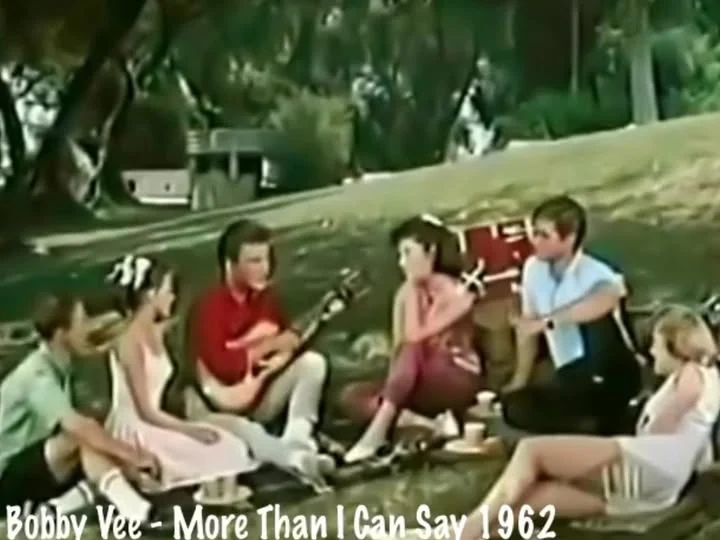
There is a moment in every oldies listener’s life when the past doesn’t feel like a faded photograph but a living, breathing room. It happened to me not long ago on a rainy stretch of coastal highway. The car radio, stuck on a station that time forgot, crackled to life with a bright, unyielding rhythm that cut through the grey afternoon. That song was Bobby Vee’s “More Than I Can Say,” and for a few minutes, the 1960s were not a history lesson but a vivid, winking presence.
Bobby Vee, born Robert Velline, occupies a curious place in rock & roll lore. His rise to fame was tethered to tragedy: he was the local musician who stepped in after “The Day the Music Died,” the plane crash that claimed Buddy Holly, Ritchie Valens, and the Big Bopper. That backstory gave Vee’s otherwise clean-cut image an unexpected depth, a quiet dignity that ran beneath every polished pop single he released on Liberty Records. The man who briefly filled Holly’s shoes would go on to create a sound that defined early 1960s teen culture.
Every sweetly strummed chord and breathy vocal seemed to carry the echo of a lost friend, a torch passed from a rock-and-roll pioneer to his accidental successor.
The mastermind behind that sound was producer Tommy “Snuff” Garrett, a Brill Building-era craftsman who knew how to take a simple melody, polish it to a mirror shine, and wrap it in a sophisticated yet driving arrangement. “More Than I Can Say” is not just a hit; it is a case study in Garrett’s philosophy. The song was written by Jerry Allison and Sonny Curtis, both former members of Buddy Holly’s band, The Crickets. That lineage gives Vee’s version an almost spiritual weight: the torch passed from the pioneering Holly to the young man who briefly took his place onstage.
What makes this recording sing decades later is the way it balances raw energy with glossy West Coast pop refinement. The rhythm section is tight and syncopated, the drums bright and urgent without ever becoming chaotic. A robust acoustic guitar provides the rhythmic scaffolding, strumming a confident, unfaltering chord progression. Over it, a clean electric guitar weaves in subtle fills — brief bursts of twang and sustain that nod to the rockabilly roots while leaning into the future. The instrumental break is a compact burst of energy, showcasing session players who blend rock-and-roll propulsion with studio polish perfectly.
The arrangement’s true sophistication, though, comes from the orchestrated backing. The strings do not swoop in as a saccharine afterthought; they enter in the verses as a brief, soaring counter-melody that lifts the emotion without overwhelming the beat. A low-register piano occasionally punctuates the rhythm, adding a percussive warmth that grounds the entire track. This is pop music designed for both the teenager dancing in a living room and the adult listening on premium hi-fi equipment.
At the emotional heart of the song is that unforgettable, wordless hook: the “wo-wo yay-yay” chorus that serves as a crescendo — a pure, wordless expression of love. It is a moment of genius restraint, a melodic phrase so universal it needs no lyrics. The chorus feels less like a manufactured hook and more like a collective sigh of inexpressible feeling.
The wordless hook is a rare instance where the music speaks what the lyrics cannot — a perfect marriage of rock-and-roll energy and studio craftsmanship.
Transatlantic Tastes and a Double-Sided Hit
The chart performance of “More Than I Can Say” reveals a fascinating divide. In the United States, where Bobby Vee had already scored massive hits like “Devil or Angel” and the career-defining number-one “Take Good Care of My Baby,” this song was a more modest entry, climbing into the lower half of the Billboard Hot 100. But across the Atlantic, it was a sensation. Paired with the B-side “Stayin’ In,” it became a double-sided hit, peaking within the Top 5 on the UK Singles Chart in 1961. This success solidified Vee’s status as a true international teen idol — a heartthrob whose clean image and catchy melodies resonated powerfully with British audiences looking for an American sound slightly sweeter than Elvis Presley.
The song’s legacy rippled forward. When Leo Sayer revived it in 1980 for a massive global hit, the original arrangement still informed the spirit of his recording — a testament to the timeless strength of the melody that Allison and Curtis forged and that Vee and Garrett polished to a gleam. Every budding singer learning to interpret an old standard should study this 1961 version as a masterclass in economy, emotion, and era-defining production.
A Living Photograph
The beauty of this enduring track is its capacity to transport. Picture a high school sock hop: a darkened gym, the scent of popcorn and hairspray heavy in the air, the bright thrum of a guitar cutting through the chatter. For three minutes, every young couple is lost in the moment. That feeling translates even today. I watched a group of college students in a café, comparing notes for their piano lessons, stop mid-sentence when a cover of the song drifted from the speakers. The joy is infectious and undeniable, a simple melody bridging generational divides.
So turn it up. Let the wo-wo yay-yay do the talking. In a world of noise, this three-minute gem still holds the secret to saying more than words ever could.