
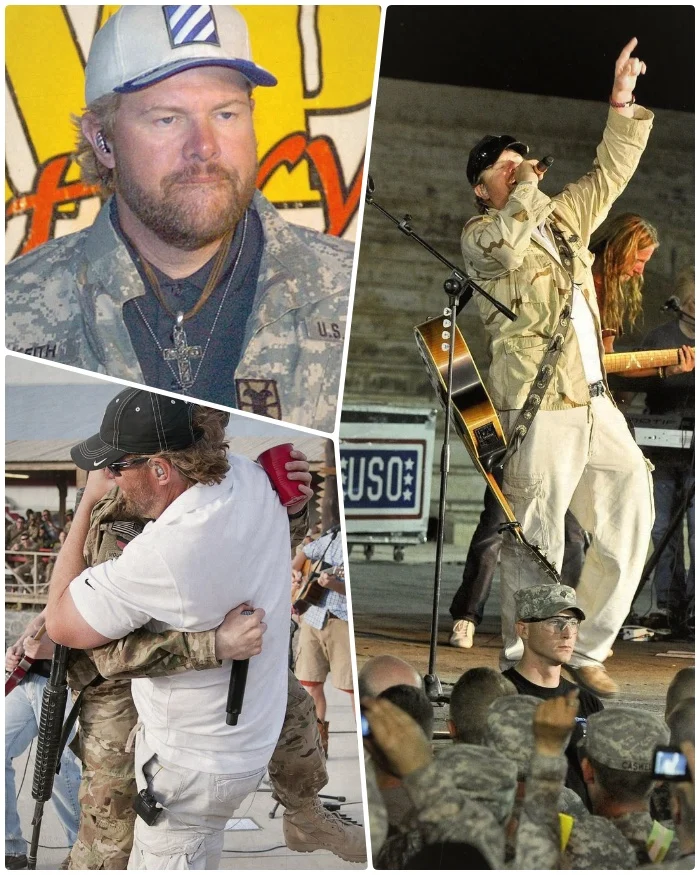
In the dust of FOB Sharana, wounded warriors sat in the front rows and lifted their crutches high into the air as music rose around them. Just moments earlier, a commanding general had pinned 26 Purple Hearts on soldiers who had paid a terrible price for their service. Then a country star with an acoustic guitar stepped forward and turned a remote outpost into a place of joy, pride and home.
That powerful scene captured the heart of Toby Keith and his seventh USO tour in the spring of 2009. Across Afghanistan, he performed 15 shows in only five days, a pace that would have exhausted even the most seasoned performer. Yet the biggest crowds were never the whole story.
At large installations like Bagram Air Field and Kandahar, thousands of service members gathered for the roaring concerts he was famous for back home. They raised red Solo cups filled with fruit smoothies in the dry country and swayed as if they had been transported to a summer festival far from war.
Keith loved those moments, but he wanted more. He urged USO organizers to change his schedule and look past the heavily fortified hubs toward the most dangerous and isolated edges of the war zone. He was determined to reach the troops who almost never saw a civilian visitor, let alone a music icon.
Reaching them meant breaking the usual rules of entertainment logistics. Organizers described the plan as a three-pronged attack. While his main crew remained behind to build the massive stages at the larger bases, Keith slipped away with a small skeleton team and a far simpler mission.
Wearing body armor, he climbed aboard smaller helicopters and flew through hostile airspace. Apache and Cobra gunships crossed behind him, guarding his path as he headed for outposts like FOB Tillman and FOB Boris near the Pakistan border. In those camps, troops lived without running water and had not enjoyed outside entertainment for more than six months.
There were no VIP barriers waiting for him at those stops. There were no elaborate lighting rigs and no media cameras. Keith simply stood on dirt ground and on the beds of transport trucks, holding nothing but a single acoustic guitar, and sang with the same fire he brought to arenas back home.
He did not just bring them a song. He brought them a piece of home.
He ate standard-issue MREs beside the troops and sat shoulder to shoulder with men and women who carried the daily weight of isolation. When the last acoustic note faded, the soldiers gave him far more than applause. They pressed unit patches into his hands, offered Cuban cigars and opened up in quiet conversations about the heavy toll of deployment.
Those honest stories stayed with him. They gave him the firsthand understanding that had always shaped his deepest tributes to the military. For Keith, gratitude was not an abstract idea. His father had been a soldier, and he had learned early that freedom demanded a physical and tangible form of thanks.
The contrast was staggering. The same man who routinely commanded 50,000 screaming fans in stateside arenas poured that exact energy into performances for only 50 dust-covered service members. He traded the safety of five-star hotels and massive stages for sandstorms, danger and dirt floors because those soldiers mattered just as much.
He did not make that journey for public relations. He made it so the most exhausted and remote units could look him in the eye and know they had not been forgotten by the country they were fighting for. His legacy was never measured only by the size of a crowd. It was measured in those quiet moments at the edge of the map, where a song became a reminder of home and a piece of his own heart stayed behind in the dust beside them.