
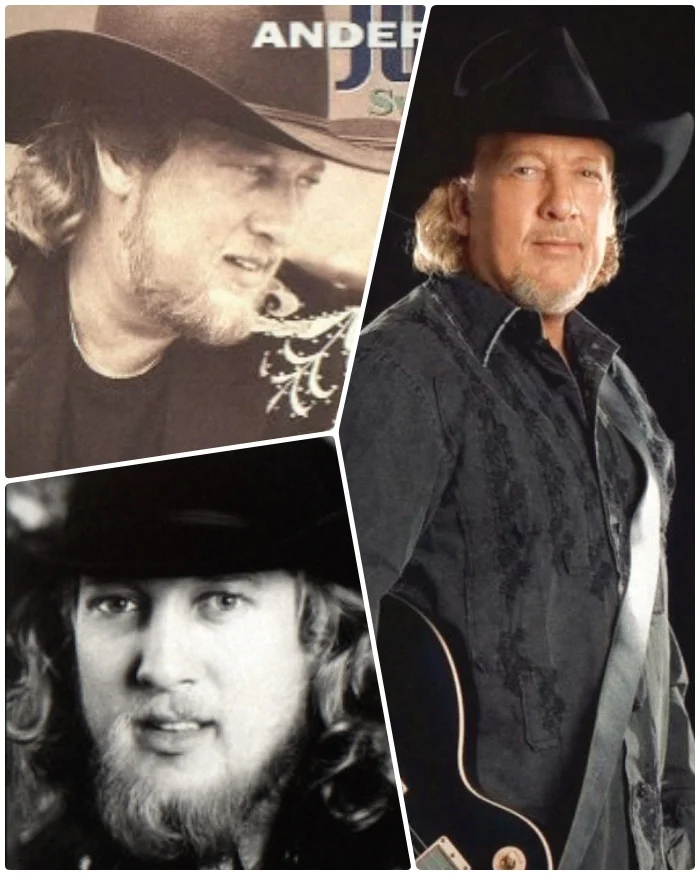
Ten years after he hauled roofing materials on Nashville construction sites by day and sang in Lower Broadway bars by night, John Anderson walked onto the Grand Ole Opry stage on October 10, 1983, and lifted two of the biggest honors of the night at the 17th Annual CMA Awards. Yet in that triumphant moment, his mind drifted back not to the bright lights or the applause but to a modest living room where he and his closest friend had once pieced together a playful tune with acoustic guitars in hand.
That tune was ‘Swingin” and by March 26, 1983, it had already rewritten the record books. It reached No. 1 on the Billboard Hot Country Singles chart, crossed over to No. 43 on the all-genre Billboard Hot 100, and sold more than one million physical 45-rpm copies to earn an RIAA Gold certification and become the best-selling country single in Warner Bros. Records history up to that time.
The story began quietly during the lean years before Anderson became a household name. He wrote the song beside Lionel Delmore, his trusted creative partner and closest friend and the son of Grand Ole Opry pioneer Alton Delmore of the legendary Delmore Brothers. Sitting together at home, the two friends built the verses quickly, sketching a lighthearted picture of everyday Southern family life where parents and relatives and young sweethearts gathered around a front-porch swing. They were not chasing an industry formula. They were simply trying to capture the rhythm and humor of the people they knew.
When Anderson carried the song into the Nashville studio for his 1982 album ‘Wild & Blue’, veteran producer Frank Jones helped him shape an arrangement that broke sharply with early 1980s radio conventions. Blending western swing and early rockabilly with a prominent saxophone solo and a steady foot-stomping beat, the recording stood in bold contrast to the smooth Urban Cowboy sound then favored by major labels.
Before the record was released as a single in January 1983, several Music Row executives and radio programmers hesitated. Some questioned whether country listeners would accept a horn solo on a traditional singer’s record, while others wondered if Anderson’s exaggerated vocal bend on the chorus and the heavy Apopka, Florida drawl he leaned into on the title word were too eccentric for mainstream airplay.
Anderson refused to sand down his delivery. Having lived the working life himself, he knew that his phrasing reflected the real voices of the working people who bought country records, and for him that working-class inflection was simply how people talked back home.
He refused to smooth away the voice that working people recognized as their own.
Once DJs began spinning the 45, station switchboards lit up from coast to coast. Truck drivers, factory workers, construction crews, and Saturday-night dance hall regulars flooded request lines, while a playful music video filmed on a baseball diamond brought Anderson into heavy rotation on both CMT and MTV.
On October 10, 1983, exactly a decade after working as a teenage laborer on the unfinished roof of the Grand Ole Opry House, Anderson accepted the Horizon Award for best new career growth, and ‘Swingin” won Single of the Year, sharing the stage’s songwriter recognition with Delmore.
That breakthrough was only one chapter in a thirty-year songwriting brotherhood. Before Lionel Delmore passed away in May 2002 at age 62 from heart bypass complications, he and Anderson penned dozens of songs together, including the reflective 1982 favorite ‘I Just Came Home to Count the Memories,’ the 1984 Top 15 single ‘She Sure Got Away with My Heart,’ and the 1993 chart-topper ‘Money in the Bank.’
Decades later, as Anderson entered the Nashville Songwriters Hall of Fame and the Country Music Hall of Fame in 2024, ‘Swingin” remained the signature moment of his catalog. Yet for the singer himself, the platinum plaques and television trophies never outweighed the memory of the friend sitting across the room when the song was born.
A living room tune that Nashville nearly passed over ended up changing the sound of 1980s country radio, and more than forty years later every chorus still carries the friendship of the two men who wrote it.
More than forty years on, that friendship still echoes in every stomping beat, every honky-tonk piano run, and every stretched-out chorus that invites listeners to swing along.