
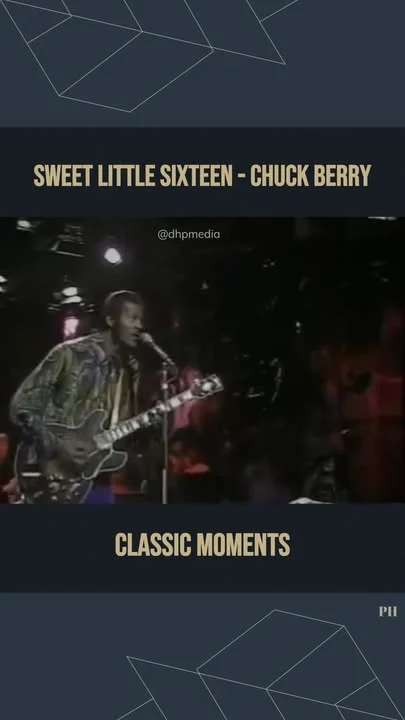
She’s got the grown up blues. Tight dresses and lipstick. She’s sportin’ high heel shoes. But tomorrow morning she’ll change her trend and be sweet sixteen and back in class again.
These lyrics, sung by a man in his early thirties, captured the entire turbulent universe of American adolescence in 1958. Chuck Berry didn’t just write a song with Sweet Little Sixteen. He assembled a time capsule, a three-minute novel about the ecstasy and anxiety of growing up in a nation discovering its own rebellious heartbeat. The track wasn’t merely played; it was experienced, a sonic passport to a world where school halls gave way to dance floors and the local bandstand became a temple of liberation.
The first time I truly heard this piece wasn’t on a pristine vinyl pressing but through a crackling jukebox speaker in a diner that smelled of burnt coffee and fried eggs. The needle dropped, the double-stop guitar riff cut through the stale air, and the entire room seemed to inhale. That is the enduring magic of Berry’s craft. It demands stillness and then, immediately, movement.
The Man Who Scripted a Generation
By January 1958, Chuck Berry had already claimed his throne. Hits like Maybellene and School Day had established him as rock and roll’s first great storyteller, the poet who transformed cars, classrooms, and teenage crushes into vivid, unforgettable fables. Sweet Little Sixteen arrived at the absolute apex of his creative power, serving as the explosive prelude to Johnny B. Goode, which would follow just months later. Produced by the legendary Leonard and Phil Chess, the recording carried the unmistakable grit of Chicago. It was a clean sound, yes, but not sanitized. It retained the raw, breathing energy of the small club where it was captured.
The track was released as a single and soon found its home on the album One Dozen Berrys, a collection that demonstrated Berry’s remarkable consistency. He wasn’t a one-hit wonder chasing lightning. He was an architect building a cathedral of sound.
The Anatomy of an Attack
The structure of Sweet Little Sixteen is deceptively simple. A brisk, driving shuffle built on a twelve-bar blues foundation, yet it feels entirely pop-ready. The song doesn’t explode. It breathes. A sharp intake of air signals the rhythm section to enter. The drums lock into a steadfast backbeat that acts as the absolute bedrock. The bass line, deep and mobile, anchors everything to the floor.
Then comes the indispensable collaboration between Berry and his longtime partner, Johnnie Johnson. Johnson’s brilliant, rolling piano figures provide the secondary engine of the track. They aren’t mere accompaniment. They are a constant, rippling counterpoint to the vocal and guitar, linking this new rock sound back to its rhythm and blues roots. Listen closely to the brief break where the piano takes the lead—an effortlessly cool flurry of notes that contrasts perfectly with the sharp edges of the guitar. This masterful interplay is a clinic for anyone seeking advanced piano lessons.
Berry’s guitar performance on this track is one of his most iconic. His famous double-stop intro riff, a sequence of notes played simultaneously on two strings, is instantly recognizable, a thrilling blend of country twang and blues phrasing. His solo, though brief, is a marvel of economy. It leaps out with a bright, clean timbre. Each note is articulated with distinct attack and sustain, avoiding unnecessary flash for pure, melodic propulsion. This solo is pure narrative. It doesn’t wander. The acoustic space captured on the recording suggests a tight room, the close-miking allowing the percussive attack of the instruments to cut through with palpable immediacy. Even today, listening on quality premium audio reveals layers of detail in that rhythmic push and pull.
The Poet of Adolescence
What truly separates Berry from his contemporaries is his lyrical vision. He doesn’t just sing about teenagers. He adopts their vernacular, inhabiting their precise world with ethnographic precision. The lyrics of Sweet Little Sixteen are a panoramic sweep of the early rock and roll circuit, moving from town to town—from Philadelphia to St. Louis to New Orleans—cataloging the anxieties and triumphs of a girl obsessed with meeting her favorite star. She is tossing and turning, all dressed up like a queen, and always too young to be sixteen.
Chuck Berry didn’t just write rock and roll songs. He wrote the script for the aspirational teenage experience, giving their fleeting moments of rebellion a sense of genuine, national importance.
The song’s tension comes from this contrast. The girl’s frenzied, almost desperate search for connection with her idols, set against the track’s disciplined, airtight musical foundation. It’s a beautifully controlled chaos, much like the life of a teenager trying to navigate an adult world. He validates their desire to escape the confines of school and home, celebrating the communal, almost religious fervor of the concert hall. The song acts as a sonic bridge, connecting the regionalism of rhythm and blues to the unifying, national language of pop.
This narrative focus on the American teenager—their clothing, their rituals, their consumption of pop culture—was a direct line to his massive crossover success. He was telling stories about an experience that was rapidly becoming universal in the late 1950s, bridging the racial divides that still structured much of American life. The success of this single, reaching high on both the R&B Best Sellers chart and peaking at number two on the Billboard Hot 100, is quantifiable proof of that universal appeal. It was a shared soundtrack for a generation.
Even in our current age of fragmented music streaming subscription models, where discovery is algorithmically dictated, a song this vibrant cuts through. It is an artifact of pure, unadulterated excitement, a reminder that the best music is always about movement—physical, cultural, and emotional. The enduring simplicity and perfection of that guitar’s voice ensures that even over six decades later, the sweet, restless spirit of that sixteen-year-old girl is forever preserved on tape. It is, quite simply, an essential listen.
Listening Recommendations
- Chuck Berry – Johnny B. Goode (1958): The indispensable companion piece, featuring an even more frenetic, narrative-driven guitar performance.
- Little Richard – Good Golly Miss Molly (1958): Adjacent in release and comparable in its explosive, ecstatic energy driven by a relentless piano and vocal delivery.
- Buddy Holly – Peggy Sue (1957): Shares a similar focus on the themes of teenage obsession and features a tight, rhythmic arrangement.
- Bo Diddley – Bo Diddley (1955): An earlier Chess single that established the raw, rhythmic sophistication foundational to Berry’s style.
- Jerry Lee Lewis – Great Balls of Fire (1957): A high-octane track where the piano, much like Johnnie Johnson’s work here, acts as the primary source of kinetic chaos.
Lyrics: Sweet Little Sixteen
They’re really rockin’ in Boston
In Pittsburgh, PA
Deep in the heart of Texas
And round the Frisco Bay
All over St. Louis
And down in New Orleans
All the cats wanna dance with
Sweet little sixteenSweet little sixteen
She’s just got to have
About a half a million
Framed autographs
Her wallet filled with pictures
She gets ’em one by one
Become so excited
Watch her, look at her run, boy“Oh mommy, mommy
Please may I go
It’s such a sight to see
Somebody steal the show
Oh daddy, daddy
I beg of you
Whisper to mommy
It’s all right with you”Cause they’ll be rockin’ on Bandstand
Philadelphia, PA
Deep in the heart of Texas
And round the Frisco Bay
All over St. Louis
Way down in New Orleans
All the cats wanna dance with
Sweet little sixteenCause they’ll be rockin’ on Bandstand
Philadelphia, PA
Deep in the heart of Texas
And round the Frisco Bay
All over St. Louis
Way down in New Orleans
All the cats wanna dance with, oh
Sweet little sixteenSweet little sixteen
She’s got the grown up blues
Tight dresses and lipstick
She’s sportin’ high heel shoes
Oh, but tomorrow morning
She’ll have to change her trend
And be sweet sixteen
And back in class againWell, they’ll be rockin’ in Boston
Pittsburgh, PA
Deep in the heart of Texas
And round the Frisco Bay
Way out in St. Louis
Way down to New Orleans
All the cats wanna dance with
Sweet little sixteen