
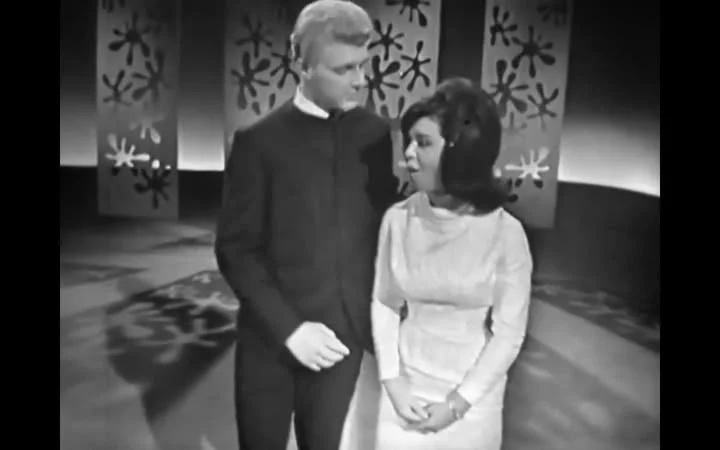
There is a moment captured in amber, frozen in the winter of 1963, when two voices meet across a modest recording studio in Fort Worth, Texas. One voice trembles with earnest desperation, the other answers with quiet certainty. Together they create something so pure and unpretentious that it would define an entire generation’s vision of teenage love. This is the story of Ray Hildebrand and Jill Jackson, two college students who became Paul and Paula, and the song that made them immortal.
The opening lines arrive like a confession whispered through a telephone receiver. “Hey, hey Paula, I wanna marry you” cuts through the air with a directness that modern pop songs rarely dare to attempt. There is no metaphor, no elaborate setup, just a boy telling a girl exactly what he wants. And when she answers, “Hey Paul, I’ve been waiting for you / Hey, hey, hey Paul, I wanna marry you too”, the listener becomes an accidental witness to something profoundly intimate. This call-and-response structure is not merely a musical device but the very heartbeat of the recording.
What makes this song endure is not complexity but its absolute refusal to be anything other than what it is. The arrangement is sparse and deliberate. Little Caesar on piano establishes the mood with simple block chords, each one placed with the careful precision of someone who understands that silence between notes matters as much as the notes themselves. The guitar work, attributed to Marvin Montgomery, provides a gentle rhythmic pulse that suggests not a rock and roll rebellion but a quiet conversation between two people sitting close together.
The serendipity of the recording session reads like something from a Hollywood script. Ray Hildebrand had written the tune after hearing Annette Funicello’s “Tall Paul,” originally calling it “Paul and Paula.” He and Jill Jackson performed it on a local Texas radio show where listener response erupted like a flash fire. Their journey to a Fort Worth studio brought them to producer Major Bill Smith, known for Bruce Channel’s 1962 hit “Hey Baby.” The session musicians had been waiting for another artist who never showed. In that moment of studio happenstance, with the clock ticking and the tape rolling, “Hey Paula” was committed to history.
The sincerity of its duet structure and the simplicity of its arrangement allowed ‘Hey Paula’ to become the universal soundtrack for every couple who ever dreamed of running away together before graduation.
The sonic texture carries the unmistakable fingerprint of early 1960s Texan pop rock. Unlike the cathedral-like walls of sound being constructed in New York and Los Angeles, this recording is dry, clean, and immediate. Guy Parnell on bass and Ronnie Dawson on drums create a rhythm section that stays out of its own way, supporting without demanding attention. The organ adds a subtle warmth, but it is the voices that occupy the center of the frame. Mixed close and without reverb, they create the illusion of standing in the same room, watching two people sing to each other rather than at an audience.
The lyrics distill teenage impatience into two minutes and twenty-seven seconds of pure emotional honesty. “I’ve waited so long for school to be through / Paula, I can’t wait no more for you” captures that specific moment when childhood ends and adulthood begins, when the final school bell rings and real life stretches out like an open road. For the teenagers of 1963, this was not background music but the soundtrack to tentative first kisses and whispered plans made in the back of a drive-in theater.
Released as a single and picked up by Philips Records, the song climbed to the top of the Billboard Hot 100 in February 1963, dominating the charts for a significant run. It was quickly packaged onto the duo’s debut album, Paul and Paula Sing for Young Lovers. The timing was impeccable. This recording arrived as the last great burst of clean, wholesome American pop before the Beatles landed and recalibrated everything. It represents a world that was about to disappear, a moment when pop music seemed linear and uncomplicated.
When listened to on good home audio equipment, the recording reveals its organic origins. There is a slight, pleasing fuzz on the guitar, suggesting a hollow body electric played through a small tube amplifier. One can almost sense the room itself, a smaller space where musicians played closely together, generating a focused mono sound field. This is not the sterilized perfection of modern production but something more human and therefore more powerful.
Today, the song offers a potent dose of nostalgia for a time that many listeners never experienced firsthand. It reminds us that sophistication in music does not require complexity. Sometimes the most powerful device is pure, relatable emotional honesty. Ray Hildebrand and Jill Jackson created characters so vivid that listeners still wonder about Paul and Paula decades later. Did they marry? Did it last? The song leaves us in the perfection of that immediate, unquestioning yes, frozen forever in the moment before reality intervenes.
For students taking piano lessons, instructors often recommend learning the chord progressions of this song as an example of classic pop simplicity. The structure is so straightforward that it becomes a teaching tool, a gateway to understanding how a few carefully chosen notes can carry the weight of an entire generation’s dreams.
Give it another careful listen. You might find that its enduring power lies not in what it says but in what it refuses to say. There is no cynicism here, no irony, no knowing wink at the audience. Just two voices meeting in a small Texas studio, making a promise that the world would never let them keep.
Listen also to these companion recordings from the same era
The Everly Brothers – “All I Have to Do Is Dream” shares the intimate acoustic approach and close harmonic duet style that defined the early 60s pop landscape.
Lesley Gore – “It’s My Party” represents the clean, slightly dramatic production style before the garage rock grit of the mid 60s took hold.
The Rooftop Singers – “Walk Right In” offers another massive hit from 1963 built around simple, compelling instrumentation and unadorned vocal delivery.
Connie Francis – “Where the Boys Are” captures the same innocent focus on the hopeful side of teenage romance that made “Hey Paula” resonate so deeply.
Frankie Valli and the Four Seasons – “Candy Girl” presents a slightly more complex vocal arrangement while maintaining the unwavering focus on young love that defined the era.
Brian Hyland – “Sealed with a Kiss” features the same delicate acoustic arrangement and theme of patient devotion set against a school time backdrop.