
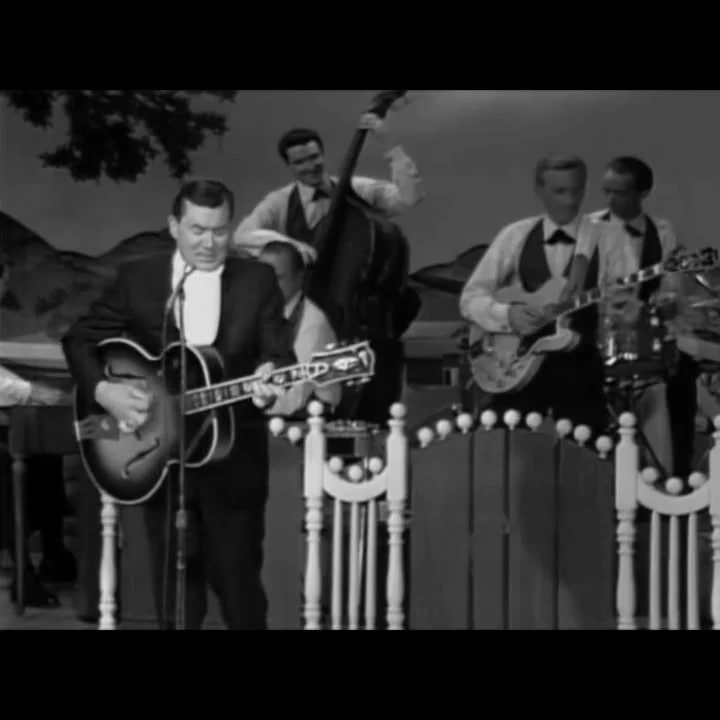
There is a loneliness that feels like watching a party through a window. Don Gibson gave that feeling a voice in 1958 with a song that sounded impossibly cheerful for its words. Oh Lonesome Me was not just a hit. It was a quiet revolution that reshaped country music and let it speak to a nation without apology.
The story begins late in 1957 at a roadside diner somewhere between Knoxville and Nashville. Don Gibson, a singer and songwriter struggling with personal demons and creative block, scratched two songs onto a napkin under fluorescent light. One was I Can’t Stop Loving You, a ballad of unrequited devotion. The other was Oh Lonesome Me, a deceptively bright shuffle that carried existential dread in every line. That napkin would rewrite country music’s future.
Gibson had a plaintive, conversational style that avoided the high lonesome twang of earlier generations. When he joined RCA Victor, he came under the guidance of Chet Atkins, the legendary producer and guitarist who wanted to smooth country music’s rough edges. Atkins envisioned a sound that could cross over to pop audiences without losing its emotional core. The recording of Oh Lonesome Me in December 1957 became one of the first great successes of that vision.
The song shot to number one on the country charts for eight weeks and reached high on the Billboard Hot 100. It anchored Gibson’s debut RCA album and proved that country music could be both commercially slick and deeply authentic. Atkins stripped away the steel guitar and prominent fiddle that had defined the genre. Instead, he built the track on elegant acoustic textures and surgical restraint.
Listen to the original recording through any decent pair of speakers today. The arrangement reveals its brilliance in what it leaves out. The rhythmic backbone is a gentle country shuffle driven by upright bass and Buddy Harman‘s subtle drumming. Hypnotic arpeggiated guitar work provides melody and rhythm at once. Floyd Cramer‘s piano does not solo. It punctuates downbeats with bright, percussive chords that cut through the mix without dominating. Every note counts.
Gibson’s vocal delivery is the masterstroke. His voice is close-mic’d and intimate. He does not wail. He simply states his loneliness with quiet, weary conviction.
Oh lonesome me, I wish that I could only die.
The lyric is devastating. The delivery is light, almost ironic. The contrast between the breezy tempo and the deep sadness creates the song’s central tension. The tight compression makes it feel like Gibson is singing directly to each listener, a confidential confession across the decades.
The backing harmonies of The Jordanaires wrap around Gibson’s voice like a velvet cloak. Their oohs and aahs are perfectly blended, smooth and pop-influenced. These voices are not the raw gospel shouts of traditional country music. They elevate the song to orchestral polish. This sonic choice signaled Nashville’s ambition to leave regional identity behind and claim space on national radio dials.
A young person in 1958 tuning the radio might be tired of the electric aggression of early rock and roll or the overt theatrics of honky-tonk. This song drifts out. It offers sorrow wrapped in elegance. It validates deep feeling without demanding loud confrontation. The song runs exactly two minutes and thirty-two seconds. It leaves you with an earworm and a pang of melancholy.
The song is a perfect articulation of the feeling that everyone else is having a party you weren’t invited to.
That sentiment remains timeless. It is the sound of the world continuing happily outside your window, indifferent to your personal tragedy. Gibson gave that isolation a voice in a song that became irresistible for other artists to cover. Neil Young turned it into a mournful crawl. Ray Charles gave it a sublime full-throated take. The endurance of Oh Lonesome Me proves that the most profound songs are often the simplest ones built on common human experience.
Listening recommendations for those who want to explore the same territory
Jim Reeves Four Walls from 1957 features a similarly smooth baritone vocal and polished arrangement that stands as an adjacent pillar of the early Nashville Sound.
Patsy Cline Walkin’ After Midnight from 1957 shares the same mix of profound loneliness and infectious country pop rhythmic momentum.
The Everly Brothers Bye Bye Love from 1957 shows the country to pop crossover achieved via clean acoustics and tight harmonies a year earlier.
Ray Price Crazy Arms from 1956 provides the essential country shuffle rhythm that Don Gibson adapted for his crossover success, though slightly rawer.
Faron Young Hello Walls from 1961 is a masterful example of personifying loneliness in a room following the emotional blueprint laid by Gibson’s hit.
Marty Robbins A White Sport Coat and a Pink Carnation from 1957 is another RCA Chet Atkins production that perfectly illustrates the smooth early Countrypolitan sound that Oh Lonesome Me popularized.