
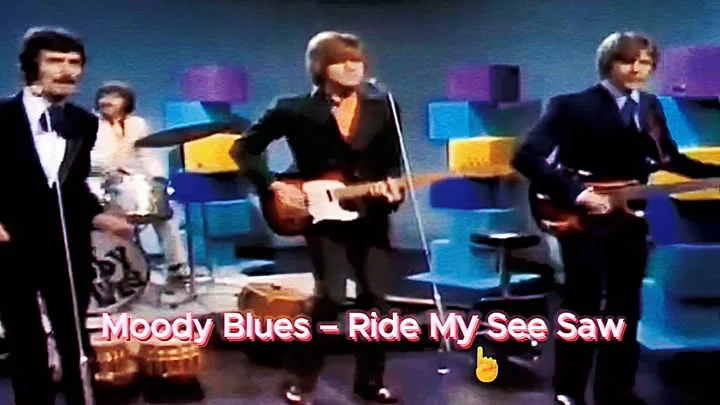
The fluorescent lights of a college library basement hummed overhead, but the sound filling my headphones was something else entirely. Ride My See-Saw by The Moody Blues didn’t just play; it demanded attention, pulling me out of the stacks and into a world where rock and philosophy collided. That moment, suspended between dust motes and academic duty, has never really left me.
This track opens the proper portion of In Search of the Lost Chord, the band’s 1968 album for Deram Records. It follows a brief spoken prologue called Departure, and from the first count-in, it announces a band in full transformation. The Moody Blues had spent 1967 building a symphonic reputation with Days of Future Passed, but they wanted something more self-sufficient. With Tony Clarke producing, they crafted an album rich with homegrown textures, and Ride My See-Saw became its most direct statement.
Bassist John Lodge wrote the song, and his stamp is all over its restless energy. The arrangement attacks in stages. The opening riff is lean and slightly serrated, like a rotating sign seen from a speeding car. Lodge’s bass thrusts forward with a rubber-band spring, giving the groove both lift and bite. Graeme Edge delivers crisp, clean drumming, the hi-hat glinting like chrome. Justin Hayward drives the melody with a bright, forward midrange, clipping its notes with precision. There is little clutter here. The frequencies lock together, making the chorus feel like a runway acceleration rather than a gear change.
Then Mike Pinder enters with his Mellotron, not as background syrup but as architectural support. The tape-based keyboard breathes in swells, its granular texture standing the hairs on end. It mimics strings without pretending to be them, and the mechanical throat-clearing before each chord bloom adds a human tactility. The vocals, meanwhile, are stacked with intention, a blend of human edges rather than angelic haze. The phrasing lands on downbeats like footsteps finding the exact stair.
Tony Clarke’s production favors clarity over excessive reverb. Each strike has a short tail and a defined place. The rhythm guitar sits slightly left of center, close enough to feel its cabinet bark. The Mellotron occupies a haloed space above, while Ray Thomas and his flute contributions, so prominent elsewhere on the album, tuck into the mix. The stereo field is purposeful, unfolding like a well-drawn plan on good speakers.
The see-saw metaphor is central. A children’s contraption dependent on balance and reciprocity becomes a symbol for the swing between certainty and doubt. The lyrics question the accumulation of facts without integration, a critique of institutional education. The band doesn’t resolve the tension; they animate it. As the saying goes,
Sometimes the fastest songs reveal the slowest truths.
I recall a friend’s cramped apartment, a cheap amp in the corner, and a battered six-string with action so high it fought every chord. He tried to teach me the main figure, and I failed gloriously, but the muscle memory of that first interval jump stuck. The song demands physicality. It doesn’t ask you to admire; it asks you to join, even if your hands stumble.
Another memory surfaces of an overnight bus after a gig, fellow passengers asleep. I played the track on a modest player, and even without premium audio, the edges stayed sharp. The midrange-forward mix ensures the bones remain, even when you roll off the high end.
At a career level, Ride My See-Saw consolidates a turning point. 1968 was a year of upheaval, and the band’s choice to craft an album dense with self-played textures was both aesthetic and philosophical. They no longer needed an outside orchestra to articulate grandeur. With Pinder’s machines, Thomas’s melodic instincts, Hayward’s gifts, Lodge’s structural savvy, and Edge’s timing, they shaped a sonic identity that carried them through A Question of Balance and beyond. The track became a statement of intent, even if it wasn’t their most famous single.
The room within the track is tight. You can sense microphone proximity, the snare having a square shoulder. The cymbals withdraw quickly, leaving space. When the band punches into the chorus, the Mellotron raises the ceiling. The interplay between guitar and Mellotron is telling. Hayward’s tone sits between chime and bite, while Pinder’s tape-sourced strings supply a tensile canopy. This is why the group influenced later symphonic-rock and art-pop bands. They made the uncanny feel normal.
The song worked as a single, making chart appearances on both sides of the Atlantic. In some territories, the B-side was A Simple Game by Mike Pinder, a pairing that showcased the band’s range from riff-forward mover to contemplative interior.
The album In Search of the Lost Chord chases transcendence through poetry, meditation, and myth. That a song about riding the machinery of education opens the gate is a delightful paradox. The see-saw is only fun if both riders cooperate, and knowledge only becomes wisdom when it enters circulation with experience. In an age of constant pings, the song’s critique of shallow input feels sharper than ever.
If you revisit the track, try two passes. One to ride the riff, another to attend to the backing vocals and Mellotron swells. If you’re a player, sit with the right-hand figure on a keyboard and feel how the intervals pull forward. For a fuller experience, listen through studio headphones to catch the harmonies sitting behind the riff, then play it aloud to let the drums work the room. For similar sounds, check out The Moody Blues’ own Question from 1970, The Zombies’ Time of the Season, Status Quo’s Pictures of Matchstick Men, Procol Harum’s Quite Rightly So, Traffic’s Paper Sun, and The Move’s I Can Hear the Grass Grow.
In the end, Ride My See-Saw remains a testament to the power of momentum married to meaning. It is flint and steel, a rocker’s impatience wrapped around a thinker’s curiosity. Whether you’re discovering it for the first time or returning after years away, the ground still rises to meet you.