
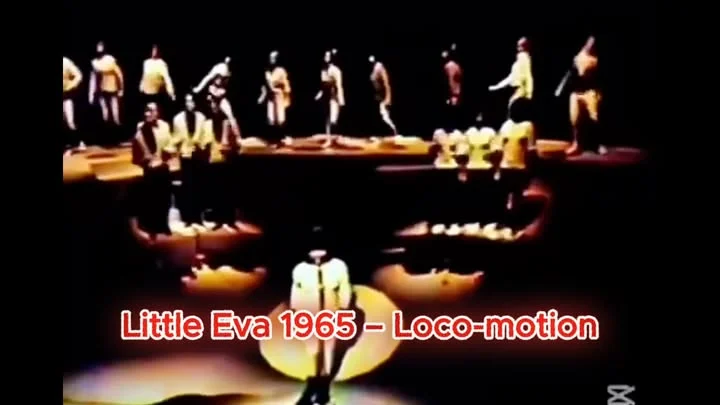
She was a babysitter who stepped into a recording booth to cut a demo. That demo became a worldwide smash. And the song it produced still makes people move, decades later.
Eva Narcissus Boyd didn’t set out to become a pop star. In 1962, the teenage North Carolina native was working as a nanny for one of the most powerful songwriting duos in America: Gerry Goffin and Carole King. What happened next reads like a piece of music-industry folklore so improbable that it could only be true.
Goffin and King had written a new track they intended to pitch to R&B singer Dee Dee Sharp, who had recently scored with the dance hit “Mashed Potato Time.” They asked Boyd to record a simple demo, a scratch vocal meant to showcase the song’s bones. That recording, raw and unpolished, landed in the hands of Don Kirshner, the head of the newly formed Dimension Records. Kirshner heard something undeniable in Boyd’s voice, a spark that no amount of studio polish could improve. He scrapped the plan to find another singer, rebranded Eva Boyd as Little Eva, and released the demo as a single. It became Dimension’s first release and shot straight to number one on the US charts.
The song was “The Loco-Motion,” and its origin story mirrors its sound: immediate, unpretentious, and irresistibly alive. The demo quality, far from being a limitation, became the record’s defining strength. You can hear it in the slight breathlessness of Boyd’s delivery, in the way the backing vocals including Carole King herself punch in with those iconic “Ooooh, yeah!” interjections. This wasn’t a performance crafted in a sterile studio. It felt like a party happening in real time.
The musical arrangement is a masterclass in economy. A crisp snare drum and a walking bassline create a relentless rhythmic engine. A trebly guitar riff, almost a muted chop, locks in like train wheels on a track. The horn section delivers short, sharp bursts of energy, while woodwinds swirl with a playful, almost vaudevillian gaiety. A piano anchors the harmonic structure without ever showing off. Everything sits in a clean, spacious mono mix that allows Boyd’s voice to cut through with startling clarity.
“The Loco-Motion is a record built not on a singer’s technical range, but on her infectious enthusiasm and perfect phrasing.”
Little Eva’s vocal performance remains the irreplaceable heart of the song. She sings with an unbridled, youthful energy that never sounds rehearsed. Her delivery is conversational and charming, like a friend giving urgent dance instructions at a crowded party. “You gotta swing your hips now, come on baby, jump up,” she commands, and the listener has no choice but to obey. The call-and-response structure transforms the track from a solo performance into a communal event, a moment shared between singer and audience.
The song arrived at a pivotal moment in popular music. The early 1960s stood suspended between the raw grit of late-period rock and roll and the gleaming, sophisticated pop emerging from the Brill Building. Songwriters, arrangers, and producers were becoming as famous as the singers who carried their tunes. In this ecosystem, “The Loco-Motion” functioned as both a blueprint and a fully realized sonic sculpture, an instruction manual for an instant dance craze that needed only to be heard to be understood.
The song’s legacy has proven remarkably durable. It climbed the charts again in the 1970s with a cover by Grand Funk Railroad and once more in the late 1980s with Kylie Minogue. Yet the Little Eva original remains the definitive statement, a snapshot of a moment when American pop was at its most exciting. Within the context of Boyd’s brief but brilliant career, the single stands as her defining moment, the lightning-in-a-bottle track she would forever be associated with.
Today, when we consider the sheer volume of music generated by the Brill Building hit factory, it is easy to overlook the human element. But in Little Eva’s take on “The Loco-Motion,” you hear the joy of creation, the thrill of a young woman’s unexpected shot at fame, and a song that is simply impossible to resist. It invites re-listening on a sunny afternoon drive, reminding us that sometimes the simplest songs are the most deeply felt.
Listening Recommendations
Dee Dee Sharp “Mashed Potato Time” (1962) A direct inspiration and genre predecessor, another perfect early-60s dance instruction anthem.
The Cookies “Chains” (1962) Features Little Eva’s backing group and that same crisp Goffin and King Brill Building production.
The Crystals “Da Doo Ron Ron” (1963) A Wall of Sound era hit providing a more ornate contrast to Loco-Motion’s cleaner mix.
Carole King “It Might As Well Rain Until September” (1962) King’s own debut hit as a singer, showcasing her vocal side in a restrained ballad style.
Chubby Checker “The Twist” (1960) The definitive early 60s dance craze song sharing the focus on simple universal movement.
The Shirelles “Will You Love Me Tomorrow” (1960) An early Goffin and King track highlighting their mastery of pop lyricism with smoother girl-group sophistication.