
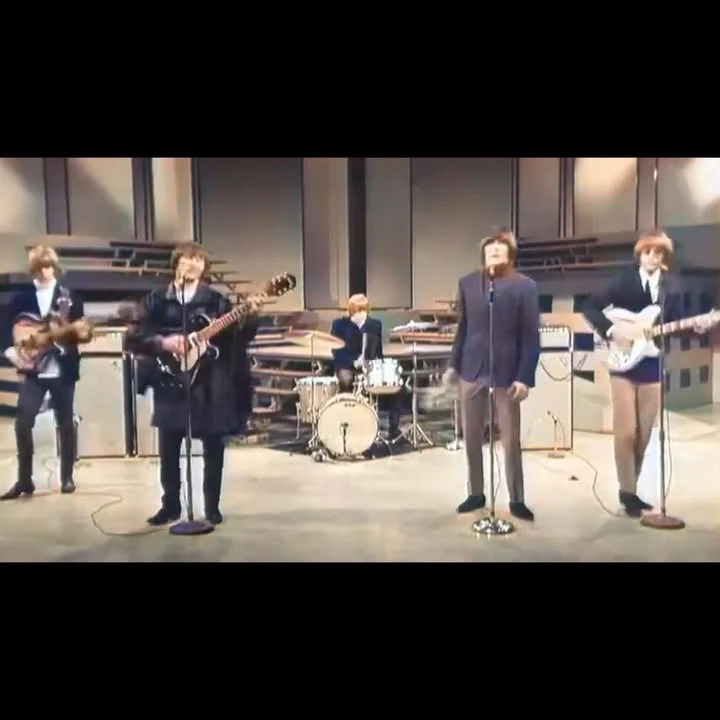
The first shimmering notes of Roger McGuinn’s 12‑string Rickenbacker cut through the air in 1965, and the sound of folk‑rock was born. That jangly, chime‑like guitar riff didn’t just introduce a song—it announced a revolution. The Byrds’ take on Bob Dylan’s “Mr. Tambourine Man” became an instant cornerstone of popular music, a moment when the poetic introspection of folk fused with the electric energy of rock to create something entirely new.
The track exploded onto radio waves in June of that year, lifting The Byrds from unknown session musicians to international stars almost overnight. But this wasn’t merely a cover. It was a complete reimagination. Where Dylan had offered a sparse acoustic meditation, The Byrds built a full‑band cathedral of sound, layering tight drumming, warm bass lines, and those unforgettable vocal harmonies. The result was a song that felt both intimate and massive, dreamy and driving.
“Hey, Mr. Tambourine Man, play a song for me / I’m not sleepy and there ain’t no place I’m goin’ to.”
Those lyrics, stripped down to just a single verse and chorus, became a radio‑ready mantra for restless souls. Producer Terry Melcher’s polished production kept the track clean and bright, while the decision to speed up the tempo made it irresistible to pop audiences. It was a masterclass in adaptation—preserving the original’s enigmatic soul while crafting a sound that could fill dance floors.
The Instrument That Defined a Genre
At the heart of the recording was McGuinn’s distinctive 12‑string Rickenbacker electric guitar, treated with compression and reverb to produce a lush, shimmering texture. That sonic hall became the signature of folk‑rock, later echoing through the work of Tom Petty, R.E.M., and countless others. The rhythm section, supplied by the legendary Wrecking Crew—drummer Hal Blaine and bassist Larry Knechtel—provided a steady, propulsive foundation that kept the song grounded even as McGuinn’s vocals soared.
The Byrds’ debut album, also titled Mr. Tambourine Man , collected an eclectic mix of Dylan covers, original songs like “I’ll Feel a Whole Lot Better” and “All I Really Want to Do,” and other folk‑rock experiments. It didn’t just showcase the band’s range—it codified a new hybrid genre that would define the mid‑sixties soundscape. The album climbed the charts on both sides of the Atlantic and inspired a wave of artists, from Simon & Garfunkel to The Mamas & the Papas, to explore similar blends of lyrical depth and electric energy.
A Lyrical Journey into Imagination
Dylan’s original words are a surreal meditation on creativity, escapism, and inspiration—lines like “Take me on a trip upon your magic swirling ship” conjure a vivid, almost hallucinatory landscape. By trimming the song to its most accessible elements, The Byrds crafted an entry point for millions who might never have encountered Dylan’s denser work. McGuinn’s earnest, plaintive delivery captures the wistful longing in lines about wandering and surrender, making the song feel both personal and universal.
The decision to use only the chorus and one verse was controversial among purists, but it demonstrated a keen pop instinct. The song’s emotional arc remains intact—from the opening plea to the final promise “I’ll come followin’ you”—while the available space allows the instruments to speak. The result is a track that works as both an existential anthem and a radio singalong.
Legacy That Keeps Ringing
“Mr. Tambourine Man” didn’t just launch a band; it reshaped the mainstream’s understanding of what folk music could be. It proved that electric instruments and poetic lyrics could coexist without losing either’s integrity. The song became a cultural touchstone for a generation hungry for artistic freedom, and its influence rippled outward into psychedelia, country‑rock, and beyond.
Decades later, the track remains a touchpoint for musicians seeking to bridge the acoustic and electric worlds. Its jangling guitar and layered harmonies continue to inspire new ears, proving that true innovation never fades. For anyone curious about where folk‑rock began, this single is not just a history lesson—it’s a living, breathing experience.
“In the jingle jangle morning, I’ll come followin’ you.”
Whether you’re discovering it for the first time or returning after many years, The Byrds’ masterpiece still feels as fresh as the morning dew. It stands as a testament to the transformative power of music—a moment when a few chords and a voice changed the world, one listen at a time.
If the magic of this track lingers, explore these companion pieces:
“Turn! Turn! Turn!” by The Byrds – The band’s second iconic single, adapting a biblical passage into a folk‑rock meditation on time and change.
“Blowin’ in the Wind” by Bob Dylan – The original touchstone of socially conscious folk, filled with introspective questions.
“California Dreamin’ ” by The Mamas & the Papas – Lush harmonies and evocative imagery that share the same dreamy spirit.
“For What It’s Worth” by Buffalo Springfield – A politically charged, atmospheric folk‑rock anthem.
“Losing My Religion” by R.E.M. – A later echo of The Byrds’ jangly guitar and emotional resonance, wrapped in enigmatic lyrics.