
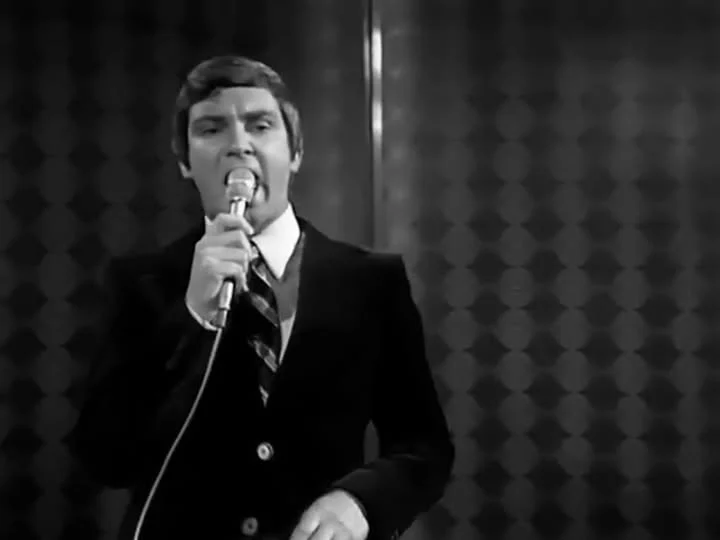
The Orphaned Epic: Gene Pitney’s “Liberty Valance” and the Accidental Masterpiece
Imagine commissioning a grand theme for a major motion picture, only to have it arrive after the final scene has already cut to black. That was the precise fate of Gene Pitney’s 1962 magnum opus. “(The Man Who Shot) Liberty Valance” was meant to soundtrack John Ford’s legendary Western starring John Wayne and James Stewart. The song arrived late. Paramount had already shipped the film to theaters without it. What remained was a magnificent orphan, a standalone 45 rpm record on the Musicor label that defied its own history to become a Top 5 smash. It is one of the great paradoxes of pop music — a piece of promotional material that failed its primary purpose yet succeeded spectacularly on its own dramatic terms.
From the very first needle drop, the world shifts on its axis. We are not in the early 1960s pop landscape of cheerful teen idols and surf rhythms. We are transported to a dusty, wind-whipped street in the cinematic West. The song carries the weight of lawlessness in a single name, and Pitney’s voice narrates an impending tragedy with the gravity of a town crier. This was no ordinary pop confection. Burt Bacharach and Hal David, already hitting their stride as architects of sophisticated pop, adapted their complex chord structures and narrative-heavy lyrics to the grandeur and grit of the Western genre. It was a remarkable flex of versatility that prefigured much of the narrative pop to follow later in the decade.
The Soundscape of Doom and Deliverance
The arrangement, credited to Chuck Sagle, does not merely accompany the song — it acts as a co-star. A driving, almost galloping rhythm section, anchored by the excellent session drummer Gary Chester, propels the story forward like hoofbeats on a dusty trail. Above this foundation, the instrumentation creates a world of vast, desolate space and sudden, sharp tension. Instead of the sun-drenched romance often associated with Bacharach, the strings are minor-key and melancholic. They swell not with sweetness but with doom, mirroring the fate of the town that Valance terrorizes. The guitar and piano provide the Americana bedrock, while the orchestration gives the piece its unmistakable high-fidelity sweep.
“The song is not just a western ballad. It is a sonic monument to the hero we need, not the one we see.”
Pitney’s High-Wire Act
Gene Pitney was a singer born for high drama. His vocal instrument was unique — piercing, effortlessly soaring into a high register, yet capable of an unnerving vulnerability. He was the master of the melodramatic ballad, and this track provided him with a perfect canvas. Listen closely to how he handles the opening verses. He becomes the griot, the storyteller, setting the scene with a restrained intensity. His voice is tight, almost compressed, reflecting the tension in the town of Shinbone. He does not shout the lyrics. He announces them, giving the lines a gravitas befitting a dark legend.
As the narrative progresses, detailing the terror and the eventual confrontation, Pitney’s famous vibrato comes into play. It is not just an ornamental flourish. It is a structural element, a trembling urgency that conveys fear and righteous anger simultaneously. When he reaches the pivotal moment, singing about the hero who “stood up for the things that he knew were right,” the vocal peak is a spectacular, controlled explosion. This sustained high-wire tenor is Pitney’s genius. He treats this pop song like a three-act opera condensed into three minutes. The final, drawn-out note on the word “Valance” does not just end the song. It echoes the shot, the silence, and the lasting legend.
The Legacy of an Accidental Classic
This single cemented Pitney’s reputation for tackling weighty, emotionally complex material. It confirmed the commercial viability of the Bacharach-David partnership on their way to pop royalty. The song resonates today because we still grapple with the duality of its theme — the man who brought order versus the legend that grew up around him. It is a song about the necessity of myth, a theme as timeless as the desert plains it evokes. It reminds us that pop music can be profoundly moral and narratively complex, a true miniature Western tragedy.
Whether rediscovered through a crackling vintage record or a high-resolution digital stream, “(The Man Who Shot) Liberty Valance” remains an anchor in the legacy of one of pop’s most distinctive voices. It is a passionate declaration that sometimes the greatest legends are the ones we never meant to create.
Further Listening
For those captivated by this intersection of pop and Western, here are six essential tracks that share its dramatic DNA.
“Town Without Pity” – Gene Pitney (1961). Shares the same grand, anxious, mid-tempo drama and Pitney’s signature soaring high notes.
“Twenty-Four Hours from Tulsa” – Gene Pitney (1963). Another Bacharach and David-penned tragedy showcasing Pitney’s mastery of the narrative ballad.
“Make It Easy on Yourself” – Jerry Butler (1962). An early Bacharach and David arrangement with similar sophisticated orchestral sweep and emotional depth.
“High Noon (Do Not Forsake Me, Oh My Darlin’)” – Tex Ritter (1952). The quintessential Western theme song that set the standard for cinematic pop gravity.
“Wichita Lineman” – Glen Campbell (1968). A later, more melancholic example of a song using vast, lonely American landscapes to reflect emotional isolation.
“Only Love Can Break a Heart” – Gene Pitney (1962). The flip side of the Bacharach and David pop coin. Pure heartache, but delivered with the same high drama.