
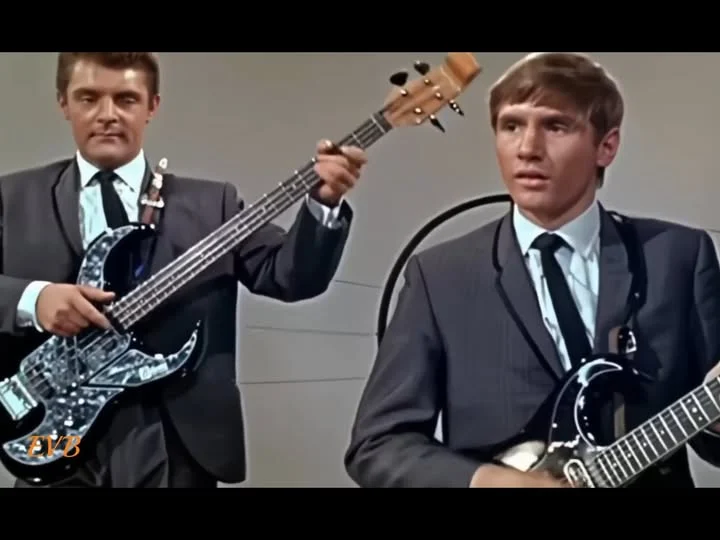
There is a moment, late at night, when the world quiets and the only thing left is the music pressing against your ears. Through a pair of studio headphones, a sound hits like a fist on a wooden door—a frantic, stomping rhythm that feels less like a song and more like an electrical storm contained in a tiny room. That moment belongs to The Honeycombs and their debut single “Have I The Right?”. It is not merely a piece of music; it is a controlled sonic riot, a glimpse into the obsessive genius of producer Joe Meek, who turned a cramped London flat into a laboratory of pop chaos.
Released in 1964, the track crashed through the polite Merseybeat landscape with a raw, percussive fury. It climbed to No. 1 in the UK and cracked the US Top 5, yet its real legacy is not chart success but the singular, claustrophobic brilliance of its production. Meek, already famous for engineering The Tornados’ “Telstar”, treated his RGM Sound studio—his own flat at 304 Holloway Road—as an instrument. The recording does not sound clean or polished; it sounds like a room pushed to its breaking point, every surface vibrating with compressed energy.
“This is the sound of pop music being recorded not in a studio, but in an eccentric scientist’s laboratory.”
The song’s heartbeat is its astonishing percussive attack. The band’s name was a playful nod to their drummer, Anne ‘Honey’ Lantree, one of the few prominent female drummers in a top-tier beat group. Her muscular, almost military beat provides the backbone. But Meek took it further: he had the band members stomp their feet on the wooden staircase outside his control room, capturing the thud with microphones fastened by bicycle clips. The result is a primal, amplified heartbeat that drives the track relentlessly forward. Combined with heavy compression and a slight speed-up, the whole mix acquires a manic, anxious energy that makes Denis D’Ell’s lead vocal sound strained and desperate: Have I the right to hold you, darling, when I know you want to leave?
Songwriters Ken Howard and Alan Blaikley provided a sturdy pop framework, but Meek gleefully deconstructed and reassembled it. The rhythm section is everything: John Lantree’s bass guitar anchors the frantic beat with deep warmth, while Alan Ward’s lead guitar cuts through like shards of bright, trebly glass. During the instrumental break, the guitar engages in a sharp, almost tuneless duel with a stabbing keyboard—often described as an electric piano or clavioline—creating a moment of sonic anarchy that prefigures post-punk by more than a decade. It is a shocking modernist jolt inside a British Invasion stomper, not a clean jingle but a metallic clang.
The track became The Honeycombs’ career-defining moment. Their self-titled debut album followed, but the momentum never returned. Subsequent singles lacked the same raw shock. The band toured internationally at an ill-timed moment, lost ground in the fiercely competitive UK scene, and disbanded by 1967. Yet “Have I The Right?” remains a lightning-in-a-bottle moment—a convergence of a band, a revolutionary producer, and a catchy song in a tiny flat.
Decades later, the track’s resonance lies in its immediacy. It captures the frantic energy of 1964 with an almost aggressive fidelity. Imagine driving a rain-slicked highway at midnight, city lights blurring into neon streaks—you need a song that matches the speed, tension, and cinematic desperation of the moment. This is that song. For a teenager taking guitar lessons today, the riff is simple, but the sound itself— brittle, overdriven, compressed—offers an education in studio manipulation. Meek’s genius was making the technically impossible sound thrillingly real, pushing all frequencies into a narrow, loud band that jumps out of any playback system, even on a music streaming subscription at lower bitrates.
For those hungry to explore this sonic universe, a few recommendations capture the same raw energy:
The Tornados – “Telstar” (1962): Joe Meek’s otherworldly, echo-drenched futurist signature.
The Dave Clark Five – “Glad All Over” (1963): A similarly thundering drum sound, though cleaner.
The Troggs – “Wild Thing” (1966): Raw, primitive, highly compressed proto-punk aggression.
The Equals – “Baby Come Back” (1966): Relentless drive from another female-drummer-fronted beat group.
The Fortunes – “You’ve Got Your Troubles” (1965): A contrast between the rough Meek sound and polished harmony-driven pop.
“Have I The Right?” is a reminder that innovation often emerges from constraint: a cramped flat, a few microphones clipped precariously, a group of dedicated players, and a producer who heard music in dimensions others could not perceive. Put it on. Turn it up. Let that massive, stomping drum track pull you into the controlled chaos of Joe Meek’s universe.