
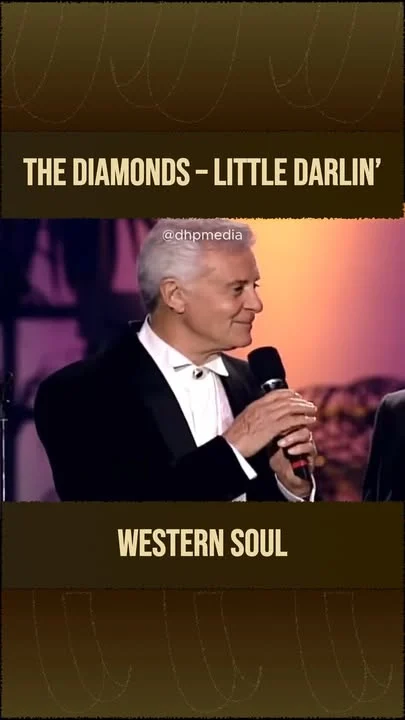
There are moments in music history that seem to exist outside of time, suspended in a perfect amber of sound and sentiment. For generations raised on the crackle of vinyl and the glow of jukeboxes, one such moment arrived in 1957 with a single note: “Eye… yi-yi-yi, yi-yi-yi…”
That iconic, theatrical opening belongs to The Diamonds, a Canadian vocal quartet whose cover of “Little Darlin’” became more than a hit—it became a cultural fingerprint of the 1950s. What started as a song by The Gladiolas, led by Maurice Williams, was transformed by The Diamonds into something polished, playful, and profoundly memorable. Their version eclipsed the original, climbing to No. 2 on the Billboard Hot 100 and staying there for eight weeks. It didn’t just capture the era; it helped define it.
Today, listening to “Little Darlin’” is like opening a time capsule. The spoken-word intro, the exaggerated vibrato, the emotional crescendos—these elements could have veered into parody, but instead, they landed somewhere between sincerity and spectacle. The Diamonds walked that line with grace, crafting a track that was both entertaining and musically impressive.
At the heart of the song’s enduring appeal is its vocal arrangement. The lead tenor’s expressive delivery is buoyed by a quartet that knows exactly when to soar and when to ground the melody. The doo-wop backing creates a rhythmic texture that feels alive, as if the singers are in the room, leaning into the microphones. It’s a masterclass in harmony and theatricality.
Instruments and Sounds
Beneath the vocals lies a classic rock ‘n’ roll skeleton: guitar, piano, bass, drums, and a saxophone that appears just long enough to leave an impression. The guitar offers a steady pulse, while the piano punctuates the rhythm with sharp chords and quick flourishes. Together, they create a buoyant energy that drives the song forward. The upright bass walks a steady line, and the drum kit stays understated, letting the vocals take center stage. That brief saxophone solo? It adds a layer of sophistication, a wink to the listener that says, “We know what we’re doing.”
This combination of instruments and voices—simple yet rich—proves that complexity isn’t required for greatness. In an age of layered production and digital effects, “Little Darlin’” reminds us that emotional authenticity and a well-crafted melody can still stop us in our tracks.
“The song was emblematic of a time when rock ‘n’ roll was still in its infancy, experimenting with structure, harmonies, and performance. The Diamonds managed to walk the line between parody and sincerity.”
Cultural Footprint
Beyond the charts, “Little Darlin’” seeped into movies, television shows, and nostalgic compilations. It was parodied, yes, but those same over-the-top elements gave it staying power. It became the kind of song that grandparents and grandchildren could hum together, a bridge between generations. Its adaptability—covered and sampled by artists over the decades—proves that its core essence is timeless.
The song also serves as a gateway to a broader musical landscape. For those enchanted by its charm, there are kindred spirits waiting to be discovered. Tracks like “In the Still of the Night” by The Five Satins, “Come Go with Me” by The Del-Vikings, and “Earth Angel” by The Penguins offer similar harmonies and heartfelt emotions. “Why Do Fools Fall in Love” by Frankie Lymon & The Teenagers captures youthful exuberance, while “Only You (And You Alone)” by The Platters delivers smooth, romantic vocals. Each of these songs, like “Little Darlin’,” is a testament to the power of vocal harmony and simple, honest arrangements.
The Legacy Lives On
In a world of ever-evolving music trends, “Little Darlin’” remains a beacon of 1950s innovation. It’s not just a nostalgic throwback; it’s a case study in how a song can capture the spirit of an era while transcending it. For seasoned collectors, music historians, or curious newcomers, this track deserves a place on any playlist.
If you haven’t heard it in a while, now is the perfect time to rediscover this gem. Let the opening “Eye… yi-yi-yi, yi-yi-yi…” wash over you. Let the harmonies lift you. Let the simplicity remind you why some songs never fade.
And if you want to sing along, the lyrics are waiting:
[Dave Somerville]:
Ah ya ya ya ya
Ya ya ya ya, ya ya yaHey, little darlin’
Oh, little darlin’
Oh ho where are you
My lover, I was wrong-ah
To try to love you
Ah ooh ah ooh ah ohh ahNo way-ah
That my love-ah
Was just for you
For only you[Spoken by Bill Reed]:
My darlin’, I need you
To call my own and never do wrong
To hold in mine your little hand
I’ll know too soon that all is so grand
Please hold my hand[Sung by Dave Somerville]:
My dear-ah, I was wrong-ah
To try to love you
Ah ooh ah ooh ah ohh ahNo way-ah
That my love-ah
Was just for you
For only you
Whether you’re discovering it for the first time or revisiting an old friend, “Little Darlin’” is more than a song. It’s a moment, frozen in time, waiting for you to press play.