
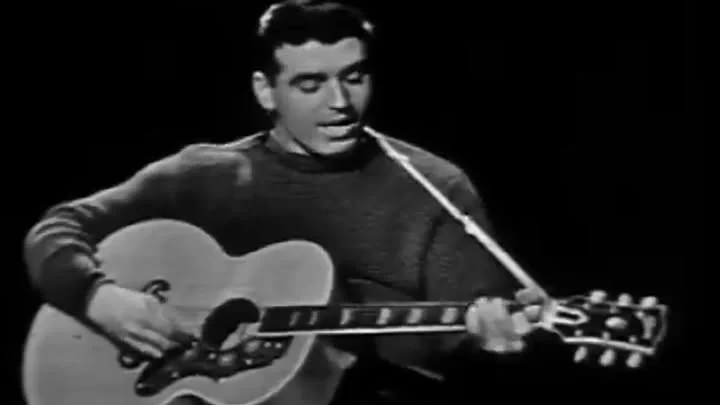
Some records arrive like a held breath. They slip into the quiet spaces of a room and wait there, patient as memory. “Teen Angel” is one of those records. Released by Mark Dinning in the waning weeks of 1959, it climbed to the summit of pop charts by early 1960, and yet its power has never depended on volume or spectacle. The song moves like a slow tide, carrying a weight that listeners have felt across generations, from the crackle of vintage 45s to the pristine glow of modern digital transfers.
The story begins inside a family. The song was written by Dinning’s sister, Jean, alongside her husband, Red Surrey. Grief, refracted through the lens of a household’s pen, became the foundation for a career-defining moment that Dinning himself may never have anticipated. At the time, he was a newcomer to the crowded pop landscape, carrying country roots in one pocket and the polish of string-swept orchestration in the other. The single, issued through MGM Records as a standalone release, would become his signature piece, the flag planted on a mountain that most people still recognize today.
Controversy followed the song’s arrival. Some radio programmers hesitated, uncomfortable with the narrative’s dark undertow. In the United Kingdom, the BBC reportedly resisted airplay, a decision that only amplified curiosity among listeners. The bans did what prohibitions often do to art, they deepened its mystique. Audiences leaned in closer, drawn by the whispered urgency of a story that felt forbidden and tender at once.
What strikes you first, before the voice enters, is the arrangement’s gentle architecture. A soft rhythm section lays the groundwork, with a brushed snare sketching a slow heartbeat while the bass lingers like dusk settling over a field. Strings weave in quietly, their bowed tones carrying a mournful countermelody that never intrudes on the vocal line. The choral voices, restrained oohs and syllabic echoes, avoid the showy doo-wop theatrics typical of the era. Instead, they form a kind of gauze, softening the scene the way fog softens a two-lane road. There is no glare here, only the warm lacquer of lamplight.
Dinning’s phrasing deserves careful attention. His consonants arrive gently, his vowels round and unhurried, a faint chamber reverb sketching the dimensions of a modest room rather than a vast cathedral. The production favors caress over emphasis, a deliberate choice that lets the narrative drive without any hint of bombast. Whether you encounter the track on a vintage vinyl pressing, a compilation reissue, or a remastered digital file, the philosophy remains consistent. The music prefers to soothe rather than to shout.
The track unfolds in overlapping arcs that reveal themselves upon close listening. The first is thematic, a fatal choice rendered in quiet detail. The second emerges through Dinning’s vocal trajectory, starting steady and gradually thinning into a delicate tremble as the memory tightens its grip. The third lives in the orchestration, where strings swell a shade more, the choral pad widens, and then everything subsides as if the room itself refuses to exploit tragedy for dramatic release. Instead of a cymbal crash or a brass stab, we receive a sigh.
The timbre palette is a study in economy. An acoustic guitar, lightly mic’d, stitches triplet figures that keep the pulse alive without crowding the lower midrange. A discreet piano appears infrequently, placed with precision to add harmonic glue, a suspended chord here, a low-end doubling there. If you listen on decent speakers, you can catch the bass note blossom and then dissolve into the room, a tiny demonstration of how restraint creates scale. Nothing in the arrangement feels fussy. It is an exercise in removing anything that might resemble consolation.
Dinning’s performance meets the track on its own terms, hovering just this side of spoken word. He leans into his natural baritone with a clarity that refuses theatrical sobs. His breath management reveals the craft, lines crest and settle without audible gasps, and his vibrato blooms late, as though emotion arrives as an afterthought the body cannot suppress. On word-endings he shades downward, protecting the narrator’s dignity. The effect lands with devastating precision. He does not reach for pathos, yet pathos arrives anyway.
Critics have sometimes herded “Teen Angel” into a category known as “death discs,” but that label fails to capture the particular heartsickness of this narrative. Many contemporaries cranked up the melodrama with squealing tires and thunderclap sound effects. This record operates instead like a small framed photograph on a mantelpiece. The orchestral pop grammar of the era remains present, strings, chorus, a halo of echo, yet the choices stay minimalist, closer to the architecture of a lullaby than an aria. That tension between glamour and grit forms the song’s secret, the gloss refuses to varnish the wound.
Consider the cultural moment into which the song slipped. By early 1960, American pop found itself between waves. The first blast of rock ’n’ roll had cooled, Brill Building craft was gathering strength, and the British Invasion remained a rumor waiting for guitars. “Teen Angel” slid into that seam with impeccable timing, singing not of rebellion but of consequence. It shares DNA with country storytelling and the polish of Nashville-adjacent studios without being reducible to either. The lyric’s moral undertow, choice, risk, the price of a single moment, felt sharp to adults and illicit to teenagers. That tension may explain why some broadcasters flinched while audiences leaned in.
The authorship carries its own weight. When a sister writes words for her brother to sing, the distance between sentiment and performance shortens considerably. You can hear that closeness in Dinning’s refusal to oversell. He sounds like someone who understands the difference between confession and theater, and the record’s framing honors that understanding. Sources note the controversy that followed its release, but controversy has a short shelf life. Careful craft endures.
The orchestration merits a closer pass. Those strings are not syrup. They function as architecture, often moving in contrary motion to the vocal line. Dinning’s melody sits on a cushion that rises as he descends, then thins when he holds a tone. The chorus entries approach choral-scholastic purity, clean vowels and blended dynamics that serve texture rather than spotlight. A faint glockenspiel or chime color, depending on the transfer you hear, glints at the edges without feeling ornamental. The drum part is so spare that it registers as a felt presence rather than a counted beat, the kind of part you sense more than you hear.
Three listening scenes come to mind. The first takes place in a quiet apartment late at night, city lights ticking through the blinds. When Dinning enters, the room seems to contract. The refrigerator hum becomes part of the accompaniment, and the final cadence lingers in the air longer than it should. The second scene unfolds in a diner’s corner booth in small-town America, a tabletop jukebox still functioning after all these years. Someone chooses “Teen Angel” because their grandmother loved it. A college student hears it as if for the first time. Phones go down. For three minutes, that booth becomes its own chapel. The third scene involves a long drive on a two-lane highway, the kind with railroad crossings and no arms, only a crossbuck. The song ends just as you glide over the tracks. You check the rearview without knowing why.
The record’s restraint also means it travels well across formats. On a mono 45, the soundstage collapses to a pillar, and the voice sits atop the center like a votive candle. On a tasteful stereo remaster, the strings widen enough to create a faint panorama while the center vocal stays intimate. That intimacy matters. Even on modern gear designed for everyday listening, the record benefits from clarity. The micro-reverb, the breath on consonants, the small choral pad, these are the details that transform sentiment into memory.
“Grief rarely arrives as a scream,” the song seems to whisper. “On ‘Teen Angel’ it pulls up quietly, leaves the engine running, and waits in the dark for you to notice.”
That sentiment describes not only the lyric but the physical weight of the record itself. Light in the hand, almost delicate, yet weighted and inevitable in the ear. The restraint is not an accident. It is design. In an era often caricatured for its innocence, this record remains honest about the consequences that lurk beyond innocence. A soft voice carrying a hard truth.
Dinning’s career beyond this single never quite replicated its peak. That fact need not read as failure. Sometimes an artist becomes the precise vessel needed for one particular moment. The single’s success placed him on the map, brought him to television, linked him to a wave of thematically similar songs, and put his name permanently into the footnotes and playlists of early-’60s pop. Browse through reissues and you will see “Teen Angel” recur like a lighthouse beam on various collections. It remains the simplest way to introduce Dinning to new ears.
The narrative has drawn debate over the years. Some hear it as moral caution, others as a romanticization of risk. The record itself does not argue. It remembers. The arrangement’s choices, soft dynamics, transparent textures, withheld climax, keep pulling attention back to voice and story. That is why, decades later, the song still lands not as kitsch but as a quiet reckoning.
One reason the track endures is its relationship to silence. After key lines, micro-rests hover. The arrangement resists the temptation to fill those gaps. In those instants, the mind supplies its own pictures, a roadside, a stalled engine, breath in cold air. The bareness makes the emotion portable. It also keeps the record from ossifying into kitsch. When people caricature this era’s “tragic teen” subgenre, they often forget how many of the best entries relied on understatement. “Teen Angel” understands that what is unsaid can carry the heaviest load.
For musician’s ears, the harmonic rhythm offers instruction. Chord changes arrive with the pacing of recollection, neither too slow to smear nor too quick to melodramatize. The acoustic guitar knitwork gives the harmony a soft percussive outline, and when the piano doubles a figure or drops a low suspension, the harmony acquires a gentle ache. It is tasteful, even educational, a reminder that harmony does not need to shout to deepen a scene.
Modern listeners meeting the track through playlists alongside hi-definition remasters might be tempted to fast-skip older mono material. Do not. The archival quality is part of the spell. A faint tape hiss, a subtle room print, a style of mic placement that flatters Dinning’s chest voice without hyping sibilance. If you are auditioning audio gear, this cut can serve as a surprising test. Does your setup preserve the air without turning the strings brittle? Does the vocal sit forward without getting glassy when the chorus opens? It is a small masterclass in balance.
For players drawn to the tune’s bones, unofficial charts and published sheet music capture the changes and basic voicings. Guitarists can shadow the triplet feel with fingerpicked arpeggios that echo the original texture without drowning it in ornament. Pianists can keep the left hand conservative and let the right voice the upper extensions sparingly. The point is not to modernize. The point is to preserve the space the song needs to breathe.
Listening habits change, but the heart still recognizes sincerity. Put the track on at night with the lights low. Let the opening bars set the room. A decent pair of studio headphones can reveal the subtle balance between string pad and voice, the tiny breaths that mark time like falling ash. Then step back and allow the ending to ring into the air. What you will feel is not nostalgia alone but the sensation of being entrusted with someone else’s most fragile memory.
For those who encounter “Teen Angel” for the first time, the story may shock by its directness. For those who know it well, the surprise is that it still surprises. That is craft. That is also empathy. The record extends its hand, asks you to carry the last note with you into the quiet. You will.
In the end, the song remains exactly what it set out to be, a modest vessel for an immodest emotion, a small frame holding an uncontainable image. Listen again, not to chase a bygone era, but to measure how restraint can make a story larger. The hush before the first line still feels like a held breath. When it releases, we are changed, just a little.
Listening Recommendations
Ray Peterson — “Tell Laura I Love Her,” 1960. Another teen-tragedy ballad whose delicate orchestration keeps the emotion close to the microphone.
Jody Reynolds — “Endless Sleep,” 1958. A minimalist predecessor where surf-tinged gloom meets stark storytelling.
The Shangri-Las — “Leader of the Pack,” 1964. Girl-group drama with revved engines and spoken asides, a louder cousin to Dinning’s restraint.
J. Frank Wilson & The Cavaliers — “Last Kiss,” 1964. A later entry that marries plainspoken grief to a radio-ready melody.
Dickey Lee — “Patches,” 1962. Not a car-crash story, but a tragic teen narrative carried by plaintive vocal and string swells.