
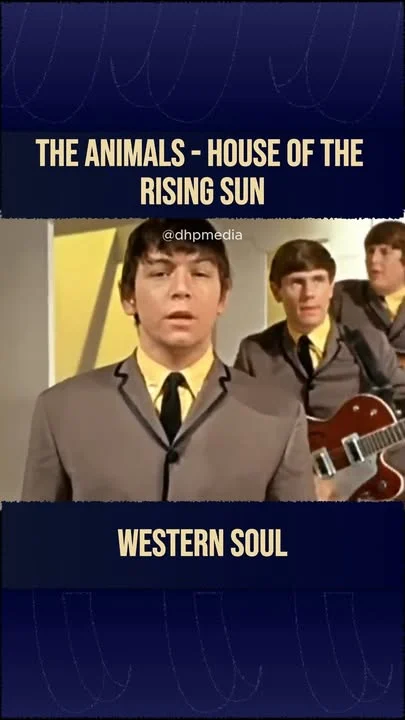
Some songs never fade. Decades after their release, they still send chills down the spine, and “House of the Rising Sun” by The Animals is one of those rare creations. The moment Hilton Valentine‘s guitar arpeggio cuts through the air, a sense of dread and beauty takes over. Eric Burdon‘s voice then emerges, weary and commanding, telling a story that feels as old as time. It is a record that refuses to age, and its power lies not just in its melody but in the raw, unvarnished emotion it carries.
Long before The Animals took the stage, this traditional folk piece already had a life of its own. Its roots stretch back to the 18th or 19th century, though no one can pinpoint the exact origin. Known sometimes as “Rising Sun Blues,” the song wandered through American folk history with shifting lyrics and changing narrators. It was performed by legends like Lead Belly and Woody Guthrie, and later recorded by Joan Baez and Bob Dylan in the early 1960s. The story it told was one of ruin and regret, set against a backdrop of a house in New Orleans that may have been a brothel, a gambling den, or something far more symbolic.
When The Animals entered the studio in 1964, they were not content to simply cover the old folk tune. They reimagined it completely. With Eric Burdon‘s booming vocals, Alan Price‘s eerie organ, and Hilton Valentine‘s unforgettable opening riff, the band turned the song into a dark, brooding rock anthem. The shift to a minor key and the slowed tempo gave the track an atmosphere of tragic inevitability. It was unlike anything else on the radio at the time, and it demanded attention.
At its core, the song is a cautionary tale. The narrator, ruined by a life of poor choices, warns others not to follow the same path. Lines like “I’m going back to New Orleans to wear that ball and chain” carry a weight that transcends the specific story. The “House of the Rising Sun” becomes a metaphor for any trap that lures people in and destroys them. It speaks to addiction, vice, and the consequences of chasing fleeting pleasures. That ambiguity is precisely why it continues to resonate with listeners of every generation.
The song’s release was a milestone in the British Invasion. While The Beatles and The Rolling Stones were rewriting the rules of pop, The Animals carved out their own dark corner of rock history. Their version of a centuries-old folk song climbed to the top of the charts in the UK and the US, proving that a traditional tune could become a global rock hit. It also broke conventions with its length, stretching past four minutes at a time when most singles barely reached three. That bold choice opened the door for other artists to experiment with structure and storytelling.
Bob Dylan, who had recorded a folk version of the song on his debut album, later admitted that The Animals‘ arrangement inspired him to embrace electric rock music. That ripple effect touched Jimi Hendrix, Led Zeppelin, and The Doors, all of whom explored the darker, more complex sound that The Animals had pioneered. The song became a template for blending folk storytelling with rock power, and its influence can still be heard in modern music.
What makes “House of the Rising Sun” so enduring is its ability to feel both ancient and immediate. The themes of loss, temptation, and regret are universal, and the haunting delivery gives them new life every time. The song has been covered countless times, across genres from blues to heavy metal, but The Animals‘ version remains the definitive one. It stands as a reminder that great music never really dies. It evolves, it transforms, and it continues to speak to each new generation.
There is a house in New Orleans
They call The Rising Sun
And it’s been the ruin of many a poor boy
And God, I know I’m one
More than half a century after its release, the song still echoes through arenas, films, and television shows. It has become part of the collective memory, a touchstone for anyone who has ever felt trapped by their own mistakes. The Animals may have recorded many great songs, but “House of the Rising Sun” is their masterpiece. It is a song that never stops haunting, never stops teaching, and never loses its power to move us.