
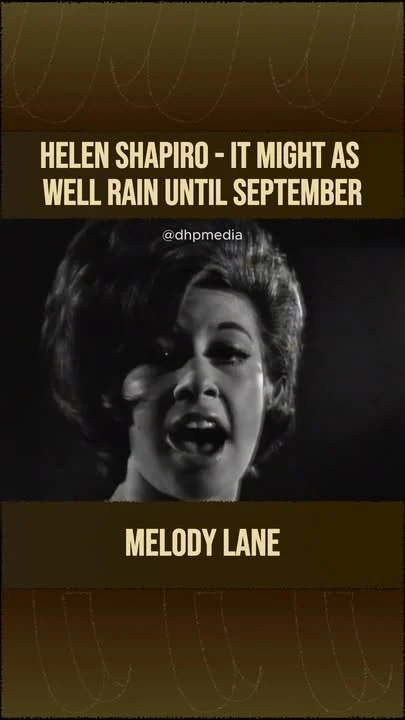
The rain refused to surrender that afternoon, hammering against the glass like a persistent memory. Inside a small café, the kind of place where time moves at its own pace, a familiar voice cut through the murky atmosphere. It was deep and soulful, carrying a weight that seemed impossible for someone who had once been a teenage pop sensation. Helen Shapiro was singing, and the song was her 1964 masterpiece, “It Might As Well Rain Until September.”
There is something profoundly cinematic about how a familiar melody can transport you. That afternoon, the Carole King and Gerry Goffin composition became more than just a song, it became a doorway into a pivotal moment in music history. Many compilations mistakenly date this recording to 1966, but the magic was captured during the transformative year of 1964, a time when the British music scene was undergoing a seismic shift that would forever change the cultural landscape.
A Voice Beyond Her Years
To understand the significance of this recording, one must first appreciate the remarkable journey of its interpreter. Helen Shapiro had burst onto the scene as a teenager with a voice that defied her age, a powerful contralto that could fill stadiums and silence critics. At her peak, she achieved what few artists could dream of, she opened for The Beatles, then an up-and-coming band from Liverpool who would soon conquer the world. But by 1964, the landscape had changed dramatically. Beatlemania was in full swing, and the polished orchestral pop that had dominated the charts seemed to be fading into obscurity.
Yet Shapiro refused to be relegated to nostalgia. Her rendition of this heartbreaking ballad, featured on her album Helen Hits Out, demonstrated a remarkable artistic evolution. Working with legendary producers John Schroeder and Norrie Paramor at EMI, she took the Brill Building sound and infused it with a distinctly British sensibility, brooding, sophisticated, and deeply introspective.
The Architecture of Sorrow
What makes this version so captivating is its complete transformation of the original emotional landscape. Where King’s 1962 recording was upbeat and almost defiant, Shapiro’s interpretation is slower, more deliberate, wrapped in a sepia-toned melancholy that feels extraordinarily mature for its era.
The arrangement is a masterclass in controlled atmosphere. It begins not with dramatic flourishes but with a hushed, almost tentative rhythm section. The drums are restrained, tapping out a gentle, martial beat that seems to echo the steady fall of rain. The bass line, warm and woody, provides the song’s emotional foundation, walking steadily beneath the melodic structure like a loyal companion.
The piano emerges as a crucial textural element, not as a soloist but as a subtle colorist. Sustained mid-range chords cushion Shapiro’s voice, their simple harmonic progressions creating a bedrock of sorrow. A clean, plucked guitar adds brief counter-melodies, small flashes of memory against the encroaching gloom. This minimalist approach stands in stark contrast to the wall-of-sound production that dominated many covers of this era.
A Study in Vulnerability
The true genius of this recording lies in Shapiro’s vocal delivery. Where her early hits showcased raw power and youthful exuberance, this track reveals extraordinary depth and nuance. Her contralto becomes a mature instrument of confession, delivering lyrics about summer romance with crushing finality. When she sings about spending vacation with a new love, it sounds less like anticipation and more like resignation.
The production deserves equal praise. The reverb is judiciously applied, creating a sense of space that suggests empty summer houses and deserted railway stations. The lower register of her voice dominates the frequency spectrum, grounding the song in undeniable emotional truth.
Shapiro doesn’t fight the rain. She pulls a blanket over herself and lets the weather become a proxy for her heart.
The moment she declares her intention to stay and cry, the strings swell with the force of emotional inevitability. It is a sonic moment of pure catharsis, executed with breathtaking precision. This is not a teenager sulking but a woman making a profound, adult choice to accept solitude.
Legacy in the Downpour
What makes this track endure isn’t its placement on chart lists or its historical significance. It’s the quiet recognition that heartbreak knows no expiration date. When listeners discover this version today, it doesn’t sound dated, it sounds classic. It speaks to that universal moment when we stop fighting difficult emotional truths and simply surrender to them.
Shapiro’s career, though challenged by the onslaught of Beatlemania and the Mod movement, pivoted gracefully into this more sophisticated territory. While her string of major hits was slowing, the quality of her album tracks remained extraordinarily high, laying groundwork for the more adult, soulful interpretations that would follow. She shed her teenage image simply by singing with the authority of someone who had truly lived her song’s despair.
This recording represents an important historical link, demonstrating how British artists could adopt American songwriting idioms and transform them into something uniquely introspective. It proves that great music transcends its moment of creation, speaking to universal emotions across generations.
This is not background listening. It demands a quiet room, a decent sound system, and the willingness to simply sit in the rain.
Further Listening
For those captivated by this particular sound, several other recordings from the same era offer similar emotional depth. Cilla Black‘s “Anyone Who Had a Heart” delivers powerful emotional depth to a Bacharach and David composition. Lulu‘s “Here Comes The Night” shares that same mood of controlled intensity. Dusty Springfield‘s “I Just Don’t Know What to Do with Myself” remains the definitive expression of heartbreak disguised by pop polish.
Listeners interested in understanding how arrangement transforms meaning should explore Carole King‘s original version, which is brighter and more buoyant. Lesley Gore‘s “You Don’t Own Me” offers another essential example of mature emotional expression in early sixties pop. Finally, P.J. Proby‘s “Hold Me” showcases the same opulent, melancholic production style that defined mid-sixties UK charts.
Each of these recordings, like Shapiro’s masterpiece, demonstrates the remarkable ability of great artists to transform simple pop concepts into moments of high drama, creating music that continues to resonate decades after its creation.