
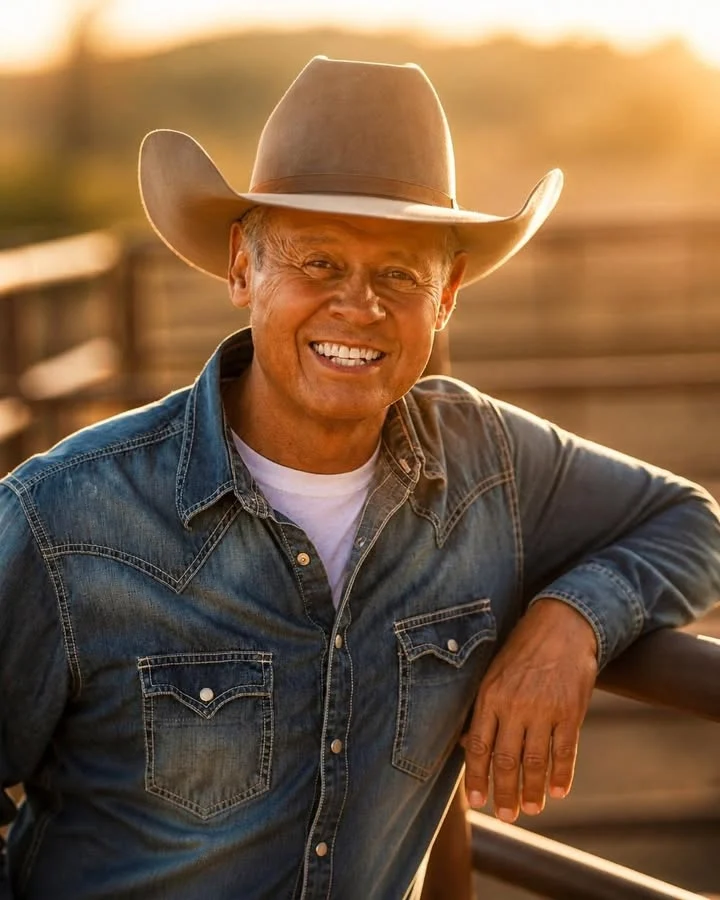
Neal McCoy never needed to make his heritage a marketing slogan. He simply walked onto country stages and proved he belonged there — twice. In 1994, the son of a Filipino mother from East Texas scored two Billboard No. 1 hits, a feat that still echoes through country music history.
Born Hubert Neal McGaughey Jr. in Jacksonville, Texas, Neal grew up with a mother born in the Philippines and an American father. Those roots gave him a perspective that stretched far beyond the small-town clubs where he first learned to sing. In those early years, he honed his craft in Texas venues that demanded every note feel honest. Applause was not automatic. It had to be earned.
A turning point came when Neal won a talent contest, a victory that eventually introduced him to Charley Pride. As Pride’s opening act, Neal spent years absorbing lessons from a legend who had broken barriers of his own. It was more than a career opportunity — it was a masterclass in resilience and stage presence.
Neal McCoy learned not only how to sing, but how to stand in front of an audience and belong there.
Success did not rush in. He signed with 16th Avenue Records in 1988, then Atlantic in 1990. Several singles came and went without a major breakthrough. But Neal kept going, building trust with listeners one show at a time, letting his work ethic speak louder than any hype.
Then everything changed. No Doubt About It climbed to No. 1, and Wink followed, holding the top spot for four weeks. In an industry that often moves fast, Neal suddenly had something lasting — proof that his voice and his connection with fans mattered on the biggest stage.
That moment carried a deeper meaning. The son of a Filipino mother had gone from East Texas clubs to the top of the country chart. But Neal McCoy never turned his heritage into a slogan. He simply kept showing up, kept performing, and let the music speak for itself.
Neal McCoy’s rise is memorable not because it was loud, but because it was steady. It took time, patience, and a willingness to keep singing even when the industry had not yet opened the door. His story is a reminder that country music has always had more than one face, more than one background, and more than one path to success.