
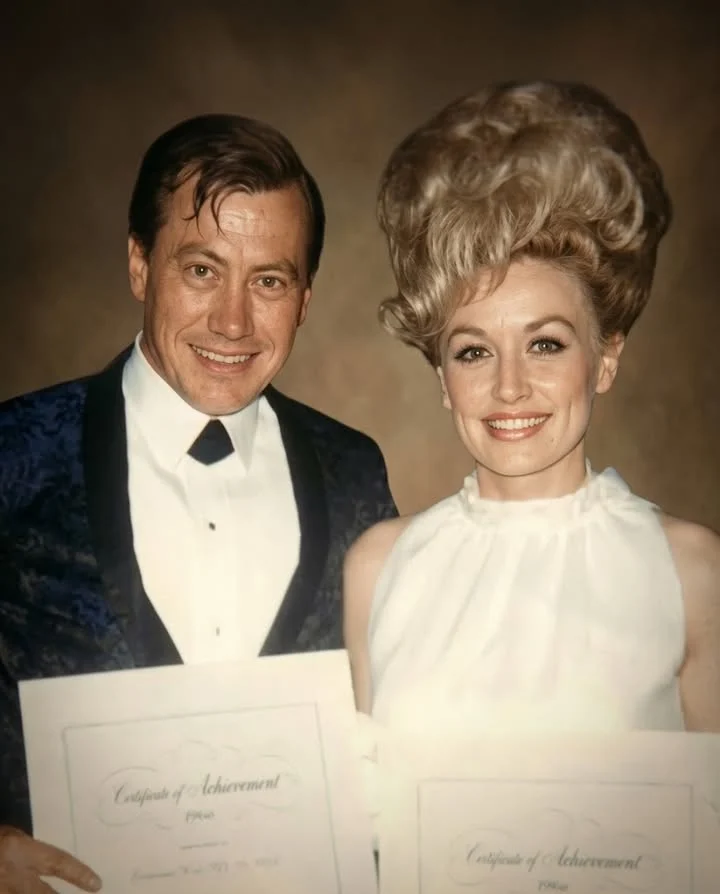
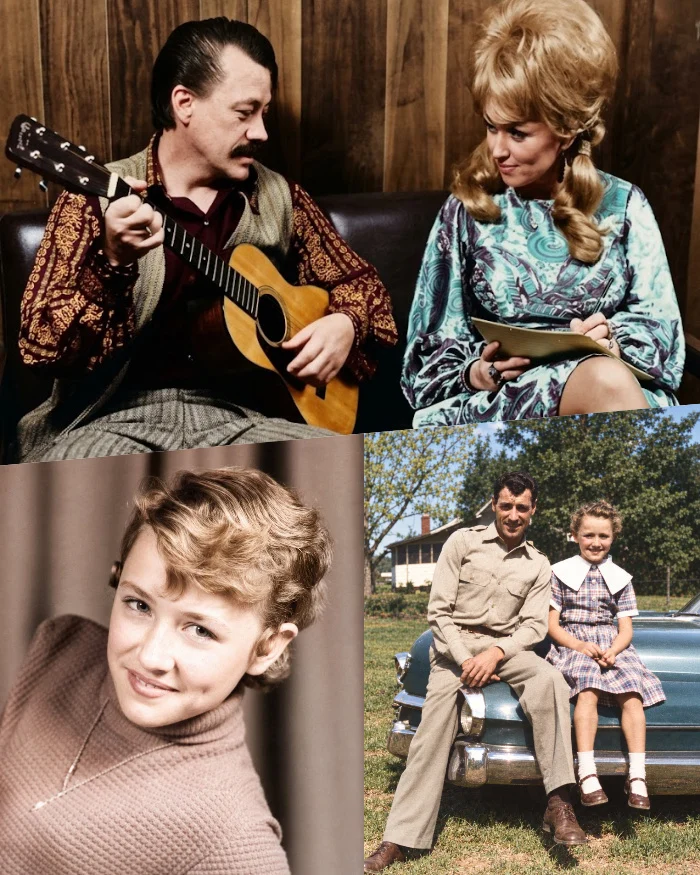
On a cold morning in the Smoky Mountains, an eight-year-old girl held a guitar that felt heavier than her entire world. Dolly Parton had been strumming a makeshift instrument built from mandolin and guitar scraps, dreaming of chords she could barely reach. Then her uncle Bill Owens placed a real Martin acoustic into her small hands. That single moment set in motion a journey that would reshape American music forever.
Uncle Bill was more than a relative. He was a struggling musician himself, working odd jobs while holding onto his own ambitions. Yet he recognized something in the young Dolly’s homemade songs. He did not just buy her the Martin guitar. He became her driver, her manager, her co-writer and her shield. Together they drove across winding mountain roads to Knoxville radio stations, where Bill would knock on studio doors until someone gave a ten-year-old mountain girl a chance to sing on the air.
Their breakthrough came through broadcaster Cas Walker on The Cas Walker Farm and Home Hour. Dolly would wake before dawn, balance school with live broadcasts, and Uncle Bill would stand beside her, tuning her guitar and coaching her timing. Between broadcasts, they filled yellow notepads with original verses. One of those songs, “Put It Off Until Tomorrow,” would later win the 1966 BMI Country Song of the Year.
Uncle Bill taught me how to structure a verse and how to hold an audience with nothing but a story. He gave me the courage to keep writing when nobody else was listening.
The biggest leap came on a Saturday night in 1959. Thirteen-year-old Dolly and Uncle Bill drove to Nashville’s Ryman Auditorium with no official booking. Determined, Owens worked his way backstage and introduced his niece to established stars. Opry performer Jimmy C. Newman surrendered one of his own slots. Johnny Cash himself introduced the young singer to the audience. Dolly stepped up to the microphone, sang George Jones’s “You Gotta Be My Baby,” and received three standing ovations from the stunned crowd.
That night proved the dream was real. After graduating from Sevier County High School in 1964, Dolly packed a cardboard suitcase and took a Greyhound bus to Nashville. Uncle Bill was already there, guiding her through Music Row publishing offices and pitching their catalog to executives. He remained her trusted partner through the decades that followed.
As Dolly rose to sell over one hundred million records and earn honors in both the Country Music Hall of Fame and the Rock and Roll Hall of Fame, she never forgot the foundation. She employed Uncle Bill at Dollywood, recorded his songs, and credited him in countless interviews until his passing in 2021 at age eighty-five.
The glittering stages eventually belonged to Dolly Parton. But the real stage was built on mountain backroads, driven by an uncle who believed early enough to change the course of American music.