
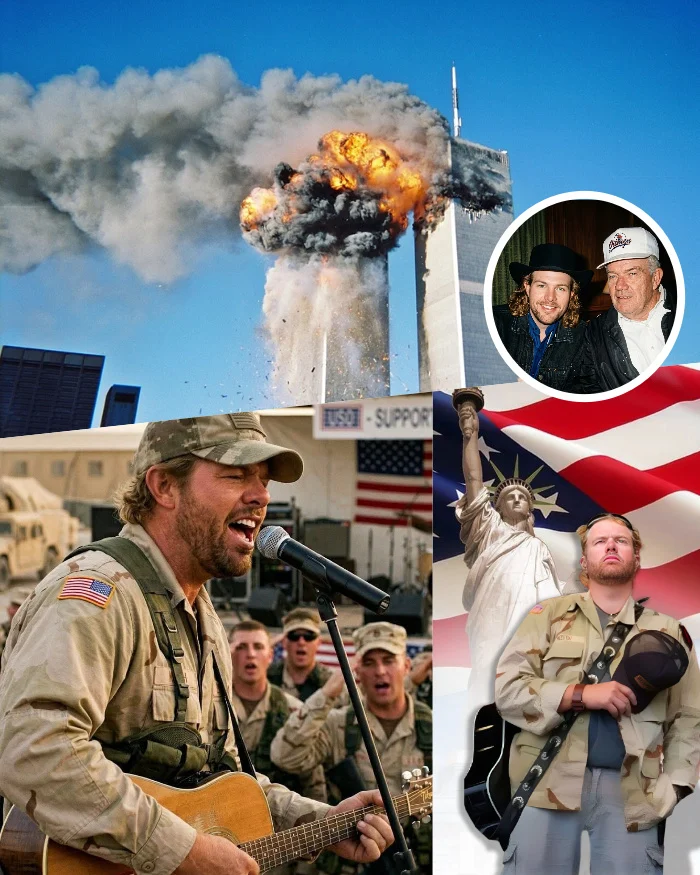
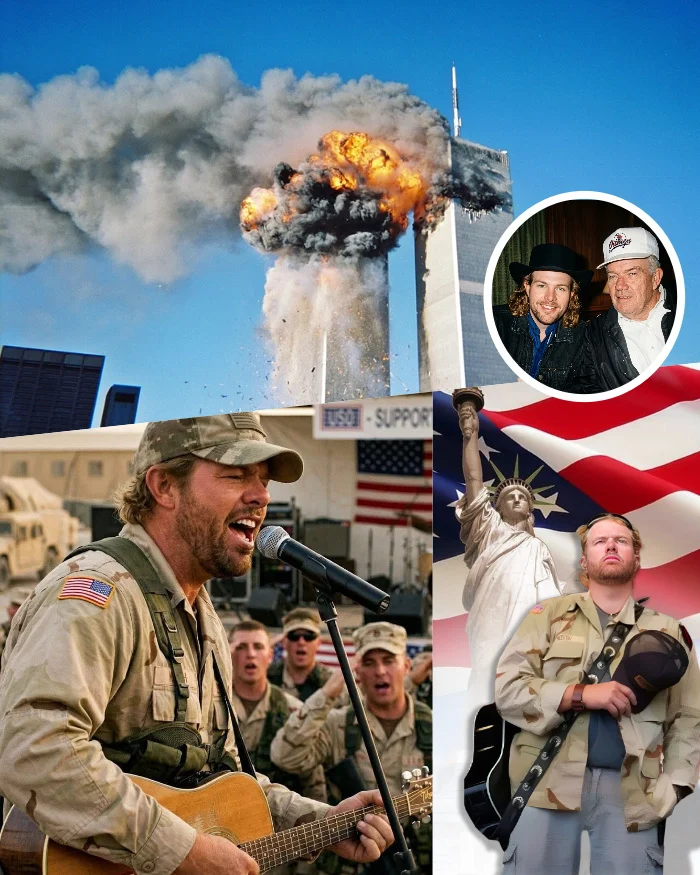
The first time mortar fire hit the forward operating base near Kandahar, Toby Keith was mid-song. He dropped his guitar and dove into a concrete bunker with the soldiers. When the explosions stopped, he climbed back out, reclaimed his instrument from the dust, and finished the set like nothing happened. That was the Toby Keith the public never saw.
Six months before the towers fell on September 11 2001, Keith lost his father, Hubert K. Covel, in a car accident on an Oklahoma highway. Covel was an Army veteran who flew the American flag in his yard every single day. The grief was raw when the nation was attacked, and Keith channeled that pain into twenty minutes of furious writing on the back of a paper sack. The result was Courtesy of the Red, White and Blue (The Angry American).
Keith kept the song for military audiences only, refusing to record it commercially. That changed when General James L. Jones, then Commandant of the Marine Corps, heard him play it privately.
The men and women heading overseas need to hear that exact message of solidarity
Jones told him. Keith cut the track for his 2002 album and it shot to number one, igniting a fierce national debate.
Critics questioned his intentions, but Keith did not retreat into safe spaces. He partnered with the USO in 2002 and spent the next decade completing eleven tours of active combat zones. He visited nearly two hundred bases from Iraq to Afghanistan, often requesting the most isolated outposts reachable only by Black Hawk helicopter. Temperatures hit 120 degrees and running water was scarce. He set up on wooden ammunition crates and flatbed trailers, shaking hands with young enlistees for hours after the music stopped.
I just wanted to sing for the men and women in uniform, as a tribute to my father Keith said later. The rest of it — the charts, the debates — that was never the point.
Long after the radio fade out and the public controversies softened, the true measure of Toby Keith lies in the dust of those forward bases. The flight logs, the grease stained stage setups, and the quiet conversations in mess tents reveal an Oklahoma boy who kept a promise to his father’s memory. He showed up when it mattered, and he never backed away.