
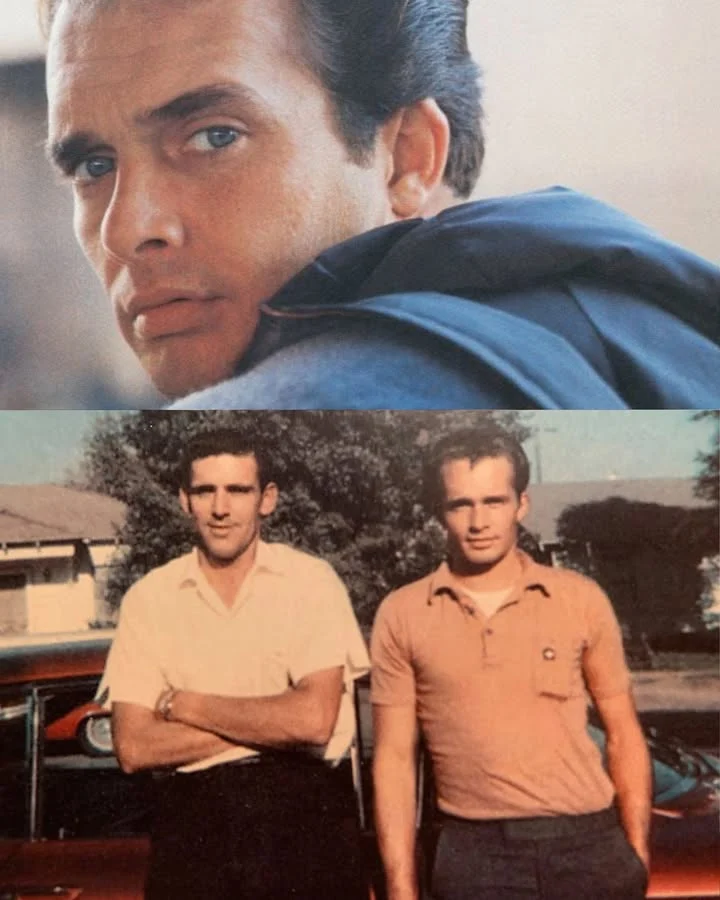
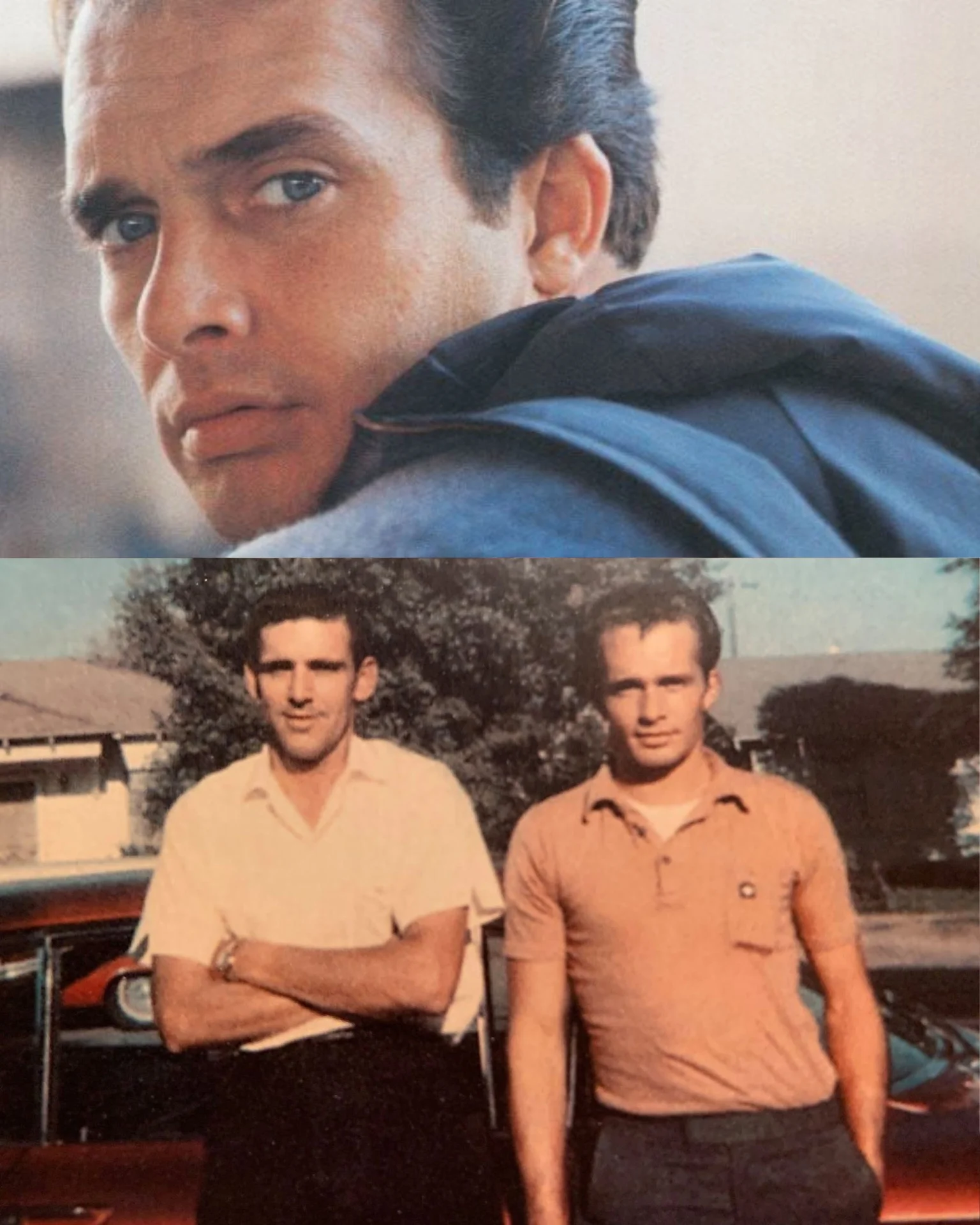
When Merle Haggard died on April 6, 2016, on his seventy-ninth birthday, the man still guiding his career was the same one who had once handed him a tiny record deal. That man was Fuzzy Owen. Their bond had survived fame, heartbreak, touring chaos, hard drinking, broken promises and decades of business pressure. It also rested on something rare in the music world. Merle trusted Fuzzy enough to leave the deepest protection unwritten.
Merle Haggard never signed a contract designed to protect him from Fuzzy Owen. By 1976, they had already worked together for fifteen years. In a 1976 interview, Merle complained that the music business had reduced a man’s word to almost nothing. Paper carried the authority. A handshake did not. Then he offered one exception.
Merle Haggard said he and Fuzzy Owen never signed anything meant to protect them from each other
He slightly qualified that statement. A document may have existed for Fuzzy’s family. Between the two men, a handshake remained enough. The correction made the arrangement more believable. They were not two country characters proudly refusing every form of paperwork. They understood that dependents might need written security. What they did not believe they needed was a document anticipating betrayal between themselves.
Merle distrusted much of the music business, where a signature could matter more than the promise that produced it. He had seen how labels, publishing arrangements, television deals and promoters could turn a misunderstanding into a permanent trap once lawyers entered it. Yet he separated Fuzzy from that suspicion.
Their story began long before Merle became a country superstar. They met shortly after Merle’s release from San Quentin. He was wiring houses and digging ditches for his brother while trying to find steady work in Bakersfield clubs. At the Lucky Spot, he joined a band that included Fuzzy, a steel guitarist who had picked cotton after arriving in California and played nights at the Blackboard.
Charles Fuzzy Owen had arrived in Bakersfield from Arkansas in 1949. He picked cotton during the day and played steel guitar at night. The Blackboard club drew oil-field workers, farm laborers and families who had moved west from Texas, Oklahoma and Arkansas.
Those clubs were not waiting for Nashville. There was no established West Coast country industry waiting to receive them. They created local radio programs, dance halls, television appearances, small studios and labels capable of pressing a few hundred singles. Fuzzy learned several parts of the work. He played steel, sang, wrote songs and watched recording sessions closely enough to understand their machinery.
With his cousin Lewis Talley, Fuzzy built one of Bakersfield’s earliest recording studios and formed Tally Records in 1955. The equipment was modest, but the label sat inside a living musical community. Buck Owens recorded an early rockabilly side there under the name Corky Jones. Bonnie Owens, Harlan Howard, Bobby Austin and numerous regional performers passed through Tally’s catalog.
Fuzzy had already seen how a small operation could reach further than expected. He and Bonnie Owens made an early version of A Dear John Letter. Their own release failed, but Fuzzy and Lewis obtained rights to the song. Ferlin Husky and Jean Shepard recorded it for Capitol, and their version became a number one country hit in 1953.
The money and recognition did not turn Tally into Capitol. They allowed two working musicians to keep a door open. Merle Haggard eventually walked through it.
Merle left San Quentin in 1960 with more experience in prisons and juvenile institutions than in recording studios. Back in the Bakersfield area, he went to work for his brother Lowell, digging ditches and helping wire houses. Music remained close enough to pursue at night but not dependable enough to feed a family.
A job at the Lucky Spot changed the arrangement. Merle joined the club band as a guitarist, working alongside Fuzzy. The older musician could hear something in him that was not yet organized into a career. Merle’s voice carried the people Bakersfield country had grown around. It carried displaced families, laborers, men with jail records, women holding households together while wages disappeared. Yet recognition of that voice came slowly. The first task was simply to make a record.
Fuzzy signed him to Tally and produced his early work. They gave Merle his first contract and pressed roughly 200 copies of his first single, largely hoping that a larger company might hear something worth buying. One of the first singles paired Singing My Heart Out with Skid Row. The record went nowhere. They kept recording him.
Those copies were partly an invitation to larger labels. They were evidence that Merle could enter a studio, finish a performance and sound like someone worth investing in. No major company responded strongly enough to take the problem away from Fuzzy. So Tally made another record.
While playing bass with Wynn Stewart in Las Vegas, Merle heard Stewart perform Sing a Sad Song. Stewart intended to record it himself. Merle asked for the song and, after some persuasion, received permission to cut it for Tally.
Released in 1963, Merle’s version of Wynn Stewart’s Sing a Sad Song entered the country chart. Sam Hill followed, then Liz Anderson’s (My Friends Are Gonna Be) Strangers. The third title supplied more than a hit. It gave Merle a name for the band that would eventually travel with him for decades, the Strangers.
The progression looks orderly from a distance. Inside Tally, it depended on people continuing after the first release had failed. Fuzzy produced, played and handled business. Lewis Talley worked the label and helped keep its practical machinery moving. Local musicians supplied the sound. Songs passed between writers and performers through clubs, homes and personal recommendation.
There was no moment when Bakersfield formally declared itself an alternative center of country music. Its independence accumulated through small transactions like these. A steel guitarist with a label recorded a former prisoner. A bandleader surrendered a song. A local single reached radio outside California. A larger company began paying attention.
Capitol producer Ken Nelson had already worked extensively with Bakersfield talent, including Buck Owens. By 1964, Merle had enough evidence behind him to make a major-label contract possible. When Capitol Records came calling in 1964, Fuzzy and Lewis sold Merle’s Tally masters as part of the move. The deal allowed Merle to move forward without leaving the first stage of his catalog stranded behind him.
That kind of transition can end a relationship. The independent label serves its purpose, the artist leaves, and the people who took the early risk become names in a footnote. Fuzzy stayed. The arrangement changed quietly after that. The men who had once owned Merle’s recording contract went to work for him.
Fuzzy joined the Strangers before leaving the steel-guitar chair to manage the road operation. Lewis became Merle’s longtime bus driver. The two men who had once controlled the small company holding Merle’s contract accepted new places inside an organization increasingly built around him.
A 1967 trade report announced that Fuzzy would leave the Strangers’ steel-guitar position while continuing to travel with the Merle Haggard Show. Directing Merle’s career had become a full-time job. The change says something about the trust between them. Fuzzy had been the man with the label and studio when Merle had neither. Once Merle’s career became the larger enterprise, Fuzzy could step into it without treating the altered balance as a defeat.
Fuzzy’s job placed him close to nearly every difficult part of Merle’s life. He arranged access when Merle agreed to be interviewed and created distance when the singer did not wish to talk. He handled dates while Merle traveled, recorded, drank, married, separated and changed his mind.
Management at that level is rarely glamorous. It is phone calls, transportation, payroll, apologies and decisions made while the artist is somewhere else. A successful night ends with another city waiting. Merle could be unpredictable. The fact that he trusted one man for so long carries more weight because steadiness was not his natural condition.
Fuzzy stayed through the Capitol years, the hits, the divorces, the canceled dates and the long stretches when Merle made life difficult for the people closest to him.
In 1974, Merle and Fuzzy revived the Tally name through a distribution agreement with MCA. The trade press described it as an unusual arrangement. A major country recording artist was establishing and administering an independent label while still under contract to another company. Merle remained a Capitol artist, but Tally-MCA gave him and Fuzzy a platform for developing other performers.
The circle was almost too neat. Fuzzy had used the first Tally label to give Merle a beginning. Now Merle’s success gave Tally another chance to provide that beginning for someone else. The revived company did not become a lasting rival to Nashville’s major labels. Its significance lies in the attempt. Merle and Fuzzy understood from experience that a regional musician could require several records before a larger company heard what was present.
The original Tally had functioned as patience made physical. It was a studio, a label design, a stack of singles and enough belief to press another one. By the 1970s, Merle could have surrounded himself entirely with people hired after fame. Instead, the man from the Lucky Spot remained beside him, still directing the work.
Fuzzy continued as Merle’s manager through the remainder of the singer’s life. The touring world changed around them. Dance halls gave way to theaters, casinos and festivals. Country labels consolidated. Bakersfield became a recognized historical term rather than simply the place where working musicians were trying to find jobs. Their original arrangement survived those changes.
Fuzzy was still Merle’s manager when the singer died in 2016. He had outlived the first Tally studio, many of the musicians who had built the Bakersfield sound and the period when 200 records could represent the full reach of a release. Fuzzy died four years later, at ninety-one.
By then, the singer he had first recorded had been placed at the center of American country music, while Fuzzy remained where he had spent most of his life. He stayed close to the machinery, visible to musicians and historians but less familiar to the audience.
The easy version of this story is that Fuzzy Owen discovered Merle Haggard. Discovery suggests a finished artist waiting to be noticed. What Fuzzy actually provided was more practical. He gave Merle a job, a studio, a label and enough time to make a second record after the first one failed.
Merle later supplied something in return. When the balance of power changed, he kept Fuzzy beside him. The label owner became the employee without becoming disposable. The relationship expanded rather than ending at the moment of success.
Their work also reveals how the Bakersfield sound reached the country beyond California. Major labels mattered, but they often arrived after local people had absorbed the first failures. Tally paid for the early attempts. Clubs gave Merle somewhere to develop. Regional musicians, television and radio made him legible to Capitol. Fuzzy stood inside every stage of that passage.
Merle spent much of his life writing about confinement, departure and people who could not be counted on. Yet the man who first placed his voice on a record stayed for more than half a century. The first Tally single needed a label number. Merle and Fuzzy apparently decided the rest could remain unwritten.
Merle Haggard’s recording career began on a tiny label Fuzzy Owen could barely afford to operate. Its longest business relationship rested on something neither man thought needed to be written down.