
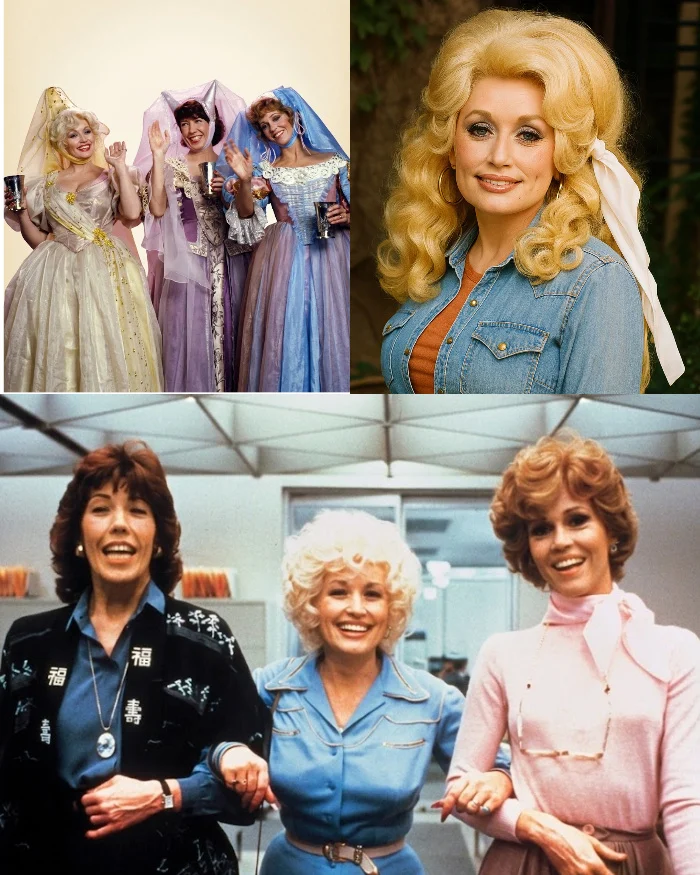
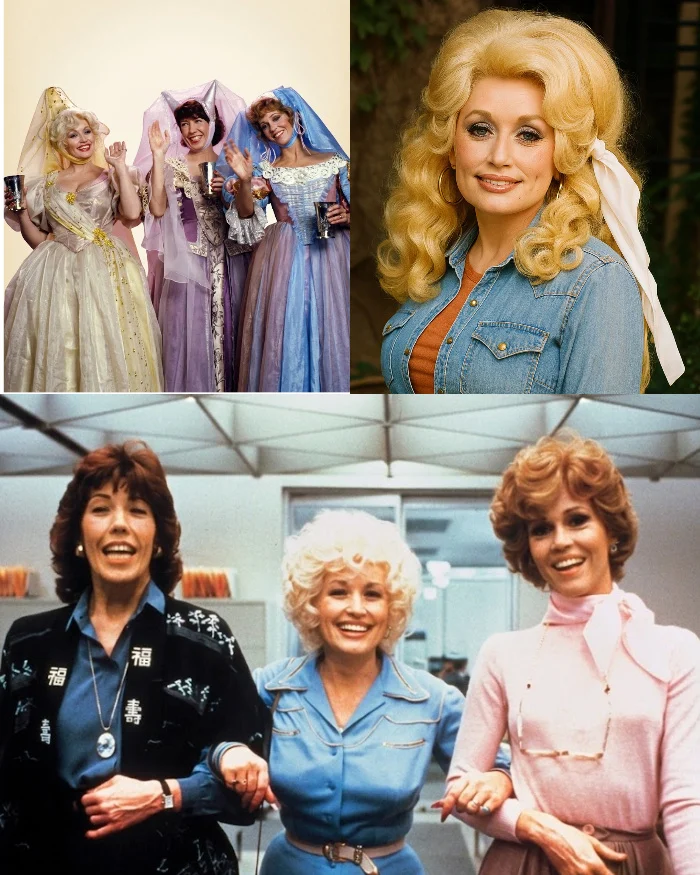
Dolly Parton stood on the 20th Century Fox soundstage in late 1979 and felt the cameras pressing against her like a wall.
The country superstar had filled arenas across America, yet she had never made a movie. She had stepped onto the set of 9 to 5 to play Doralee Rhodes and believed one wrong move could ruin everything.
Opposite her sat Jane Fonda and Lily Tomlin. Fonda had earned Oscar glory and Tomlin carried comedy legend. Parton saw herself as the rookie in the room and decided to fight fear with memory.
She studied the script through California nights until every page felt etched into her mind. She did not only learn Doralee’s lines. She memorized what Fonda would say and what Tomlin would say and what the scene required from everyone.
During the first week of filming, that devotion created an unexpected problem. The cameras caught Parton silently mouthing Fonda’s words right back at her. The director had to stop takes again and again because the newest actress was accidentally acting out every part in the shot.
In a town built on egos, that moment could have turned ugly. Instead, Fonda and Tomlin saw the truth behind the mistake. They understood the pressure Parton had placed on herself.
She only needed to worry about Doralee and she could finally relax.
That gentle correction lifted a mountain from her shoulders.
The film that became a 1980 blockbuster began with a leap of faith. Fonda had first imagined a serious drama rooted in the real struggles of clerical workers in Boston who faced corporate exploitation. She realized comedy could carry the message farther, so she reshaped the script and searched for women who could anchor it.
Fonda heard Parton’s voice on the radio while driving down a California freeway and knew she had found Doralee. Recruiting the singer required a deal. Parton accepted the career risk only if she could write and perform the title track.
Once cameras rolled, Hollywood mechanics overwhelmed her. She did not know films were shot out of sequence. She did not know how to hit tape marks or preserve continuity between setups. She assumed a film set worked like a theater stage.
Cramped dressing room space forced the three women close. Long waits between lighting setups became laughter, stories, and a bond that bled into their performances.
Parton used the downtime to honor her condition. She rubbed her long acrylic nails together in a sharp staccato click. The sound mimicked a typewriter and gave the working-class anthem its pulse. She carried that exact rhythm into the recording studio and turned it into percussion.
Tomlin and Fonda had years of technical training. Parton had instinct. She understood Doralee because the character was constantly underestimated and judged by a hyper-feminine appearance. That was a prejudice Parton had navigated, weaponized, and outsmarted throughout her music career.
Released in December 1980, 9 to 5 smashed expectations and became the second-highest-grossing film of the year. Parton earned Golden Globe nominations for New Star of the Year and Best Actress in a Motion Picture Comedy. Her theme song swept the charts and earned an Academy Award nomination.
The movie pushed workplace equality into the mainstream. For Parton, it became a cinematic triumph, a definitive anthem, and a friendship that began the moment she stopped reading everyone else’s lines and has lasted more than forty years.