
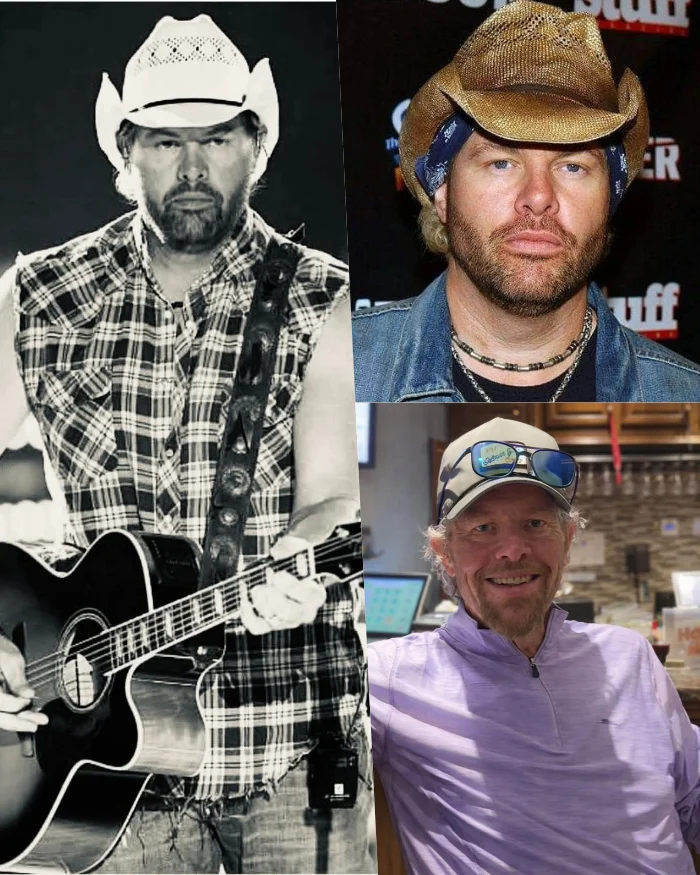

Toby Keith did not need a polished Nashville welcome to begin a legend. He needed a microphone, a tired room, and a voice that sounded like honest work. The man who would later fill arenas first learned how to hold a crowd in small bars where nobody wanted a fake story.
Before fame, his world was Clinton and Moore, Oklahoma. The oil fields gave him rhythm. The heat gave him sweat. The derrick gave him a working man’s patience. Later, when the industry collapsed in the 1980s, he kept fighting on bruising semi-pro football fields with the Oklahoma City Drillers while raising a young family.
His real stage waited after dark. He formed Easy Money and carried his gear across Texas and Oklahoma honky-tonks. Under dim neon, smoke, and clinking bottles, he sang to mechanics, cowboys, and oilfield workers. They did not care about image. They cared about truth.
He learned to command a room before the world ever heard his name.
In the early 1990s, he brought a worn demo tape to Nashville. Music Row was bright, clean, and cautious. Many newcomers were asked to smooth their edges, soften their drawl, and dress for a commercial mold. Keith kept his faded jeans, his battered hats, and his booming baritone.
The doors did not open right away. He faced rejection after rejection and returned home, ready to keep playing local gigs instead of chasing a label. The breakthrough came far above the ground. A flight attendant who had seen his shows passed his tape to Mercury Records executive Harold Shedd.
Shedd did not summon him to an office. He flew to Oklahoma and watched Keith play a regional bar. The live room told him everything. The singer owned the stage, the crowd leaned in, and the song had the kind of grit no polished pitch could fake.
That visit led to a contract. In 1993, “Should’ve Been a Cowboy” rose to No. 1 and became the most-played country song of the decade. The industry that had shut him out now had to celebrate him exactly as he arrived.
Years later, Keith played for millions, traveled on USO tours for troops, and earned a place in the Songwriters Hall of Fame. Yet his records still carried the gravel of hometown roads. He proved a man could conquer the spotlight without letting it scrub his roots away.
The real triumph was not the fame. The real triumph was that Nashville heard the dust in his voice and never managed to clean it off.