
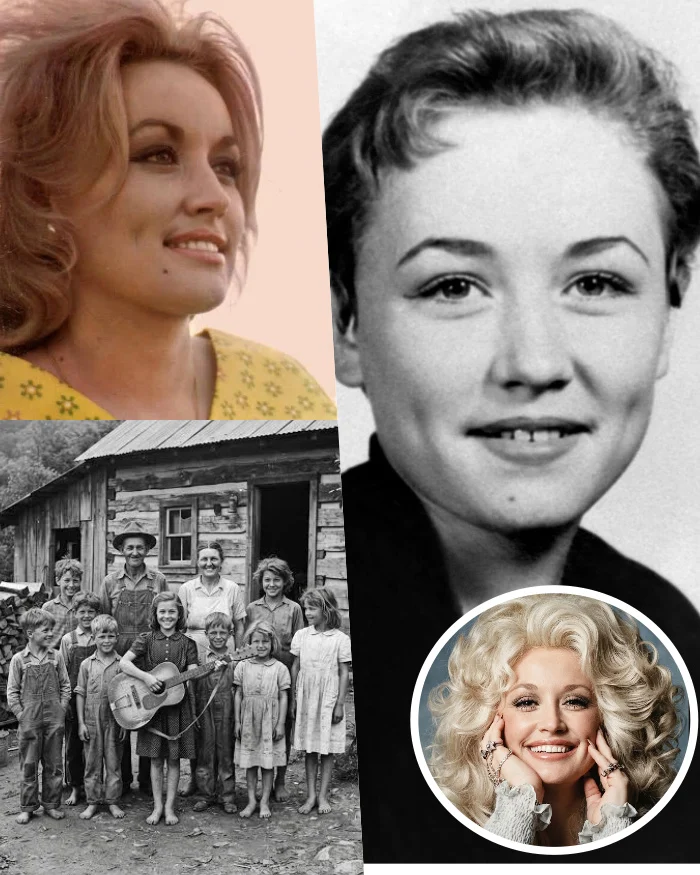
Three encores at the Grand Ole Opry made it impossible to ignore a thirteen year old girl from Tennessee. Johnny Cash introduced her to a national audience, and her voice carried the weight of a childhood lived in a one room cabin on the banks of the Little Pigeon River.
Dolly Parton did not need fancy equipment. A tin can wedged into a crack on a wooden porch became her first microphone. A yard full of farm animals became her first audience. That rough beginning did not limit her imagination. It sharpened it.
She was born into extreme poverty in Sevier County and shared the drafty cabin with eleven siblings. There were no store bought instruments and no recording studio. She built melodies in her mind and memorized them before she could read or write. Her mother Avie Lee transcribed the words onto scraps of paper.
Her uncle Bill Owens heard something rare in her voice. He took her to local Knoxville radio and television stations while she was still in elementary school. She became a working performer on the Cas Walker Farm and Home Hour. The porch had become a stage.
She earned three encores that night, proving her voice could command a room far beyond her home county.
But the empire did not arrive through applause alone. After the Opry moment she returned home to finish school. She packed one suitcase for Nashville on the morning after her graduation in 1964. The decision was quiet and deliberate. It was the first step toward ownership.
On Music Row she understood that survival required control. Female artists were rarely encouraged to own their business affairs. She retained her publishing rights. She co-founded Owe-Par Publishing with her uncle and later established Velvet Apple Music. When major acts including Elvis Presley wanted to record her songs in exchange for half the publishing rights, she refused.
That uncompromising grip on her own catalog funded everything that came next.
She used that power to keep her roots visible. Rather than leaving rural Tennessee behind, she funded an exact replica of the wooden cabin and porch at Dollywood in 1986. Visitors could see the place where she started. The tin can microphone was never a symbol of lack. It became proof that poverty could not define her future.
The rhinestones and global tours came later. The quiet resilience came first. It lived in a girl who sang to animals, wrote with her mother’s help, stepped onto the Opry at thirteen, and then chose ownership over convenience. Dolly Parton’s first microphone may have been a tin can, but it carried a voice that changed the economics of country music.