
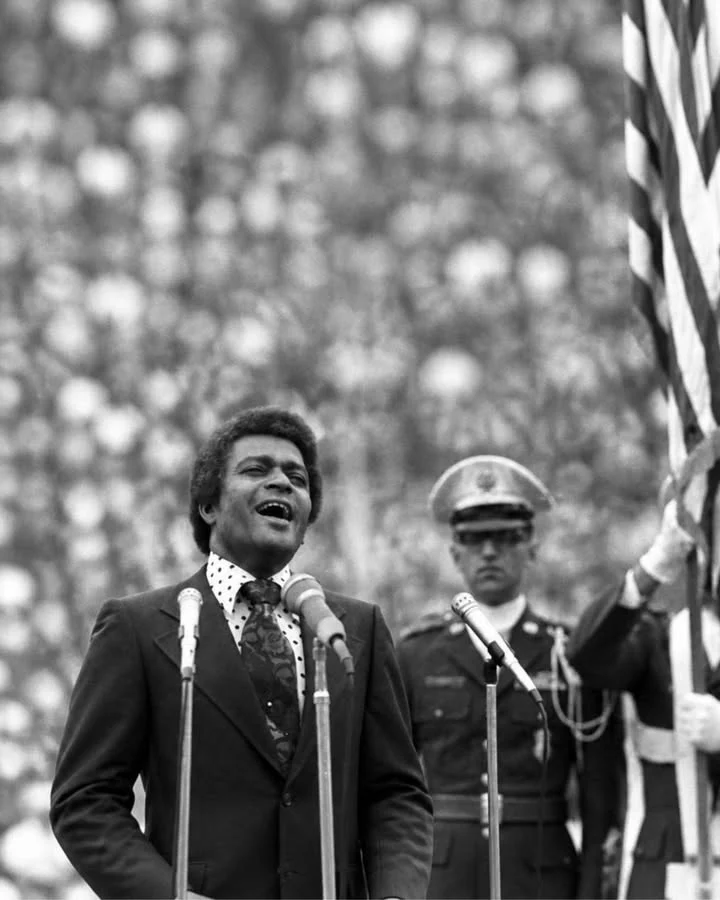
On a January afternoon in 1974, more than 71,000 fans packed Rice Stadium not knowing they were about to witness a quiet revolution. The stadium lights blazed over the field, and then a lone figure stepped into the spotlight. Charley Pride raised the microphone, and with the first note, history was made.
He was country music’s first Black superstar, an artist who had risen to fame in a genre where faces like his were rarely seen on stage. That night at Super Bowl VIII, he didn’t just sing the national anthem. He became the first solo singer ever to perform it at the big game, and he did so without any grand production. Only a microphone and a voice that had already won millions of hearts.
First came “America the Beautiful” and then “The Star-Spangled Banner.” The simplicity of the moment made it unforgettable. There was no elaborate staging, no visual overload, just a man and his song. In that stillness, Charley Pride made a statement that needed no words.
He did not make a speech about breaking barriers. He simply sang.
For many in the stadium and watching at home, seeing Charley Pride in that role was quietly powerful. It showed that excellence can break through even the most stubborn walls. His presence on that field was a reminder that representation matters most when it is calm and confident.
Decades later, the Super Bowl anthem has become a massive cultural event, but Charley Pride’s performance remains a touchstone. It was graceful, understated, and deeply historic. Sometimes history is made not with fanfare but with a single voice under an open sky.