
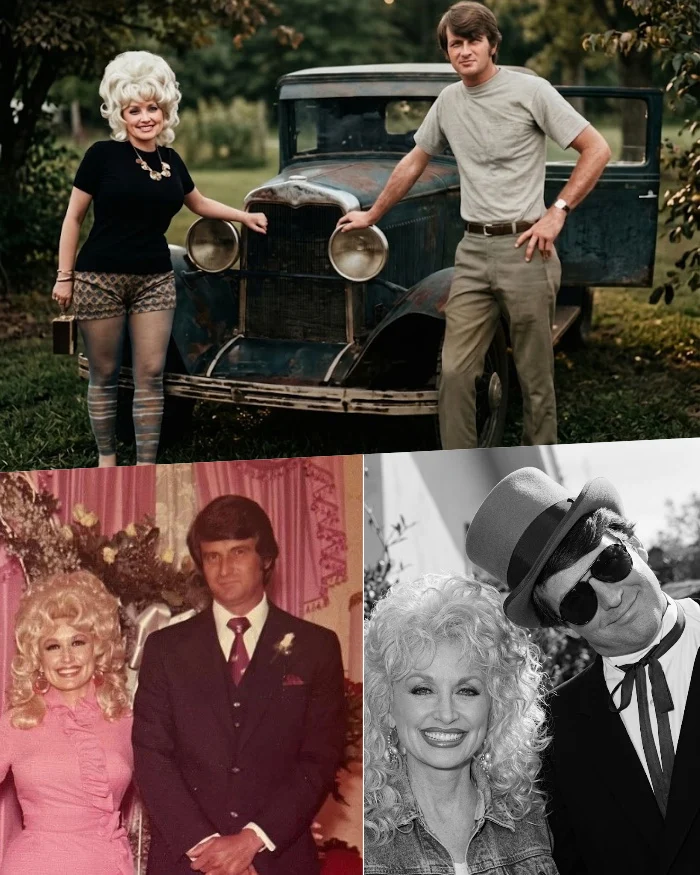
Dolly Parton could own a private island yet she and Carl Thomas Dean often find their deepest freedom in a plain motel room where the makeup washes away and the superstar disappears.
The global country icon has built an empire filled with private jets, sprawling estates, and unimaginable wealth. For nearly six decades, she and Dean have skipped luxury suites and exclusive hideaways for a simpler tradition. They load up their car or personal RV and travel the backroads of Tennessee, Georgia, and Kentucky. They look for nothing more than a cheap roadside motel with a clean bed and a working television.
These trips have no security detail, no publicist, and no entourage. When they pull into a standard motel parking lot, Parton leaves the towering wigs and heavy rhinestone gowns at their Brentwood estate. She washes off her signature stage makeup, pulls her natural hair back, and wears unassuming clothes. She travels completely disguised, often packing a simple cooler of sandwiches, so the most recognizable woman in country music can walk into a diner or pass through a fast-food drive-thru without turning a single head.
That fiercely guarded privacy is not a new habit because it is the foundational agreement that saved their relationship during her earliest and most turbulent days in Nashville.
When Parton first signed a major contract with Monument Records in 1966, label executive Fred Foster explicitly warned her not to get married. He feared a husband would ruin her marketability as a rising female country star. Defying the industry, Parton and Dean crossed the state line to Ringgold, Georgia, and quietly eloped in a small Baptist church with only her mother as a witness.
Shortly after the wedding, Dean made his one and only attempt to step into her professional world. He escorted his new wife to a BMI industry dinner in Nashville. Overwhelmed by the flashing cameras, aggressive networking, and sheer noise of the music business, he turned to Parton on the drive home and stated firmly that he never wanted to attend another public event. Instead of letting the Nashville machine tear them apart, Parton accepted his boundary completely.
While she spent the late 1960s and 1970s sleeping on cramped tour buses alongside Porter Wagoner to build her legendary career, Dean stayed behind in Tennessee. He ran his own asphalt paving business and deliberately constructed a quiet, fiercely normal life. He never needed to walk a red carpet to prove his devotion. By keeping his hands on the steering wheel of his work truck and avoiding the press, he gave her a safe fortress to return to when exhausting tours ended.
That unspoken bond quietly bled into the music that made her a global icon. While Dean stayed invisible, his presence anchored some of her most defining studio sessions. Her 1968 track “Just Because I’m a Woman” was written as a direct response to Dean asking about her past relationships, proving their marriage was built on absolute honesty from the start. Five years later, the 1973 masterpiece “Jolene” was famously sparked by a real-life red-headed bank teller who playfully flirted with Dean. Decades later, Parton wrote the tender ballad “From Here to the Moon and Back” specifically to articulate the depth of a husband who let her belong to the world while securing a private world that belonged only to them.
Inside those rundown motel rooms, the billionaire superstar vanishes.
When the heavy makeup washes down a small ceramic sink, she is no longer a country institution carrying the heavy weight of public expectations. She is simply the young woman Dean first spotted outside Nashville’s Wishy Washy Laundromat in 1964, sitting next to a man who loved her long before she became a legend.
They proved that surviving the blinding Nashville spotlight does not require fighting for attention but knowing exactly when to disappear. The greatest luxury of Parton’s towering life was never the fame she achieved but finding a man willing to navigate the quiet roads while the rest of the world looked the other way.