
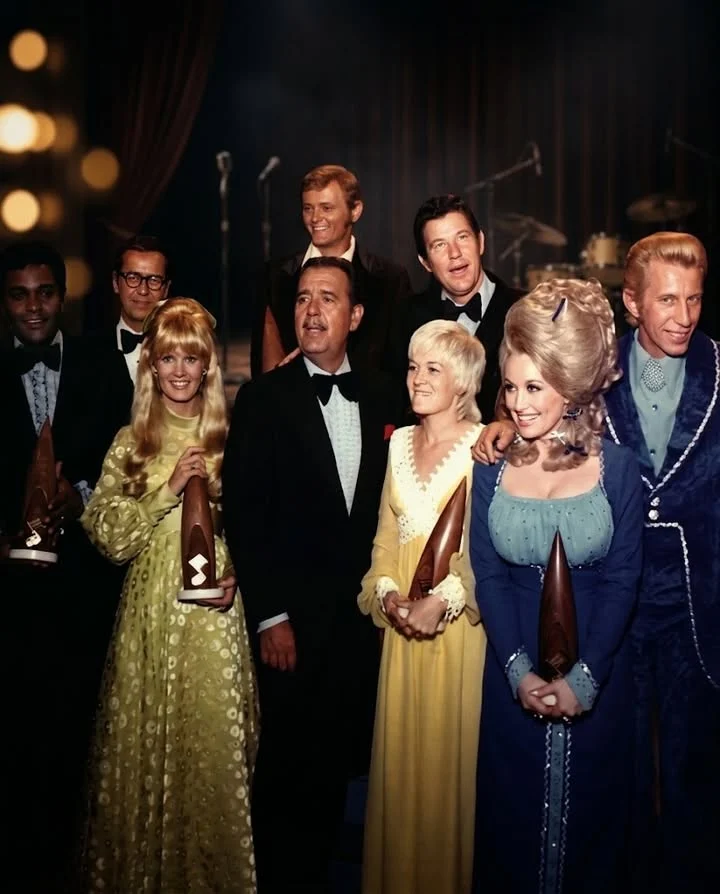
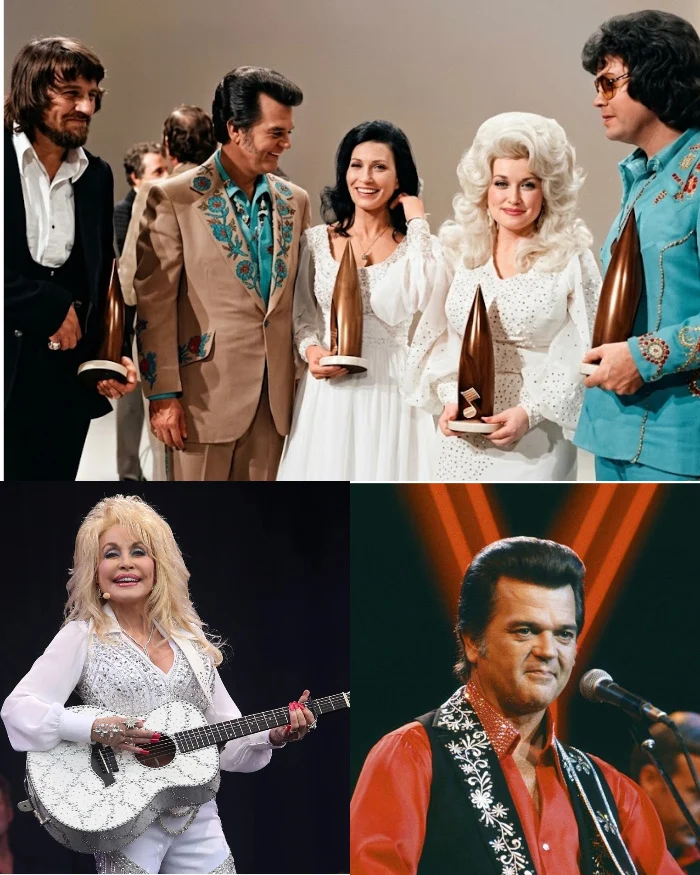
The applause rang through the Grand Ole Opry House on September 22 1999, yet the most powerful moment belonged to silence. Dolly Parton rose from her seat while the families of Conway Twitty and Johnny Bond stepped forward to receive what their loved ones could not.
The Country Music Association gathered for the 33rd Annual CMA Awards and formally inducted three monumental figures into the Country Music Hall of Fame. The night had national cameras, formal attire, and a celebration of the genre at its highest level. Still, the ceremony carried a bittersweet contrast between presence and absence.
Parton arrived at fifty-three, vibrant and still building. She was not a closed chapter. She was touring, writing, releasing new work, and returning to traditional bluegrass roots with The Grass Is Blue. The audience inside the Opry House could applaud a living pioneer while she could hear it.
One woman walked forward while two families carried memory in her place.
Twitty had died in June 1993 after suffering an abdominal aortic aneurysm while on tour in Missouri. He was fifty-nine. He left behind fifty-five number-one singles and a reputation as one of the most trusted storytellers in American music.
Bond had been gone since 1978. His work in Western swing, songwriting, and Hollywood films helped shape the sound of country music during the 1940s and 1950s.
Their bronze plaques stood beside Parton’s, but their medallions were received by surviving loved ones. Twitty’s children accepted his heavy honor before an industry that had relied on his voice for more than three decades. Bond’s family stepped up with quiet dignity.
The class of 1999 reflected the Country Music Association’s guarded voting process. An anonymous panel of industry historians and veteran executives cast ballots across distinct categories. The system balanced living modern era performers against historical pioneers and posthumous artists, ensuring earlier eras were not eclipsed by contemporary radio success.
For the audience, the evening became a portrait of country music itself. Parton stood as a living anchor. The room honored her power, then bowed to the empty spaces left by her peers.