
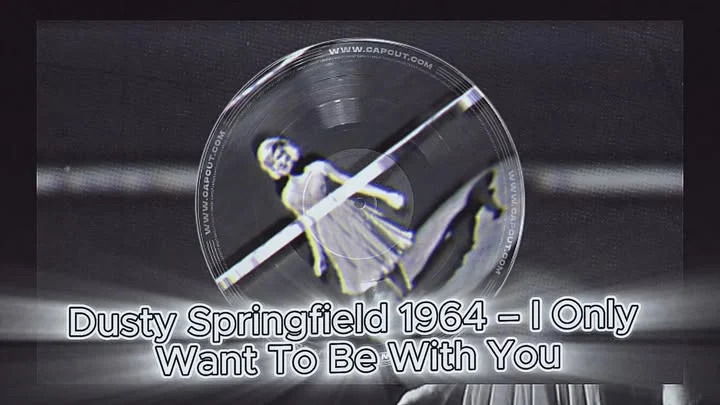
I first heard Dusty Springfield pour her heart into “I Only Want To Be With You” in a tiny record shop on a rainy afternoon. The owner placed it on a battered turntable and the sound cut through the vinyl crackle and the smell of old paper. It was not a nostalgic echo. It was a revelation of craftsmanship.
The year was 1963 and British radio was caught between the lingering ghosts of skiffle and the urgent rise of Merseybeat. In the middle of that shift a spectacular gamble began to pay off. Mary O’Brien had just left the folk pop trio The Springfields and reinvented herself as Dusty Springfield. With a blonde beehive and fierce ambition she wanted the raw power of American soul and the grand emotional sweep of the girl groups.
Her debut solo single was not merely a song. It was a statement of intent and a glittering bridge between the innocent UK pop of the era and the deeper currents of Stax and Motown. Released in November 1963 on the Philips label, it flew up the UK charts and made her one of the first British acts, alongside The Beatles, to make a genuine dent in the US Billboard Hot 100 as the British Invasion began in early 1964. The track became a global success and immediately placed Dusty at the front of sophisticated, emotionally charged pop.
The song arrived as a standalone single rather than a full album’s lead track. It later found a home on her debut LP A Girl Called Dusty in 1964. The recording grew out of a deliberate creative partnership. Producer Johnny Franz knew exactly the sound she was chasing and she had fallen hard for the scale and excitement of the new American production style.
The first thing anyone notices is density. Arranged and conducted by Ivor Raymonde, the record plays like a British interpretation of Phil Spector’s Wall of Sound, less cavernous in echo but still completely full throttle. From the opening beat the attack is unmistakable. A clockwork pulse keeps time while the drums ride high in the mix with a tight ticker-ticker hi-hat that never relents. That percussive engine turns a love song into a breathless chase.
Beneath the wave of sound the bass line walks with a warm, melodic swagger and holds the dazzling arrangement together. The electric guitar and piano rarely step into solo territory. They work as texture, adding bright chiming accents and rhythmic stabs that punctuate the verse like extra drums. Every musician plays for the collective sweep instead of individual flash.
Then the strings arrive. Ivor Raymonde layered lush, swirling lines that swell beneath the chorus and lift the entire record off the grooves. The backing singers, reportedly including Jean Ryder of The Breakaways, do more than harmonize. They chant and echo Dusty’s pleas, turning an intimate promise into a communal anthem. This kind of maximalist production demanded quality playback equipment. It was a moment when premium audio gear was becoming more accessible and records like this rewarded anyone who had invested in a fine pair of speakers.
At the center of that orchestral explosion Dusty’s voice remains the undisputed focus. Her phrasing is perfect. She sits slightly behind the beat in the verses, almost teasing, then snaps directly onto the pulse for the chorus. The simple words “I only want to be with you” become a mixture of vulnerability and absolute conviction. Her vibrato on sustained notes is controlled and impassioned at the same time. It sounds like a tremor of feeling rather than technical ornament. The vocal track carries a layer of compression and room reverb that places her inside the mix, not on top of it, and that makes her feel immediate and real.
The true power of this song lies in its ability to translate a whisper of personal devotion into the roar of a public declaration.
Part of the record’s staying power is the contrast between its image and its voice. Dusty presented the world with high fashion and impossibly polished hair. Yet her singing was pure gut level soul. She was not simply reading notes on sheet music. She was translating them through self-taught rhythm and blues instincts.
Picture a teenager catching this song on a transistor radio in 1963. The landscape was changing fast. The Beatles were breaking America. Fashion was swinging. And a British woman was singing with a force that matched anything from the United States. It was an intoxicating rush of modernity. It became the soundtrack for a sudden, all-consuming crush, the kind that makes you want to run through the streets just to reach the one you love.
There is a tiny drama hidden in the bridge as well. For a moment the tempo seems to relent and the song catches its breath before the full orchestra crashes back in. That tension, followed by the sudden beautiful sweep of returning strings, is a masterclass in dynamic arranging. It sets up the final chorus and makes every repeated refrain feel absolutely earned.
Dusty Springfield did more than launch a solo career with this single. She broadened the scope of what British pop could be. She demanded that listeners take her seriously and the world has been listening ever since. The record remains a blueprint for the perfect transatlantic hit because it balances the polish of commercial pop with a deep-seated emotional sincerity.
For listeners who love this sound, The Ronettes offer a spiritual sibling in “Be My Baby” from 1963, with all the Wall of Sound grandeur and emotional scale. The Shirelles gave that same vulnerability a voice in “Will You Love Me Tomorrow” in 1960. Petula Clark delivered another magnificent slab of British pop with “Downtown” in 1964. The Walker Brothers took the dramatic orchestral mood even deeper with “The Sun Ain’t Gonna Shine Anymore” in 1966. Skeeter Davis brought a country pop delicacy to “The End of the World” in 1962. And Lesley Gore captured the teen drama and glossy production of early sixties American pop with “It’s My Party” in 1963, exactly the sound Dusty admired and helped bring across the Atlantic.