
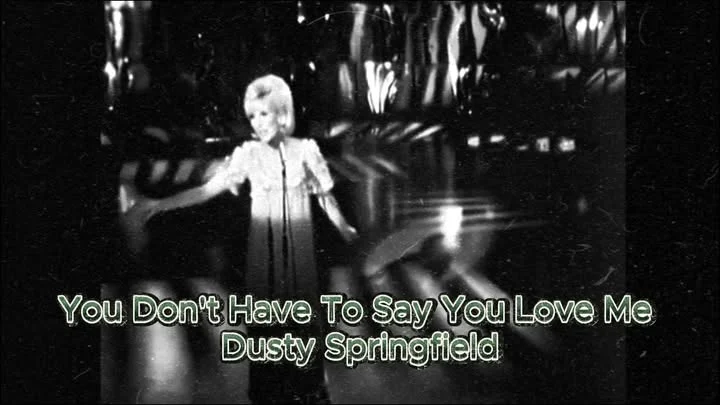
The stairwell became a cathedral. In a London studio, after nearly four dozen attempts, Dusty Springfield fled the booth and found the acoustics of a concrete corridor. The sound that emerged was not merely recorded but captured, a voice ricocheting off walls that did not know they were building a monument to heartbreak. That gasp, that first piano note hanging in the air like a question no one wanted to answer, had finally found its home.
When Dusty Springfield released You Don’t Have to Say You Love Me in March 1966, she was already a British Invasion force, a singer who had danced across the line between UK pop and American R&B. Yet nothing in her catalog had prepared listeners for this. The song climbs from a tentative piano figure into a sudden sweep of strings, a sonic whiplash that announces catastrophic stakes within seconds. It became a UK number one and a US top five hit, her commercial zenith and arguably her most enduring statement on the agony of clinging to a dying connection.
It is a confession whispered in a cathedral of echo.
The origins of the track lie in Italy. Pino Donaggio had performed Io che non vivo (senza te) at the 1965 Sanremo Festival, and Springfield, seated in the audience, was moved to tears despite understanding not a word. She secured an acetate, and her managers Vicki Wickham and Simon Napier-Bell quickly produced English lyrics. They crafted a narrative of raw codependence: “You don’t have to say you love me, just be close at hand.” This was not the confident Dusty of earlier hits but a woman bargaining for proximity over truth, presence over honesty.
Producer Johnny Franz oversaw the sessions at Philips Records in London. Springfield, a notorious perfectionist, struggled to find the right vocal take. Legend holds that after 47 attempts in the main booth, the solution came from the studio stairwell. The natural reverb there gave her voice a raw immediacy, a holy sustain that makes the sustained notes in “love me” and “forever” feel almost operatic. That final master is not just a performance but an artifact of acoustic happenstance, a voice reaching for catharsis in a space made for footsteps, not song.
The arrangement itself is a masterclass in mid-sixties orchestration, blending pop immediacy with cinematic grandeur. The opening piano motif, drawn from the Italian original, descends in a minor key that drips melancholy. When Springfield sings the title line for the first time, the orchestra detonates. Strings swell into a heartbreaking wave, while the rhythm section remains subdued—a gentle brush on drums, a bass line that walks with a funereal gait. Brass is used sparingly but devastatingly, punctuating the pain like a fanfare for the soul’s collapse. The key change before the final verse is a classic pop device, but here it achieves maximum catharsis. Springfield’s voice sheds all restraint, hitting an operatic peak that feels designed for a vast theater yet translates perfectly through a pair of modern studio headphones. That final minute is not about nuance but absolute surrender, a plea so desperate it threatens to shatter the fragile architecture of the song itself.
This single arrived at a pivotal moment in Springfield’s journey. Its massive international success gave her the freedom to pursue her most celebrated album, 1969’s Dusty in Memphis, where she leaned further into the soul influences she adored. The song bought her the currency to make the art she truly wanted. It has become the soundtrack for breakups, for late-night drives, for anyone who has ever compromised self-respect just to delay goodbye. Its core vulnerability is universal: the realization that sometimes the simple presence of another person is enough, even if that presence is dishonest. This stark honesty, wrapped in the velvety cloak of the arrangement, is its genius. New generations still discover this classic piece of music via a music streaming subscription and are instantly captivated by its emotional immediacy.
Dusty Springfield, with her towering blonde beehive and thick black eyeliner, was the picture of swinging London glamour, yet her voice conveyed profound, timeless sadness. This single is the perfect manifestation of that contrast: a massive, glamorous orchestral sound carrying the weight of the most intimate, humiliating heartache. It proves that the truest artistry often lies in the willingness to expose your deepest, most ragged need.
For those seeking similar experiences, consider these tracks
Cilla Black – Anyone Who Had a Heart shares the same mid-60s orchestral melodrama and high-stakes vocal delivery on a tale of romantic blindness.
Scott Walker – The Sun Ain’t Gonna Shine Anymore offers another example of a dramatically arranged 60s pop song using theatrical dynamics to convey deep sadness.
The Righteous Brothers – Unchained Melody features a soaring, desperate vocal over a majestic wall of sound.
Aretha Franklin – I Say a Little Prayer showcases raw soul power and vocal nuance that Dusty channeled in the studio.
Dionne Warwick – Walk On By wraps complex emotional vulnerability in sophisticated, highly structured pop.
Elvis Presley – You Don’t Have to Say You Love Me (1970 cover) is an essential comparison, revealing how another legendary vocalist reinterpreted the song’s dramatic core.